Three major heavy truck manufacturers form PACT to jolt electrification push
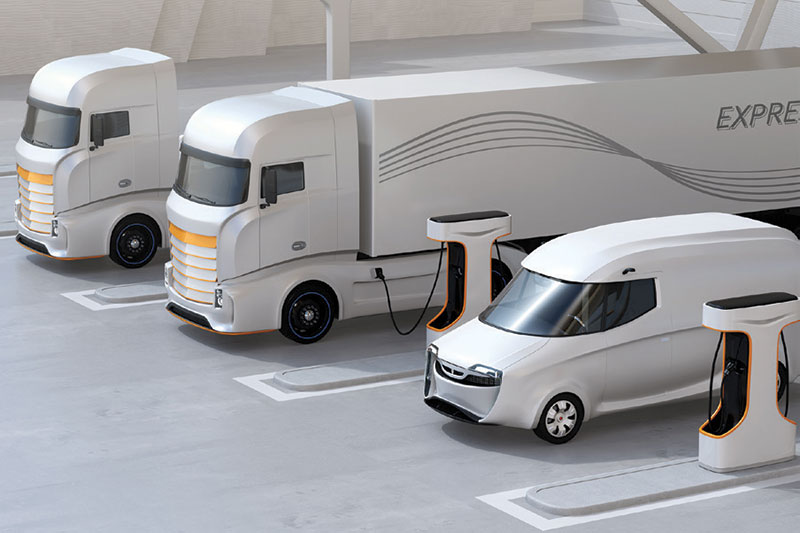
There’s safety in numbers and in cooperation. That’s what three major worldwide heavy truck manufacturers seem to be saying in getting ready for vehicle electrification.
Original equipment manufacturers (OEMs) Volvo Trucks North America, Navistar and Daimler Truck North America are trying to reduce transportation's carbon footprint by taking a collective approach.
Those three OEMs – which produce the Volvo, Mack, International, Freightliner, Western Star and Rizon nameplate electric trucks—represent 70% of all new Class 6-8 truck sales in the U.S.
In February, they announced a cooperative call “Powering America’s Commercial Transportation (PACT).” It calls for the three OEMs to focus on education and advocacy for accelerating the construction of national infrastructure for medium- and heavy-duty zero-emission vehicles (ZEVs).
It is similar to a cooperative finalized in Europe in 2022 that calls for Volvo Group, Daimler Truck and Navistar parent Traton to jointly install and operate a $550 million high-performance public charging network for electric, heavy-duty, long-haul trucks and buses.
The European cooperative is called “Milence.” Its goal is installation and operation of at least 1,700 high-performance green energy charging points on and close to highways by 2027.
According to the International Council on Clean Energy Transportation, nearly 700,000 chargers will be needed in the U.S. to accommodate 1 million Class 4-8 medium- and heavy-duty ZEVs anticipated to be deployed by 2030. Those trucks are forecast to use 140,000 megawatts of electricity every day—or the monthly energy needs of over 100 million American homes.
“The scale of infrastructure required for medium- and heavy-duty EV adoption is unprecedented,” Stephen Roy, president of Mack Trucks and chairman of Volvo Group North America, said at the rollout at the National Press Club in Washington.
Daimler Truck North America President and CEO John O'Leary admitted the transition to zero-emission vehicles is “stalling” without the deployment of the needed charging infrastructure.
“We need some help,” O’Leary said during PACT’s launch at the National Press Club.
O’Leary spoke alongside OEM presidents, Navistar’s Mathias Carlbaum and Volvo Trucks North America President Peter Voorhoeve. O’Leary stated the PACT’s premise of working toward the same vision and goal as an industry.
“We want other players out there, whether it’s utilities, equipment manufacturers, [and] all that – we need everybody in this game together and then all rowing in the same direction,” O’Leary said.
“Partnership is the new leadership,” Voorhoeve said.
“The footprint of transportation in the U.S. is very favorable for electrification,” Navistar’s Carlbaum said.
The need for speed is paramount in the U.S. market, American trucking fleet executives say.
“While electric vehicles are hitting the market first, they may not be suitable for every application at this time—especially when it comes to regional and long-haul transportation,” Kent Williams, Averitt Express executive vice president of sales and marketing, told LM.“We believe EVs could be the way of the future for all Class 8 tractors, but there are significant issues preventing adoption at scale now.”
Among the issues is current EV tractors do not have the range for most fleet applications. Nor would EVs work well in the 24-hour environment that most long-haul fleets operate.
“The most significant challenge is that our facilities lack the necessary physical infrastructure from local electric companies that would allow us to charge an adequate number of tractors each day,” Averitt’s Williams said.
Most Averitt facilities are domiciles for more than 100 power units. “Most of these facilities would require a new electrical substation to be built to charge fleets of this scale,” Williams added.
While supporting the deployment of commercial ZEV infrastructure, PACT will not advocate for specific vehicle, power generation or utility distribution technologies.
Rather PACT’s primary purpose is to educate stakeholders about infrastructure challenges that hinder medium- and heavy-duty ZEV adoption in the marketplace and work with stakeholders to find solutions for the benefit of all interested parties.
PACT’s founders said membership is open to all stakeholders with an interest in accelerating the deployment of zero-emission trucks and the necessary infrastructure. Besides the three OEMs, founding members include ABB E-mobility, Burns & McDonnell, the British Columbia Hydro and Power Authority, Greenlane, Prologis Inc. and Voltera.

Article Topics
Hackett Associates News & Resources
Expected U.S.-bound import declines remain intact, notes Port Tracker report U.S.-bound container imports are expected to see declines through year end and into 2026, reports Port Tracker U.S.-bound imports are expected to decline, with reciprocal tariffs now in place U.S.-bound imports remain on an uneven, tariff-driven path, with declines expected in the coming months, says Port Tracker report Port Tracker report expects U.S.-bound imports to dip in the coming months Letter to USTR slams proposed fees on Chinese ships, predicting harm to U.S. businesses and consumers U.S.-bound imports remain high but could see declines as summer approaches, notes Port Tracker report More Hackett AssociatesLatest in Logistics
ISM forecast sees a manufacturing rebound in 2026 as services maintain steady expansion PwC report indicates transportation and logistics dealmaking activity is focused on strategy, not scale ShipMatrix reports strong Cyber Week delivery performance results National diesel average falls for the fourth straight week, reports EIA FTR’s Shippers Conditions Index shows modest growth Trucking executives are set to anxiously welcome in New Year amid uncertainty regarding freight demand ASCM’s top 10 supply chain trends highlight a year of intelligent transformation More LogisticsSubscribe to Logistics Management Magazine

Find out what the world's most innovative companies are doing to improve productivity in their plants and distribution centers.
Start your FREE subscription today.
December 2025 Logistics Management
Latest Resources