2025: Groundhog Day all over again
The logistics industry enters 2026 feeling a strong sense of deja vu, as shifting tariffs, uneven freight markets, and persistent uncertainty left many managers reliving the same disruptions throughout 2025.

As Bill Murray’s character in Groundhog Day quipped: “I wake up every day, right here, right in Punxsutawney, and it’s always February 2, and there's nothing I can do about it.” For many logistics managers here at the end of 2025, that line hits a little too close to home.
Every day, everywhere we turned, the news about shifting tariffs and policy had many of us feeling as if we were watching Murray’s brilliant, cynical performance on a loop. We felt the same volatility, heard the same cautious optimism, and experienced the same uneasiness as shippers worked on contingency planning—and hopefully learned the true value of solid, flexible service provider partnerships.
As Brooks Bentz lays out in our year-in-review, that déjà vu became the defining theme of the past 12 months in logistics management. Despite talk of recovery, weak industrial production, flat retail volumes, and inconsistent trade activity, left freight markets uneven. “And while capacity never truly left the industry, confidence did,” he says.
As Bentz reports, technology, of course, was the only bright spot. AI dominated conversations across every mode and at every conference—with talk of productivity breakthroughs for those with clean, reliable data.
Yet, as Bentz warns, the AI hype feels a lot like the dot-com days: “One of my top shipper sources says: ‘Don’t sit it out, but choose your partners wisely.’ Wise advice as more technology providers promise to automate away the complexity we still can’t quite control.”
From parcel and LTL to intermodal and ocean, the year played out as a story of fragmented networks and shifting power. Amazon now moves more parcels than the “Big 3,” inland ports wrestle with tariff fatigue, and ocean carriers blanked sailings at pandemic-era levels to keep rates afloat. The result? A logistics landscape that’s still resilient—however, many are weary from the strain of hearing and seeing the same situations play out over and over and over.
As we head into 2026, the industry’s collective challenge is to now turn this new brand of chaos into clarity. Uncertainty may be the constant, but our willingness to adapt to new ways of managing freight will remain our advantage.
Now, we need to engage with what’s next. To do this, I’m advising two big steps. The first is to visit the Logistics Management feature stories we’ve curated for this special issue. This year we collected a number of feature articles that are straightforward logistics, transportation and technology themed, and another group of features that focus inside the four walls of your warehouse/DC operations—putting the spotlight on how operations are applying automation and robotics to work to calm the complexity.
The second step is to register and attend our 2025 Supply Chain Outlook Virtual Summit: Navigating Disruption, Driving Innovation. Due to the uncertainty that you’re still feeling, chances are high that you and your team are now assessing and leveraging software and automation tools that are now necessary to streamline operations for the future.
Based on the past 12 months, it’s clear that disruption isn’t a passing phase—it’s the environment in which we now operate. The question for 2026 isn’t how to avoid uncertainty, but how to build cultures, systems, and partnerships resilient enough to thrive inside it. Those who stop waiting for stability—and instead prepare for change—will be the ones writing a different story next year.
Here at Logistics Management, we believe that, by taking those steps, you’ll be ready for whatever 2026 brings.

Article Topics
Viewpoint News & Resources
2025: Groundhog Day all over again 2024: Connecting the dots to shape the future Kimberly-Clark: AI-enabled transportation transformation When crisis creates opportunity Technology Issue: Evaluate first, then apply E-commerce: Balancing new patterns of demand Global Logistics: Vexing issues linger More ViewpointLatest in Logistics
Union Pacific–Norfolk Southern merger filing with the STB is delayed delayed until mid-December Old Dominion Freight Line issues November operating metrics update Services economy remains on growth track in November, reports ISM Looking at the LTL market with Scooter Sayers U.S. Department of Transportation targets ‘CDL Mills’ as thousands of training providers removed from federal registry Key Ocean, Air, and Trade Trends as We Approach the New Year National diesel average falls 7.3 cents, down for second consecutive week, reports EIA More LogisticsAbout the Author

Subscribe to Logistics Management Magazine

Find out what the world's most innovative companies are doing to improve productivity in their plants and distribution centers.
Start your FREE subscription today.
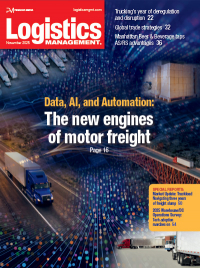
November 2025 Logistics Management
Latest Resources