Prologis and Performance Team roll out largest electric charging depot in Southern California
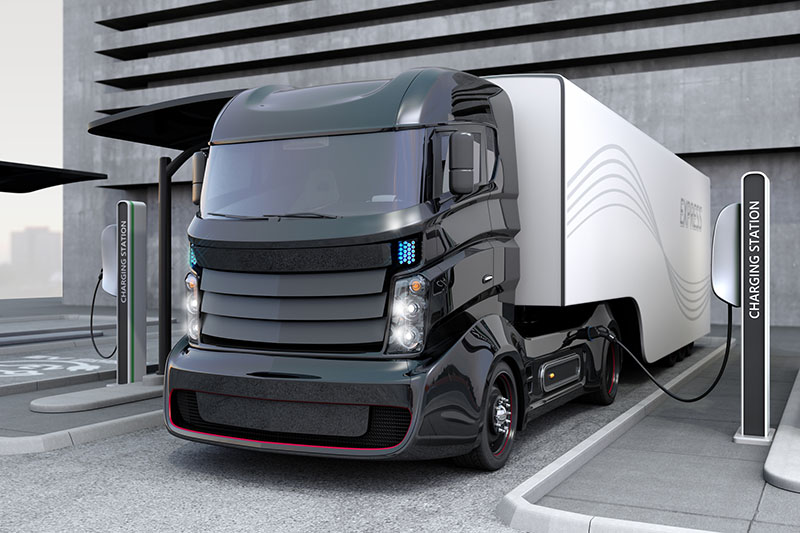
A collaboration announced this week between two well-known supply chain players—San Francisco-based real estate investment trust company Prologis and Performance Team, a subsidiary of Copenhagen, Denmark-based A.P. Moeller Maersk, an integrated global logistics services provider, operating more than 140 electric vehicles across the U.S.—heralds the rollout of the largest heavy-duty electric vehicle (EV) charging depot in Southern California.
The companies said that this depot is in close proximity to the Ports of Los Angeles and Long Beach, off of the Harbor (110) Freeway) in Los Angeles on Denker Avenue, and within five miles of Interstate 405 and California State Route 101 and is powered by the largest EV microgrid in the United States. What’s more, they added that the charging depot can charge up to 96 EV trucks at a time, with the facility being constructed in five months. The Performance Team’s fleet of Volvo VNR Electric Trucks, which have a range of 240 miles and charge up to 80% in 90 minutes, will use the depot to charge its trucks.
This depot’s construction comes at a time when California is requiring the end of the sale of diesel trucks and the subsequent move to diesel trucks by 2035 and to electric heavy-duty trucks by 2045, coupled with many companies taking steps to allocate capital for charging infrastructure. Prologis and Maersk described this charging station project as a “key connector in the infrastructure needed to meet the state’s goals.”
As for how this undertaking began, the companies said that Prologis installed the charging infrastructure to expedite the time the project could get online and also get trucks on the road, as opposed to two-year wait for the grid update. They also said that Prologis developed a charging solution with Mainspring Energy in order to build a microgrid, which is defined as any small network of electrical generators and loads that may be grid-connected but capable of operating independently of the local grid, with the Prologis Denker microgrid using 2.75 MW of fuel-flexible hydrogen-ready linear generators that are paired with 18 MWh of batteries to provide up to 9 MW of charging capacity.
In an interview with LM, Javier Garcia Atique, Regional Head of Transportation Operations, North America at A.P. Moller—Maersk, explained that going back to when Maersk started looking at the EV space, it engaged its procurement team in understanding how to put an entire solution together. And he explained that having worked with Prologis in other areas of the U.S. and abroad and an evaluation of its different services and solutions, it became clear Prologis could meet Maersk’s expectations.
“We were able to come in with the flexibility we needed to go ahead and make the investments and support the charging needs that we have,” he said. “Part of the challenge with going into the electric vehicle space is that you have a lot of things that are new for everybody. So, I think we have learned through the process, and it's been a very good relationship thus far.”
And Henrik Holland, Global Head of Prologis Mobility, said it is really important in the vehicle electrification space to work very closely together between the fleet operators and those who own and control the vehicles and also the charging services providers to get to a high reliability and a seamless experience.
He also noted that this is not the companies’ first foray into the EV space together. In November 2022, Prologis rolled out two electric truck charging installations, through its Prologis platform, enabling Maersk’s Performance Team to simultaneously charge up to 38 of its Volvo VNR Electric Class 8 battery-electric trucks.
“This is obviously a very significant and a very large project,” said Holland. “This was a very exciting expansion of what we did in 2022. And we were very pleased to be able to continue to support Maersk with its very innovative deployment of these vehicles. This is very new, and a lot of things need to be figured out, in terms of how these vehicles operate, and the relationship is very strong on the operational side.”
To that end, Holland said the companies collaborate on a day-to-day basis to ensure its systems work closely together and also understand the needs of the EV fleet.
“This isn't a pilot, this is real core to the business,” noted Holland. “So, these units need to be out there every day. And by working closely together we can ensure that Maersk gets the most out of its assets and out of its investments, so that the relationship deepens. From that perspective, it's not just about building a project and walking away. It's really, really important to continue that current collaboration as these sites are operational.”
In the coming years, Holland observed that there is going to be a significant need for additional charging capacity for California’s EV mandates to be met, with Prologis continuing to invest in the required infrastructure to support its customers to make the transition a reality, in regards to this new location.
“I think we have a really solid amount of capacity to support this particular fleet at this moment in time,” said Holland. “But the great thing about this particular solution is that it's very flexible and very modular. So, as and when more energy capacity is required at this site or at other locations, we're going to be ready to scale that up.”
Looking at how shippers are expected to benefit from this new initiative, Garcia Atique said that they are excited about how EV technology is becoming a reality, in that Performance Group can start generating direct impact in the environment with its operation.
“Customers are excited,” he said. “We have some customers that have different levels of degrees to their commitments. When we replace traditional diesel trucks for electric vehicles, there's definitely an impact on productivity because of the time it takes to charge these trucks, and the range of these vehicles is very different from a traditional diesel truck and some customers. We have also invested significantly in some of these charging stations or in places that are in real estate locations that are fairly expensive.
So, some customers really understand that in order for us to be able to drive those investments to support those capex requirements, they have to pay a premium and participate and collaborate with us. Some of the customers are more into the idea but probably they're not able to pay an additional amount of money to pay a premium for the services and that's where I think generally speaking, we're going have to come to terms in working together in ways that we can do to improve operations to be more productive and close that gap in how we work together with authorities, with manufacturers, and with infrastructure companies to make sure that the cost gap can get reduced and it can be more efficient so that ultimately, we can reduce the difference between operating in a traditional diesel environment and operating in a clean environment. We have made tremendous progress, and there is definitely excitement across the board.”
When asked about the respective competitive advantages of this collaboration, from a Maersk perspective, Garcia Atique said Maersk has made a decision to be fully sustainable by 2040 in 100% of its operations, calling this a step in that direction.
And he said that for those companies that really prioritize the use of a logistics services provider with that focus, Maersk is ahead of the game.
For Prologis, Holland agreed with Garcia Atique, adding that it is a smart decision to get ahead of what is coming, as it takes time to actually dial into the operations of these new types of fleets.
“That learning will lead to cost advantages, and I think that Maersk is going to have a real competitive advantage in that ahead of the market,” he said. “On the real estate side, our decision has been to be there for our customers as they make this transition happen. Prologis mobility was set up to support our customers’ transition to zero emissions logistics. We have realized that in order to do that competitively, we need to become a leader in logistics, fleet electrification. So, that is what we're doing here. We provide the services at Prologis locations, but also increasingly outside of the Prologis footprints. In order for us to be the leader, alongside our customers, we need to be a leader across the industry as a whole. And that's the competitive capability that that we're building here. What I think is really core to this competitive differentiation is to bring real estate capability and the endless footprint of the warehouses that Prologis has together with expertise in EV charging, because a lot of these trucks are going to charge within that real estate footprint and that logistics real estate footprint.”

Article Topics
Maersk News & Resources
European shippers expect disruptions to last two more years, states Maersk survey Maersk Ground Freight opens up new Dallas-area facility Top 30 Ocean Carriers: Navigating a still-volatile seascape 2025 Ocean Carrier Trends: Mixed signals prevail in 2025 ‘Gemini Cooperation’ is officially open for bookings, kicking off in February Top 30 Ocean Carriers 2024: Still navigating disruptive seas Maersk rolls out new El Paso-based warehouse facility More MaerskLatest in Logistics
PwC report indicates transportation and logistics dealmaking activity is focused on strategy, not scale ShipMatrix reports strong Cyber Week delivery performance results National diesel average falls for the fourth straight week, reports EIA FTR’s Shippers Conditions Index shows modest growth Trucking executives are set to anxiously welcome in New Year amid uncertainty regarding freight demand ASCM’s top 10 supply chain trends highlight a year of intelligent transformation Tariffs continue to cast a long shadow over freight markets heading into 2026 More LogisticsAbout the Author

Subscribe to Logistics Management Magazine

Find out what the world's most innovative companies are doing to improve productivity in their plants and distribution centers.
Start your FREE subscription today.
December 2025 Logistics Management

Latest Resources