Lithium power gets big
Bigger, more capable lithium batteries are making electric lift trucks an attractive alternative to internal combustion (IC) trucks as both industry advancements and increasing corporate and legislative pressures drive market changes.
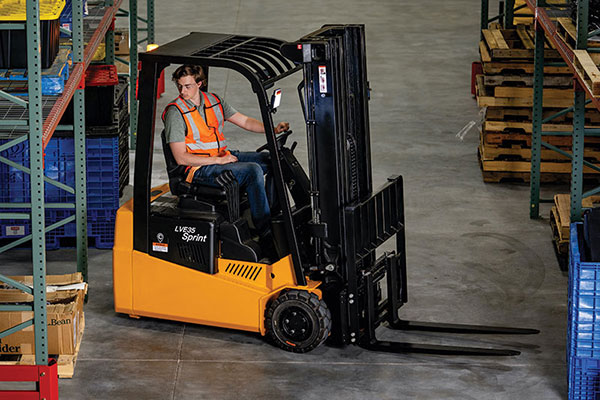
The regulatory phase-out of IC trucks in California under the Zero Emission Forklift Initiative, which severely restricts the sale of any large, spark-ignited IC engine powered forklift in the state starting in 2026, is one major driving factor for lift truck battery change, as well as growing corporate initiatives to improve on sustainability and cut carbon emissions in operations. Electrification has been identified as the top entry point for transitioning to a more sustainable supply chain, according to MHI’s 2024 annual report.
“For businesses, pressure is mounting to move toward a more sustainable future,” says Herman Klaus, director of Big Truck Applications Solutions at Hyster Company. “Green-focused targets have been embraced by governments worldwide, such as the United States aiming to cut greenhouse gas emissions in half from 2005 levels by 2030, and the European Union raising their binding renewable energy target to a minimum of 42.5% by the same deadline.”
But emerging government targets and regulations are not the only forces at play.
“Corporate initiatives, employee health and safety concerns, supplier mandates, and the behavior of conscientious consumers and investors are all compelling operations to consider their impact on communities and the planet,” Klaus adds.
On the electric battery front, lithium-ion batteries now come in higher voltages capable of lifting medium sized and even larger loads. This makes transition from IC trucks more attractive for busy operations that don’t want to take on the battery swapping processes and battery changing room investments that can come with ensuring high uptime for electric trucks running on traditional lead acid batteries.
“The value today’s industrial lithium batteries offer essentially eliminates all the pains and barriers to entry associated with lead-acid battery technology, which has changed very little in a century,” says Martin Boyd, CMO of Big Lift. “The past decade has seen strong movement from IC to lithium electric-powered lift trucks in the 5,000-pound capacity range. With strong acceptance in the market, the desire for larger capacity, lithium-powered lift trucks is strengthening. “
The shift from lead acid batteries
The electric lift trucks of years past were typically powered by lead acid batteries, which are large and heavy and often unable to match up to the productivity levels of IC-powered trucks. With the introduction of lithium-ion batteries nearly 15 years ago, the updated battery technology has slowly begun to replace lead acid, making way for real growth in electric fleets.
IC trucks remain a solid choice for certain industries and applications, but market data shows a steady shift to greater use of electric trucks. In 2024, according to Industrial Truck Association (ITA) figures, electric trucks made up 71% of the North American market, with the electrification trend expected to continue. Not only that, lithium-ion is gaining share within the electric market, with lithium-powered power options and models that can lift well beyond the payload range one might expect in a lithium-powered lift truck.
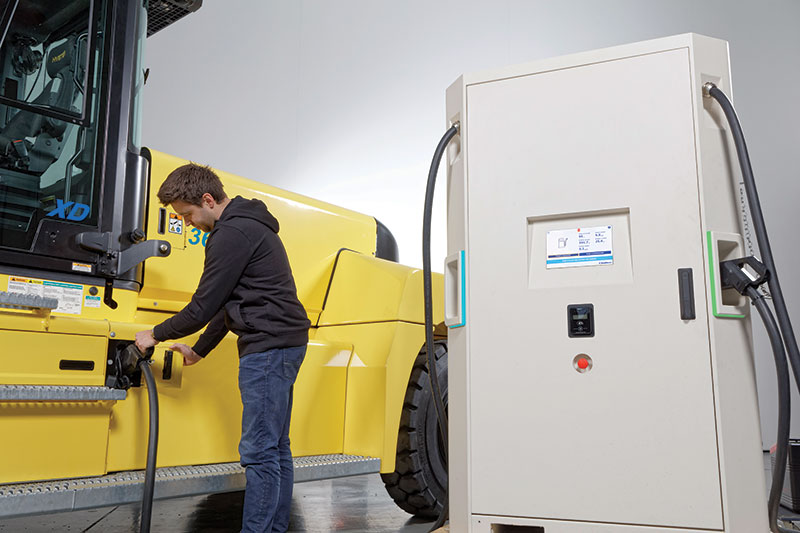
Hyster, for example, offers lithium-ion battery powered forklifts with capacities up to 40,000 pounds.
“This level of performance is comparable to what operations are used to from the ICE-powered trucks that have long powered heavy-duty applications,” says Klaus. “Not only that, newer electric forklifts that use lithium-ion batteries provide consistent power until depletion, putting them more in line with ICE performance than the legacy electric option, lead-acid batteries.”
Where lead-acid batteries are generally too large and heavy to be adequately scaled up to satisfy the energy draw of a high-capacity forklift, Klaus says lithium-ion has a smaller, lighter form factor and can tolerate a high energy draw without overheating or dropping in efficiency.
“Compared to lead-acid batteries, lithium-ion offers far greater energy density, power transfer and service life,” he says.
Boyd adds that some manufacturers are offering high-voltage, lithium-powered equipment in the 18-ton (36,000 pound) range.
“With energy storage in the range of 275 to 300 kWh, these large tonnage trucks can operate for hours without a charge and if the application allows, frequent fast charging between shifts and breaks can easily support two, and in some cases, three shift operations,” he says.
Indoor applications are still the most common adopters, and we’re just starting to see the impact lithium has in manufacturing plants, warehouse and distribution centers, and retail stores that traditionally have operated propane-powered trucks.
For companies such as Big Lift, they envision a future where the use of IC lift trucks indoors is a thing of the past.
“Integrated lithium-powered lift trucks, like the Big Joe LCE50, which was purpose-built to replace ITA Class 4 IC forklifts, were designed to make the idea of an IC-powered forklift operating indoors incomprehensible, much like the idea of smoking in an airplane or in the office,” says Boyd.
As confidence grows in indoor applications, Boyd expects ports, lumber yards, shipyards and other outdoor industries that rely heavily on large capacity lift trucks will follow suit.
Lithium-ion batteries perform well in hot and cold environments as well, adds Klaus, noting Hyster’s integrated lithium-ion forklifts use a sealed battery housing to keep out moisture.
“IC forklifts have been the tried-and-true option for demanding outdoor operations because they offer remarkable durability and have a proven record of standing up to the most extreme environments, but electric trucks can handle these environments, too,” says Klaus.
Maintaining uptime requires solid charging strategy
A common concern about electric lift trucks is the need to be charged frequently, which can be disruptive to productivity. This concern is a holdover from the days of lead acid batteries, where operators had to switch out batteries to allow for the other battery to charge and cool down.
Lithium-ion solutions, as well as thin-plate pure lead (TTPL), by contrast, are sized and designed for opportunity charging on breaks or shift changes. The sizing can take some study and assessment.
“Before any operation decides to make the switch, it’s absolutely critical to ensure the operation, the facility and even the operators of the equipment will be able to support a lithium electric fleet,” says Boyd.
He recommends undergoing an operational power study to determine the energy requirements of a new electric fleet.
Chris Behan, senior marketing manager, Americas for motive power at Enersys, also suggests companies verify that lithium-ion is right for them. EnerSys helps clients answer this question using a data-driven approach that takes usage data from their equipment to determine the optimal battery and charger combination for their application.
“That lets us really take the customer’s actual data, and prescribe a solution: the right power system for their application,” says Behan.
This is especially critical when it comes to using lithium-ion in heavy duty applications. The harder your truck is working; the more energy is required. Recharging batteries quickly and efficiently must be part of your operational model.
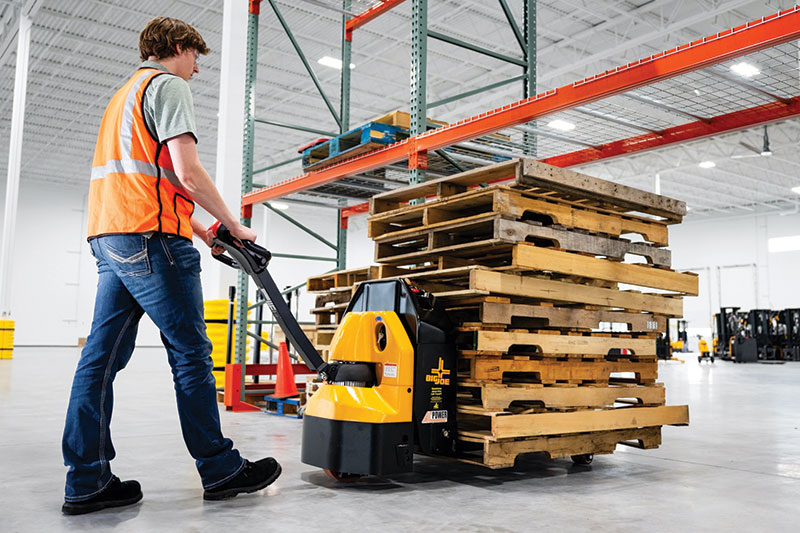
“If you’re going to look at lithium-ion…the system that you use—the battery, the charger and the battery controls or the battery monitoring system that’s on the battery itself—all three of those need to be designed as a holistic system,” says Behan. “Your best bet is to get a system that’s designed from the ground up to work together.”
And when it comes to lithium-ion, the size of the battery is less important than the charging infrastructure, according to Robin Schneider, director of marketing at Green Cubes Technology.
Regardless of their size, lithium-ion batteries charge at about a 1C rate, says Schneider, meaning it takes about one hour for the battery to charge to full capacity,
“A bigger battery can accept proportionally higher current, so the limitation is on the charger and infrastructure side,” she adds. “The challenge is making sure the site service and grid have the capacity to deliver that much electricity.”
This requires warehouse operations to adopt a good overall charging strategy, considering things like the number and type of chargers, their location and expected operator behavior.
“Developing an effective charging strategy can help operations determine how many and what type of chargers are necessary,” says Klaus. “Important factors influencing this approach include the types of batteries, the necessary voltage, number of trucks on-site and total application hours they must run, and operator charging discipline.”
Choosing the right location for electric lift truck battery chargers is also important, so operators can maximize opportunity charging. Klaus recommends considering your operators, facility layout and electrical infrastructures.
“Chargers should be placed in locations that are convenient for operators to access, particularly for charging strategies that include opportunity charging to top off the battery’s state of charge during lunch or other breaks when the forklift is not in use,” says Klaus.
He adds that another important part of charging electric lift trucks is local infrastructure. Depending on the fleet size, chargers and existing electrical wiring and connections, transitioning a fleet to electric can require upgrades. Unlike IC trucks, electric forklifts depend on the electric grid in your area, and areas with weak grids become more susceptible to interruptions the more intense the charging requirements are.
“It’s important to work with partners who can help you understand the power requirements for your planned fleet, communicate with your utility provider and develop an appropriate charging strategy,” says Klaus.
Government incentives
Cost is often cited as the biggest barrier when it comes to electrification. A recent survey of lift truck buyers from Hyster found that 37% of respondents identified cost as the biggest unknown for their company, followed by facility infrastructure (32%).
There’s no doubt that making the change from IC to electric is a big investment, but monetary support is available through various grants, rebates and offset credits offered by governments to support decarbonization and incentivize adoption of electric equipment.
“Checking with a local expert can help businesses understand what incentives they qualify for, which can enhance the business case for adoption electric equipment,” says Klaus.
Additionally, operational cost benefits in making the switch to electric on lower forklift capacities are lessening the strain on operators hoping to see similar benefits on larger equipment.
“In heavy use applications, Li-ion batteries almost always have a lower total cost of ownership than alternatives,” says Schneider. “It’s good to not just evaluate the carbon footprint, but also other economic savings, such as electrical efficiency, improved space utilization and improved charge times.”
Despite these perceived barriers, electrification as it stands today is in fact a real option for businesses with heavy-duty applications. Many operations are already making the shift, with adoption at an all-time high in 2023 and accounting for more than a third of all sit-down counterbalanced forklift purchases, according to Industrial Truck Association.
“Unlike the automotive industry where the retail buyer is primarily attracted to electric offerings through a sense of responsibility to the environment, the industrial market is electrifying because it just makes sense all around,” says Boyd. “Lithium-powered lift trucks have proven themselves to be more comfortable, more productive, less maintenance and easy to work on than their IC counterparts.”

Article Topics
Latest in Logistics
FTR’s Shippers Conditions Index shows modest growth Trucking executives are set to anxiously welcome in New Year amid uncertainty regarding freight demand ASCM’s top 10 supply chain trends highlight a year of intelligent transformation Tariffs continue to cast a long shadow over freight markets heading into 2026 U.S.-bound imports see November declines, reports S&P Global Market Intelligence FTR Trucking Conditions Index shows slight gain while remaining short of growth AAR reports mixed U.S. carload and intermodal volumes, for week ending December 6 More LogisticsAbout the Author

About the Author
Subscribe to Logistics Management Magazine

Find out what the world's most innovative companies are doing to improve productivity in their plants and distribution centers.
Start your FREE subscription today.
December 2025 Logistics Management

Latest Resources