U.S.-bound September imports see annual decline, reports S&P Global Market Intelligence
October 17, 2025
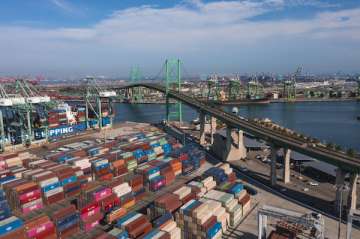
The firm reported that September imports, at 2.72 million TEU (Twenty-Foot Equivalent Units), fell 5.8% annually, down from August’s 2.9 million TEU July’s 3.01 million TEU (which topped the 3 million TEU mark for the first time and came on the heels of a June decline, coupled with importers looking to optimize sourcing following the White House’s reciprocal tariffs related to the International Emergency Economic Powers Act on most U.S. trading partners, which went into effect on August 7).
U.S. container Imports dip in September after summer surge, reports Descartes
October 14, 2025
September U.S.-bound container import volume—at 2,307,933 TEU (Twenty-Foot Equivalent Units)—fell 8.4% compared to August’s 2,519,722 TEU, the second-highest monthly total in 2025 and close to the May 2022 monthly record, as well as the third-highest September tally on record, and was also down 8.4% annually. On a year-to-date basis through September, volumes are up 1.9% compared to the same period a year ago, which Descartes said suggests moderate resilience in overall demand.
USTR enforces shipbuilding modifications, while China retaliates with vessel charges
October 14, 2025
Actions outlined by the Office of the United States Trade Representative (USTR), in regards to announced modifications of certain aspects of the responsive action to modify American shipbuilding from April, went into effect.
LMI shows logistics expansion continues at slower pace amid falling transportation and warehousing costs
October 14, 2025
The September reading, at 57.4 (a reading above 50 indicates growth is occurring), trailed August’s 59.3 by 1.9%, coming in at its lowest level since March and its second-lowest this year—and it is the seventh consecutive month the LMI reading has been below the all-time overall average of 61.5.
Tariffs, trade, and uncertainty drive supply chain strategy shifts, notes CSCMP EDGE panel
October 10, 2025
A session at this week’s Council of Supply Chain Management Professionals (CSCMP) EDGE conference in National Harbor, Maryland addressed various aspects related to the current state of the freight market, including the impact of various freight recessions, above-average inventory levels despite efforts to reduce them, the importance of maintaining shipper-provider relationships, as well the impact of tariffs, and other topics.
Supply chain experts forecast stabilization amid rising costs and global uncertainty
October 9, 2025
A panel of industry experts across different areas of the supply chain provided a detailed overview of market trends and themes this week in a session at the Council of Supply Chain Management Professionals (CSCMP) EDGE annual conference, which was held in National Harbor, Maryland.
Expected U.S.-bound import declines remain intact, notes Port Tracker report
October 8, 2025
For the first half of 2025, Port Tracker said that total volume, at 12.53 million TEU, rose 3.7% annually, with calendar year 2025 expected to be down 2.9% annually, to 25.5 million TEU.
President Trump rolls out new tariffs ahead of Supreme Court review
September 26, 2025
White House imposes steep tariffs on trucks, furniture, and pharmaceuticals as legal challenge to trade powers looms
DHL executives forecast subdued but strategic 2025 Peak Season amid global trade shifts
September 26, 2025
Top-level executives at Plantation, Fla.-based global express delivery and logistics services provider DHL shared their thoughts and expectations about the 2025 Peak Season this week, on a company-hosted call.
POLA and POLB volumes remain strong in August
September 18, 2025
POLA reported that total volume, at 958,355 Twenty-Foot Equivalent Units (TEU), saw a 6% annual increase. The Port of Long Beach reported that August volume, at 901,846 TEU, was off 1.3% from its August 2024 record, while still posting its second-best volume August on record, as well as its sixth-busiest month in port history.
U.S.-bound August shipments see annual gains, reports S&P Global Market Intelligence
September 15, 2025
ng off of a record-setting July, United States-bound containerized freight imports saw annual gains, albeit at a reduced pace, according to data recently issued by S&P Global Market Intelligence.
Mexico plans to raise tariffs on Chinese cars and parts to 50%
September 12, 2025
The plan also covers steel, textiles, and around 1,400 other products from countries without trade agreements.
U.S.-bound container imports hit second-highest month on record amid tariff and seasonal pressures
September 11, 2025
August U.S.-bound container import volume—at 2,519,722 TEU (Twenty-Foot Equivalent Units)—decreased 3.9% compared to July (higher than the 3.0% decline for the same period a year ago) and were up 1.6% annually and 17.6% higher than pre-pandemic 2019.
Supreme Court is set to hear expedited appeal on legality of White House IEEPA tariffs
September 10, 2025
The United States Supreme Court said yesterday that it has agreed to hear arguments in regards to the legality of tariffs implemented by the White House under the International Emergency Economic Powers Act (IEEPA), in the form of an expedited review set to begin in November.
U.S.-bound container imports are expected to see declines through year end and into 2026, reports Port Tracker
September 9, 2025
For July, the most recent month for which data is available, U.S. imports came in at 2.36 million TEU (Twenty-Foot Equivalent Units), with the report’s authors saying that this tally excludes numbers for New York/New Jersey, Port Everglades, and Miami, marking a 20.1% gain over July, a period when importers were bringing in merchandise in advance of tariffs going into effect on August 1, while posting a 1.8% annual gain. This tally would mark the second highest-volume month on record, trailing...
Market update with Matt Muenster, Chief Economist, Breakthrough
September 8, 2025
Logistics Management (LM) Group News Editor Jeff Berman recently spoke with Matt Muenster, Chief Economist for Green Bay, Wisc.-based Breakthrough, an innovator in transportation management, dedicated to creating transparent and fair strategies for the world’s leading shippers. Muenster provided Berman with an overview of trade and tariffs, the industrial economy, and Peak Season, among other topics.
Logistics Managers Index continues to show growth in August
September 5, 2025
The August LMI reading, at 59.3, eked out a 0.1% gain over July’s 59.2.
Pandemic lessons and trade war turbulence define a new logistics era
September 3, 2025
It is hard to find a period in time in which supply chains have seen so much volatility and uncertainty, in various ways as over the last five years. That is nothing new, to be sure, but, at the same time, it does speak to the significance of the industry (whether you may be a shipper, carrier, 3PL, academic, analyst, lobbyist, or anything else along those lines).
Tariff uncertainty deepens as appeals court rejects IEEPA duties
September 2, 2025
Late last week, the U.S. Court of Appeals for the Federal Circuit issued a ruling, by a 7-4 margin, in which it stated the majority of the IEEPA (International Emergency Economic Powers Act) tariffs rolled out by the White House are illegal. Tariffs will remain temporarily in place until October 14, which will give the White House time to appeal its case to the Supreme Court.
U.S. and EU release additional details to trade deal framework
August 21, 2025
Following a late July announcement in which the United States and the 27-nation bloc comprising the European Union, which collectively represents the largest trading partner for the U.S., announced they had come to terms on the framework of a large global trade deal, the parties said earlier today that they have agreed to additional details but are not yet at the finish line.