How drones are transforming GNC’s DC operations
GNC's labor-intensive inventory counting process once relied on teams navigating 450,000 square feet of warehouse space with materials handling equipment. Now, drones are streamlining cycle counts, reducing resource constraints, and improving efficiency across its distribution centers.
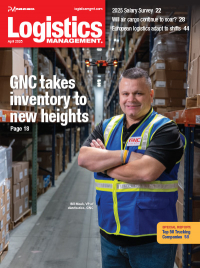
Before drones started flying around counting inventory in GNC’s two large distribution centers (DCs), the nutritional supplement and vitamin retailer relied mostly on an internal resources to perform cycle counts.
It was a labor- and time-intensive process: teams would go out and audit every location—40,000 locations total—in GNC’s Indianapolis and Phoenix facilities a minimum of twice a year.
From its two DCs, GNC ships to its physical stores, domestic and international wholesalers, and individual customers. It manages a catalogue of over 3,000 stockkeeping units (SKUs) from those two locations.
The cycle counts took place daily on different shifts, and sometimes over the weekend—and the facilities also have internal and external auditors come in and validate the accuracy of the inventory at least twice a year.
Team members used GNC’s materials handling equipment to reach all corners of the combined 450,000 square feet of space across both facilities. “They’d go out to our reserved locations and our forward-pick/active locations and count the inventory,” says Bill Monk, vice president of distribution for the Pittsburgh-based global
The amount of people and materials handling equipment needed to handle the task was substantial, particularly at the company’s Indianapolis facility. Because that DC runs around the clock, for example, the equipment itself doesn’t get any real “downtime.” That means there’s no good time to redeploy lift trucks and other vehicles to the inventory counting process. “It was definitely creating resource constraints,” says Monk.
Hitting the target
The company started looking for a better way to manage its growing distribution and logistics operation, with an emphasis on using technology to streamline the process and free up both human resources and equipment to focus on more strategic work.
Monk says GNC found what it was looking for at an industry trade show, where Corvus Robotics was demonstrating its Corvus One drone-based inventory management solution.
“It really came down to the number of people and the amount of equipment that it takes to do the counts,” says Monk. “We wanted to give our teams technology that could help them repurpose labor to potentially focus on other areas that the drones couldn’t do.”
As he walked the exhibition floor at ProMat, Monk was on high alert for a good solution to his company’s inventory management conundrum. He says Corvus Robotics had a simple booth setup at the show, but its technology and offering really stood out. “There wasn’t a lot of flash and hype around the product, but it actually counted the location and didn’t just ‘verify’ it, like most of the other solutions did,” says Monk. “That’s exactly what we needed.”
The Corvus rep also explained how the drone could take a heat image, develop an estimate based on that image, and then compare that number to what was in GNC’s system.
“That’s what really sold us on it,” says Monk, who also liked how the drones could make multiple flights per day and operate fully autonomously. “At the end of the day, they allowed us to repurpose our labor to more ‘satisfying roles’ for the associates themselves—and also freed up our materials handling equipment.”
The drones take off
GNC’s original DC in Phoenix opened in 1996, which made it a good “test case” for the inventory counting drones. It would later push the new solution out to its larger, state-of-the-art Indianapolis distribution facility. The company’s internal IT department has strict policies concerning new implementations, and Monk says Corvus was able to “meet those very quickly” for the vitamin retailer.
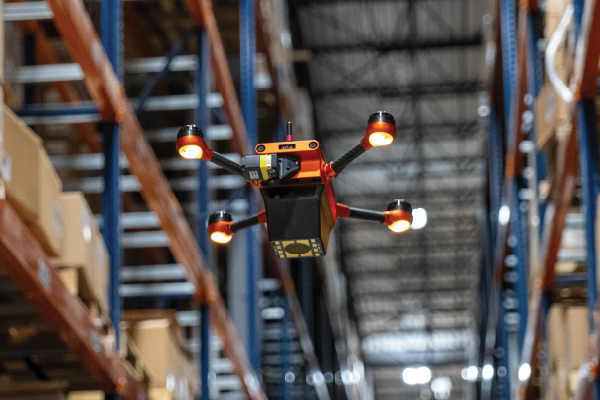
The project kicked off with a site survey and ended just a few weeks later when the first drone left its docking pad to start counting inventory. The company currently has four Corvus One drones and seven landing pads across its two facilities.
The drones use computer vision and generative AI to understand the environment and can operate in both very narrow and very wide aisles. Using obstacle detection technology, the lightweight drones fly at walking speed without disrupting workflow or blocking aisles. They can read any barcode symbology in any orientation as long as it’s placed anywhere on the front of cartons or pallets.
The company typically uses the drones for seven to eight flights per day, with each flight taking approximately 30 minutes to 45 minutes. GNC’s flight schedule deploys missions every two to three hours. During that time, the drones perform cycle counting throughout the facility multiple different times. GNC uses these for its reserve inventory cycle counts requirements that used to take place twice a year.
“We’re now doing complete counts 10 to 12 times a year,” says Monk. “In our Indianapolis operation we have about 24,000 unique locations and the drones are counting nearly 31,000 locations per month. Allocating the required number of people and amount of materials handling to manage that is just not feasible.”
This is where the drones step in to help. Aside from a bit of white noise generated during takeoff and landing, and a slight buzz overhead as they go about their business, the drones operate stealthily and behind the scenes.
Once the drones return to their landing pads, team members review any errors and address any discrepancies between the counts and what’s reflected in the company’s system. Monk says that finding lost or misplaced products is much easier now because the drones report back on any items that are in the wrong place.
“Human error is going to happen when you are moving the amount of inventory we do” Monk says. “Using the drones has allowed us to identify and problem-solve much quicker.”
Out of sight, out of mind
One of the most important metrics for GNC’s busy distribution centers is ship rate, and hitting that goal requires a high level of inventory accuracy. “It’s an unwritten rule that our shipments are on time and in full, so every order that gets dropped to us today gets shipped today,” says Monk. From there, the company measures its “non-ships” and strives to maintain less than 100 units across all SKUs.
Overall, Monk says the drones have helped improve inventory accuracy and reduced shrinkage within the four walls of its warehouses. “The drones have helped us become very agile when it comes to the number of inventory counts we can do,” says Monk, who enjoys showing off the technology to visitors. “Everybody that sees the drones asks us who’s flying them. When we tell them that it’s fully autonomous, they’re amazed that the solution is on schedule and kind of out of sight, out of mind.”
The company also audits the drones to ensure that the items accounted for are indeed in their respective places in the warehouse. “We’ll go out and check that just for our own peace of mind,” says Monk, “but the drones have really become that extra set of eyes that allows us to leverage people in other aspects of the operation.”
Tremendous inventory accuracy improvements
Since deploying Corvus’ drones, Monk says GNC’s inventory accuracy has “improved tremendously” and errors have been greatly reduced.
“With the millions of dollars of inventory that we have inside the four walls of the facility, getting that accuracy really starts with our receiving, putaway and reserve storage operations,” Monk explains. “Every pallet, case and unit counts, and the drones have definitely gotten us to a better place overall from an inventory accuracy standpoint.”
According to Monk, the drones have also contributed to an overall more streamlined, reliable inventory management process for GNC. “With the number of pallets that we move in and out of our building every day, and the amount of product that we pull out of it every day, there’s always an opportunity for lost or misplaced items.”
And where the company once had 20 employees working in its inventory control department seven days a week, it now has 13 individuals handling the work. “We’ve successfully redeployed those individuals to other projects within the building,” says Monk, whose team is highly focused on accuracy
and is now installing some additional technologies to help support that push.
Handling mission-specific tasks
Looking ahead, Monk expects to start using the drones more often and to handle more functions.
The devices today perform flights every two hours to three hours. GNC eventually wants to leverage the drones for mission-specific tasks, like finding a lost pallet out in the DC based on some estimated coordinates.
“If we have an idea where the pallet is, we’d be able to have the drone go out and search for it in an ‘off-schedule’ timeframe,” says Monk, who’s pleased with the drone deployment so far and expecting to see even more benefits from the investment in the future.
“The more we can verify and count reserve locations, the better off we’re going to be,” says Monk, who recalls the time when full cycle counts were only performed two to four times annually. Now they’re happening 10 times to 12 times a year thanks to the drones.
“That in and of itself is a massive improvement, but there’s still a chance for something to be misplaced in that 30-day window, so we’ll be exploring how the drones can help us mitigate those types of issues,” Monk adds.

Article Topics
Warehouse News & Resources
PwC report indicates transportation and logistics dealmaking activity is focused on strategy, not scale ASCM’s top 10 supply chain trends highlight a year of intelligent transformation Federal Reserve moves forward with its third consecutive rate cut IKEA moves more manufacturing to U.S. as tariffs raise costs Logistics growth sees mild decline in November, states LMI DHL’s 2025 Peak Season approach includes more planning and less panic Services economy remains on growth track in November, reports ISM More WarehouseLatest in Logistics
PwC report indicates transportation and logistics dealmaking activity is focused on strategy, not scale ShipMatrix reports strong Cyber Week delivery performance results National diesel average falls for the fourth straight week, reports EIA FTR’s Shippers Conditions Index shows modest growth Trucking executives are set to anxiously welcome in New Year amid uncertainty regarding freight demand ASCM’s top 10 supply chain trends highlight a year of intelligent transformation Tariffs continue to cast a long shadow over freight markets heading into 2026 More LogisticsAbout the Author

Subscribe to Logistics Management Magazine

Find out what the world's most innovative companies are doing to improve productivity in their plants and distribution centers.
Start your FREE subscription today.
December 2025 Logistics Management

Latest Resources