Earning More, Doing More: What our 2025 Salary Survey reveals
As logistics professionals take on greater challenges in an unpredictable world, salaries are reflecting their growing importance. Our annual salary survey uncovers key compensation trends, job satisfaction levels, and career insights shaping the industry.
Related Slideshow

Market volatility, geopolitical events, and general uncertainty have all thrust logistics management into the spotlight over the last few years. The individuals who support, plan, and orchestrate logistics and supply chain networks are also garnering more attention—and in some cases, receiving bigger rewards for their roles—as they help their organizations navigate the complexities of the modern supply chain environment.
And as organizations strive to build more resilient and agile supply chains, demand for qualified logistics professionals is outpacing supply. This is one of many factors currently driving up compensation rates and emphasizing the vital role logistics and supply chain managers play in overall organizational success.
Peerless Research Group’s (PRG) new 2025 Salary & Compensation Survey, conducted on behalf of Logistics Management of more than 200 qualified respondents, reveals some interesting facts about the current state of logistics management from the compensation perspective.
It also digs into topics like job satisfaction, length of tenure in specific job roles, and the support networks that logistics managers rely on to help them learn, grow and advance in their careers.
This year PRG once again invited expert input on the survey results and feedback on the career-related industry trends. Abe Eshkenazi, CEO at ASCM, and Tom Derry, CEO at the Institute for Supply Management (ISM), both gave feedback on the report and explained some of the survey’s more surprising revelations.
What’s the average?
Logistics management salaries have been gradually increasing over the past few years, but the average annual salary for 2025 was $120,600 versus $128,030 in 2024.
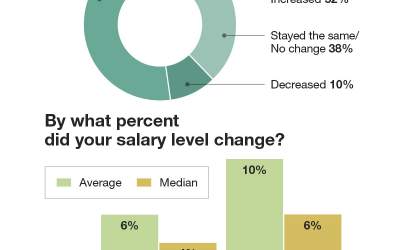
This may have had something to do with the specific survey sample, especially considering that in the following questions, just 10% of respondents say that their salary level has decreased in the last 12 months.
Derry:
“The fact that total compensation ticked downward really stood out to me. I think the explanation is the demographic change in the workforce, which is shifting to a slightly younger age profile. They’re not yet at the ‘high earning’ stage, and therefore it’s natural for the compensation level to kind of reset to one commensurate with the level of experience of people who are in the field.”
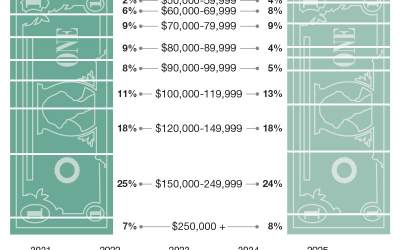
This year, 24% of total annual salaries for logistics and supply chain professionals (including bonuses and commissions) exceeded $150,000, but on the other end of the spectrum, 8% came in at less than $50,000. In addition,18% of respondents said their annual salary for 2025 is between $120,000 and $149,999, while 13% earn $100,000 to $119,999, and 8% earn between $60,000 and $69,999.
Breaking it down demographically, 38% of respondents are between 55 years old and 64 years old; 29% are between 45 and 54; and 19% are between 35 and 44. Those aged 55 to 64 are the highest earners, with an average salary of $135,750, followed by those between 45 and 54, whose average salary is $129,990.
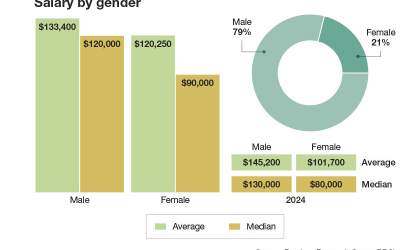
This year, 79% of respondents were male and 21% were female. Men continue to earn more than their female counterparts, but the gap seems to be narrowing. Males reported an average annual salary of $133,400 (down from $145,200 last year), and females reported an average salary of $120,250 (up from $101,700 last year).
Eshkenazi:
“This coincides with our salary survey in terms of women entering the field, and that they’re earning greater salaries. The delta for us is that the longer women stay in the industry, the more the pay gap inverts. That means women may earn significantly less than men the longer they stay in the industry, and that’s a pretty big concern.”
Job functions and tenure
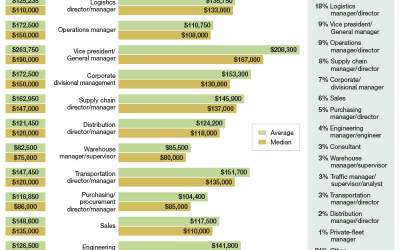
This year’s respondents represent a variety of job titles from logistics manager/director (18%); VP/general manager (9%); operations manager/director (9%); and supply chain manager/director (8%).
Of these titles, VP/general managers earn the most, with an average salary of $208,300, followed by logistics managers who earn $135,750 on average, and supply chain directors or managers who bring in average salaries of $145,900.
According to the survey, the most important job functions for these professionals include distribution/logistics (18%), operations (15%), supply chain management (14%), and sales (9%). Breaking the functions down by salary level, distribution/logistics professionals earn $134,500; those in operations earn $145,000 per year; and supply chain management professionals take home $137,250 per year.
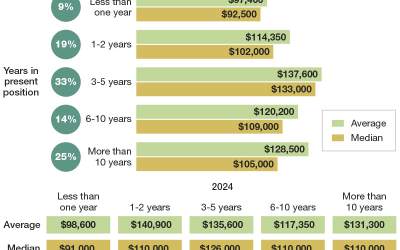
Professionals who have been in their current positions for 3 years to 5 years earn the highest salaries at $137,600 per year, while those who have been in place for 10 years earn $128,500. Forty-four percent of respondents have been with their present employer for more than 10 years, while 20% have been with their employer three to five years and 16% have been working for their companies for 6 years to 10 years.
Tenure counts in supply chain management, but once someone hits the 10-year mark their salary may level off. For example, individuals who have been onboard with their current companies for 6 years to 10 years earn the highest annual average salary of $135,900, yet those with 10+ years with the same company earn $125,700.
Despite these variances, logistics professionals continue to play an increasingly important and visible role in their organizations. “We learned during the pandemic how vulnerable supply chains are to disruptions and companies realize it’s not always about the ‘lowest costs,’” says Derry. “The visibility and stature of our profession has never been more prominent and appreciated than it is today, and I think that’s reflected in the compensation trends.”
Doing more with less
Logistics and supply chain managers are doing more than ever, with 67% of them revealing that the number of job functions they perform increased over the last 2 years to 3 years.
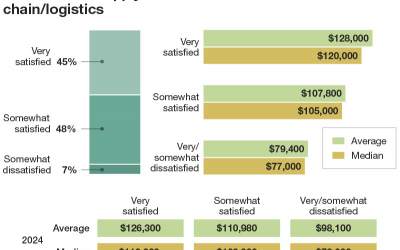
Despite the added workload, job satisfaction remains high in the field where nearly all (93%) of respondents say they’re satisfied with their careers. These happy professionals also happen to earn the highest average salary of $128,000.
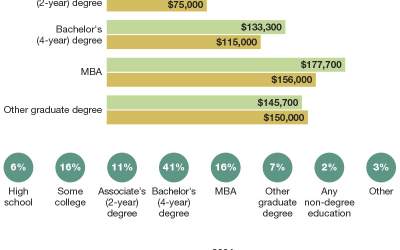
The highest earners in this year’s survey hold an MBA and make an average of $177,700 annually (up from $146,100 for the same group last year). Graduate degree holders earn $145,700, and those with 4-year college degrees earn $133,300. All of these salaries are higher than 2024’s numbers. Also, about 36% of this year’s survey respondents have completed formal education in logistics or supply chain management and earn $136,600 on average (up from $126,800 last year).
Advancing their careers
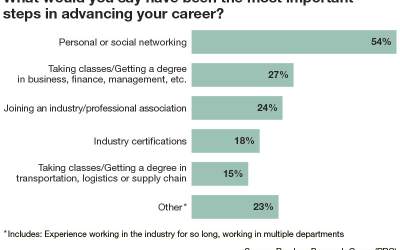
When asked about the most important steps they’ve taken to advance their careers, 54% of professionals use personal or social networking, while 27% have taken classes or pursued a degree in business, finance, or management. Another 24% joined an industry or professional association, while 18% have received industry certifications, and 15% have taken classes or pursued a degree in transportation, logistics, or supply chain.
Of the respondents who pursued logistics or supply chain management education, the majority completed job-related training (66%); attended industry conferences or workshops (41%); or earned a professional certification (24%) or related undergraduate degree (16%). Twelve percent have earned a graduate degree in logistics or supply chain management.
“These numbers are consistent with our own survey results, which show that supply chain certification pays off at every level,” says Eshkenazi, who’s bullish on the overall results of the survey and on the job prospects for men and women in the field. And, he says that the survey uncovered some very positive indicators in terms of attracting individuals into the industry.
Eshkenazi adds:
“The salaries are significant relative to the job opportunities that exist. Supply chain continues to be a very attractive field, and I think this salary survey continues to demonstrate that the industry does pay for competent, capable individuals. We just need to find more of them.”

Article Topics
Latest in Logistics
FTR’s Shippers Conditions Index shows modest growth Trucking executives are set to anxiously welcome in New Year amid uncertainty regarding freight demand ASCM’s top 10 supply chain trends highlight a year of intelligent transformation Tariffs continue to cast a long shadow over freight markets heading into 2026 U.S.-bound imports see November declines, reports S&P Global Market Intelligence FTR Trucking Conditions Index shows slight gain while remaining short of growth AAR reports mixed U.S. carload and intermodal volumes, for week ending December 6 More LogisticsAbout the Author

Subscribe to Logistics Management Magazine

Find out what the world's most innovative companies are doing to improve productivity in their plants and distribution centers.
Start your FREE subscription today.
December 2025 Logistics Management
Latest Resources