U.S. Chamber of Commerce-led letter to USTR reiterates support for USMCA
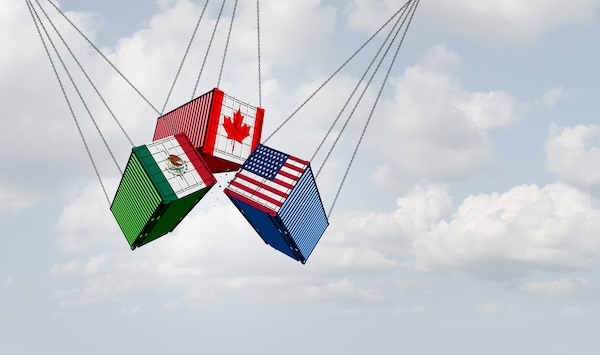
A letter sent to United States Trade Representative Jamieson Greer, which was led by the United States Chamber of Commerce and signed by more than 500 businesses, organizations, and chambers of commerce, made the case for their continuing support of the U.S.-Mexico-Canada Agreement (USMCA).
“USMCA remains critical to our economic future because it preserves and strengthens U.S. trade ties to Canada and Mexico,” the letter stated. “More than 13 million American jobs depend on trade with Canada and Mexico. U.S. manufacturers export more made-in-America manufactured goods to our North American neighbors than they do to the next 12 largest export markets combined, and the two countries account for one-third of U.S. agricultural exports. They are also the top two export destinations for U.S. small and medium-size businesses, more than 100,000 of which sell their goods and services to Canada and Mexico.”
The letter added that USMCA ensures U.S. manufacturers, farmers, and service providers can continue to access the Canadian and Mexican markets, while also noting that it guarantees that virtually all U.S. exports enter these markets tariff-free, while also helping American companies and their employees compete in the country’s top two export markets.
In addition to the U.S. Chamber of Commerce, organizations that signed the letter to the USTR included: the American Apparel & Footwear Association (AAFA), American Association of Importers and Exporters; American Trucking Associations; Business Roundtable; Industrial Truck Association; and the National Retail Federation, among others.
In mid-September, the Office of the USTR announced there would be a public consultation process in advance of the joint review of USMCA on July 1, 2026. The consultation process is required by law, according to the USTR, with the focus for solicited public comments including, but not limited to:
- Any aspect of the operation or implementation of the USMCA;
- Any issues of compliance with the Agreement;
- Recommendations for specific actions that USTR should propose ahead of the Joint Review;
- Factors affecting the investment climate in North America and in the territories of each Party, as well as the effectiveness of the USMCA in promoting investment that strengthens U.S. competitiveness, productivity, and technological leadership; and
- Strategies for strengthening North American economic security and competitiveness, including collaborative work under the Competitiveness Committee, and cooperation on issues related to non-market policies and practices of other countries
On Monday, December 1, USTR said that it will hold a public hearing from Wednesday, December 3-Friday, December 5 on the operation of USMCA prior to the aforementioned first six-year joint review of USMCA on July 1, 2026.
The USMCA agreement went into effect on January 29, 2020, during President Trump’s first term in the White House, which replaced its predecessor, the North American Free Trade Agreement.
USMCA, in various ways, is actually based on the same rules and procedures and most of the same products, as NAFTA, which took effect in 1994. Analysts say that there are some strong environmental and labor regulation improvements, and it incentivizes domestic production of cars and trucks. It’s also the first free trade agreement that has ever included intellectual property protections, which are very timely given the current trade wars that were triggered by the alleged theft of American intellectual property by China and other nations.
Former United States Trade Representative Robert Lighthizer said at the time that USMCA marks a significant improvement over NAFTA, in the form of its objectives to create more manufacturing jobs, protect America’s competitive advantage in technology and innovation, secure greater market access for American businesses, farmers, ranchers, and, critically, to change the stale politics of trade by creating bipartisan consensus around a new model that works better for all Americans.
Since President Trump returned to the White House earlier this year, there have been various back and forth actions, with both Canada and Mexico, that have seen some ebbs and flows.
As previously reported by LM, in July, President Trump stated on a social media message he sent Canadian Prime Minister Mark Carney a letter stating that effective August 1, the U.S. would charge Canada a 35% tariff on products imported into the U.S. from Canada, separate from tariffs on specific sectors. Tariffs placed on Canada by the U.S. currently include: a 25% tariff on non-USMCA goods; a 10% tariff on energy resources and potash; a 50% tariff on steel and aluminum; and a 25% tariff on autos and auto parts.
In that letter to Carney, President Trump said that the U.S. initially imposed tariffs on Canada in an effort to combat the U.S. fentanyl crisis, with Canada subsequently replying in kind with tariffs on U.S. goods imported into Canada. On March 4, Canada implemented 25% tariffs on $30 billion worth of U.S. imports, including consumer and household goods, followed on March 12, with 25% tariffs on $29.8 billion worth of U.S. goods, including steel, aluminum, tools, computers, and other items.
And in late August, Carney announced that Canada will remove various retaliatory import tariffs on United States goods that are covered under USMCA (United States Mexico Canada Agreement). This marked a shift in policy compared to the high tensions between the nations going back to when President Trump re-entered the White House in January. But in late October, President Trump said that trade negotiations with Canada were halted, due to a television commercial which aired in Canada financed by the province of Ontario, including the late former President Ronald Reagan saying that “tariffs hurt every American.”
President Trump stated that this commercial was released by the province of Ontario to interfere with the pending decision of the United States Supreme Court, and other courts, in regards to the legality of the White House’s usage and implementation of IEEPA tariffs.
As for Mexico, for Mexican imports to the U.S. that qualify under USMCA rules of origin are exempt and able to enter the U.S. duty-free, with a 25% tariff for imports not covered under USMCA. In a March letter to Claudia Scheinman, president of Mexico, Trump stated that the United States imposed tariffs on Mexico, the largest U.S. trading partner, to deal with the nation's Fentanyl crisis, which is caused in part by Mexico's failure to stop the cartels.
In addition to the 25% tariff on goods unless they qualify under USMCA origin rules, tariffs placed by the U.S. on Mexico currently include: a 25% import on steel and a 10% tariff on aluminum; a 25% tariff on autos and auto parts not meeting USMCA content or labor thresholds; and a 20% fentanyl tariff on non-originating goods.

Article Topics
3PL News & Resources
U.S. Chamber of Commerce-led letter to USTR reiterates support for USMCA Q3 intermodal volumes see annual gains, reports IANA Manufacturing declines for the ninth consecutive month, reports ISM Looking at the impact of tariffs on U.S. manufacturing Proposed Union Pacific-Norfolk Southern merger draws praise, skepticism ahead of STB Filing Domestic intermodal holds key to future growth as trade uncertainty and long-term declines persist, says intermodal expert Larry Gross Q&A: Ali Faghri, Chief Strategy Officer, XPO More 3PLLatest in Logistics
U.S. Chamber of Commerce-led letter to USTR reiterates support for USMCA Real Answers for Automation at the Loading Dock 2026 Freight Market Outlook: Key trends & insights Q3 intermodal volumes see annual gains, reports IANA Manufacturing declines for the ninth consecutive month, reports ISM Looking at the impact of tariffs on U.S. manufacturing UP CEO Vena cites benefits of proposed $85 billion Norfolk Southern merger More LogisticsAbout the Author

Subscribe to Logistics Management Magazine

Find out what the world's most innovative companies are doing to improve productivity in their plants and distribution centers.
Start your FREE subscription today.
November 2025 Logistics Management

Latest Resources