National diesel average falls 7.3 cents, down for second consecutive week, reports EIA
December 2, 2025
Falling 7.3 cents, the national average, for the week of December 1, came in at $3.758 per gallon, which followed a 3.7-cent decline, to $3.831, for the week of November 24.
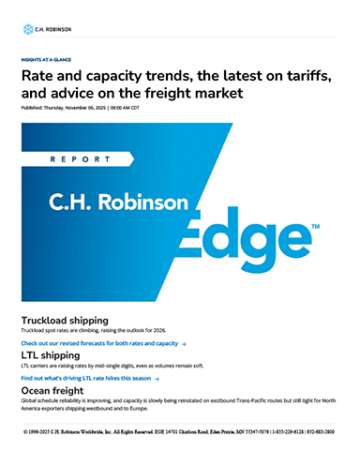
November Edge Report: What’s shaping freight now
December 2, 2025
Stay informed and ready for what’s next with the November Edge Report from C.H. Robinson.
Turning Border Challenges into Advantages
December 2, 2025
When a major automotive manufacturer faced delays and high costs managing freight from more than 30 vendors in Mexico, Averitt delivered a streamlined cross-border solution.
Examining AI’s role in modernizing the freight procurement process
December 2, 2025
Are manual processes in freight procurement costing you time and money? It's time to bridge the gap and embrace a modern, AI-powered approach.
U.S. Chamber of Commerce-led letter to USTR reiterates support for USMCA
December 2, 2025
The letter added that USMCA ensures U.S. manufacturers, farmers, and service providers can continue to access the Canadian and Mexican markets, while also noting that it guarantees that virtually all U.S. exports enter these markets tariff-free, while also helping American companies and their employees compete in the country’s top two export markets.
2026 Freight Market Outlook: Key trends & insights
December 1, 2025
Four considerations for your supply chain strategy
Q3 intermodal volumes see annual gains, reports IANA
December 1, 2025
Total loadings, at 4,757,324, increased 2.8% annually, hitting its highest level since the second quarter 2021.
2025 in Review: Uncertainty amidst a new brand of chaos
December 1, 2025
2025 delivered a near repeat of 2024's volatility, with tariffs, uneven demand, political uncertainty, and shifting trade dynamics leaving logistics managers stuck in a constant state of reaction. Across every mode—trucking, intermodal, rail, ocean, parcel, and shipper operations—experts point to the same themes: excess capacity, fragile confidence, tariff-driven distortion, and a growing reliance on technology as the industry waits for clarity that never quite arrives.
Manufacturing declines for the ninth consecutive month, reports ISM
December 1, 2025
The report’s benchmark reading, the PMI, registered a reading of 48.2 (a reading higher than 50 indicates growth), down 0.5% compared to October, contracting, at a faster rate, for the ninth consecutive month, with the overall economy growing, at a slower rate, for the 67th consecutive month.
2025: Groundhog Day all over again
December 1, 2025
The logistics industry enters 2026 feeling a strong sense of déjà vu, as shifting tariffs, uneven freight markets, and persistent uncertainty left many managers reliving the same disruptions throughout 2025. Yet amid the volatility, technology—especially AI—offers a path forward, and those willing to adapt, rethink partnerships, and invest in smarter tools will be best positioned to navigate the chaos ahead.
Emerging trends in logistics technology adoption
December 1, 2025
Companies worldwide are accelerating their adoption of advanced logistics technologies—from cloud platforms and control towers to generative and agentic AI—as they push toward higher levels of automation, autonomy, and real-time decision-making. Yet with markets, industries, and regulatory environments maturing at different speeds, success hinges on strong data foundations, selective tech investment, and a phased roadmap that builds from analytics and automation toward predictive and fully autonomous logistics capabilities.
Looking at the impact of tariffs on U.S. manufacturing
November 26, 2025
Six months into the latest tariff wave, the US faces a widening gap between policy-driven optimism and the real-world challenges of restoring competitive, resilient domestic manufacturing.
UP CEO Vena cites benefits of proposed $85 billion Norfolk Southern merger
November 25, 2025
In a speech at last week’s RailTrends conference in New York, Union Pacific Railroad CEO Jim Vena made the case for Union Pacific’s historic proposed $85 billion merger with Norfolk Southern, in advance of the company submitting its merger application to the Surface Transportation Board.
Proposed Union Pacific-Norfolk Southern merger draws praise, skepticism ahead of STB Filing
November 25, 2025
With an expected December 1 date for the application regarding the historic $85 billion proposed merger between Class I railroad carriers Union Pacific and Norfolk Southern, there was no shortage of opinions regarding the deal at the RailTrends conference.
National diesel average is up for the fourth consecutive week, reports Energy Information Administration
November 25, 2025
With a 3.1-cent gain, the national average came in at $3.868, for the week of November 17.
Domestic intermodal holds key to future growth as trade uncertainty and long-term declines persist, says intermodal expert Larry Gross
November 24, 2025
The state of the North American intermodal market could be described as somewhat bifurcated, based on a presentation at last week’s RailTrends conference in New York by noted intermodal expert Larry Gross, president of Gross Transportation Consulting.
Railroads urged to refocus on growth, reliability, and responsiveness to win back market share
November 24, 2025
In a wide-ranging presentation at the RailTrends conference in New York last week, Adriene Bailey, partner and head of the North American Rail Team at Oliver Wyman, offered up detailed insight and analysis on various topics impacting the North American freight railroad market.
Q&A: Ali Faghri, Chief Strategy Officer, XPO
November 24, 2025
Logistics Management Group News Editor Jeff Berman recently interviewed Ali Faghri Chief Strategy Officer at Greenwich, Conn.-based national less-than-truckload (LTL) carrier XPO. Faghri provided Berman with a detailed overview of the LTL market, economic conditions, and how XPO is leveraging AI, among other topics, in the interview below.
Sizing up reasons for why 2026 demands a new freight playbook
November 20, 2025
High-value cargo and volatile trade conditions are reshaping freight management, demanding a shift from reactive tracking to proactive, data-driven control.
European shippers expect disruptions to last two more years, states Maersk survey
November 19, 2025
Companies are responding by diversifying sourcing and looking for new trade routes.