Key characteristics of emerging digital supply networks
The article discusses the rapid evolution of digital supply chains, highlighting how technological advancements and AI are transforming supply chain performance by enabling real-time data utilization, connected networks, and optimized decision-making.

“The future ain’t what it used to be,” opined Yogi Berra.
In the current climate, this seems more true than ever, with much uncertainty, chaos, conflict, and polarization on many fundamental issues.
This was borne out with the onset of the pandemic, which illustrated the brittleness and fragility of supply chains around the globe. Of course, supply chains hadn’t been truly stress-tested in the way they were with the global pandemic crisis.
When I started in the railroad business as a brakeman in 1969, supply chain technology relied on Telex machines, rotary-dial phones and the U.S. Mail. Field “communications” were all manual. We had five-man crews and, when switching in yards, we walked the car tops to pass signals by hand or by lantern.
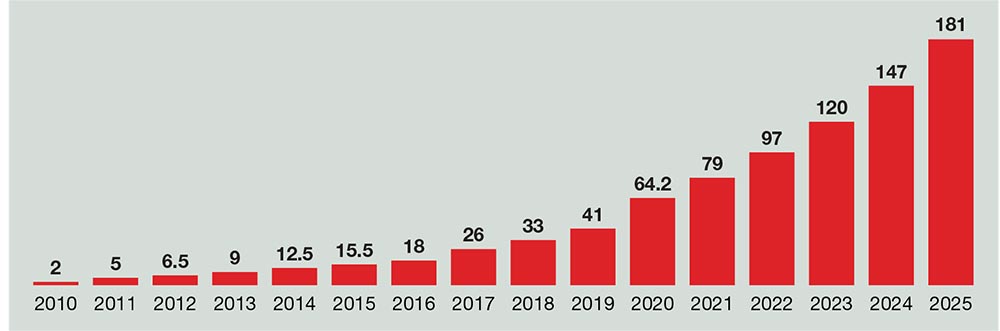
In the intervening period, we’ve made great leaps forward, with the size and speed of technological innovation amping up capabilities at a furious pace. A Forbes report from 2020 said that the digital universe had reached 44 zettabytes (44 trillion gigbytes) or 5,200GB for every person on earth. They projected this universe doubling in size every two years.
Well, it reached 97ZB in 2022 and, as of this past July it’s at 147ZB, a fairly astounding level of growth, with no apparent end in sight.
The sharp edge of this becomes duller when you examine the use of all this data. Estimates are that as little as 3% is actually tapped, with machine learning driving a large percentage of the rapid growth behind the scenes.
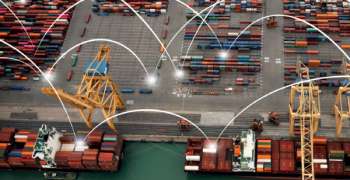
A key point in all this as that AI-enablement will be essential in accessing and analyzing such enormous piles of data in order to make use of it in the digital supply chain. It simply outstrips even a tech-enabled human’s ability to cope with it all. It’s no mystery that we’re all becoming increasingly more connected through technology.
Volume of data consumed worldwide
(Data valume in zetabytes)
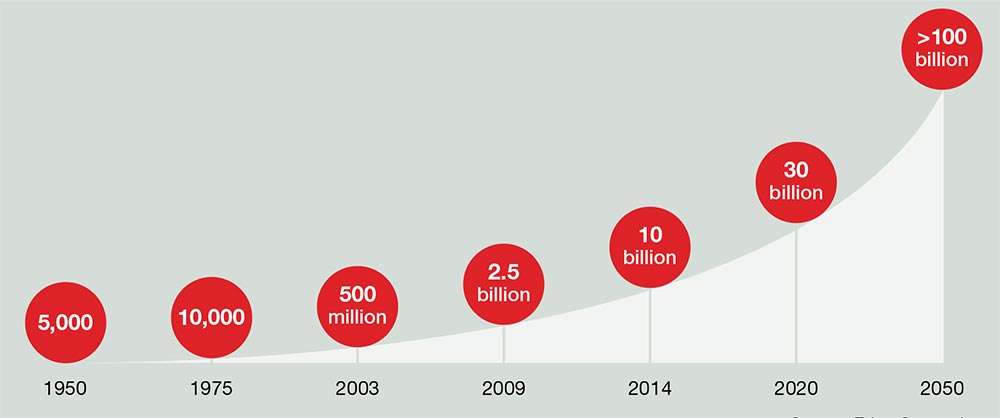
The use of such devices has rapidly advanced, as well. For example, truck drivers no longer need to pull over and use pay phones to call dispatch, or even rely on in-cab radio communication. Virtually all necessary tools are available on their hand-held devices, from traffic and weather to pick-up assignments, pay information, hours of service monitoring and performance data.
All of this is driving better supply chain performance. According to Kevin Mahoney, managing director and one of the leading supply chain practitioners at Deloitte: “New technologies and tools have driven supply chain transformations and allow the traditionally linear supply chain to collapse into an agile interconnected network that unlocks new value across the digitized nodes.”
Expected adoption rate of IoT devices
This has created better, faster, and smarter integration across capabilities and allowed organizations to achieve their ambitions:
- become more cross-functionally integrated;
- become more globally applicable, while achieving local customization;
- enable more effective user adoption;
- move closer to having a single source of truth;
- unlocked real-time supply and demand balancing;
- enable a more AI and automation-driven culture.
Mahoney points out key characteristics of emerging digital supply networks:
1. “Always-on” agility. Securely, DSNs pull together traditional datasets along with new datasets that are, for example: sensor-based; location-based; and “right-time” vs. “real-time.”
Outcome: Rapid, no-latency responses to changing network conditions and unforeseen situations.
2. Connected community. Real-time, seamless, and multi-modal communication and collaboration across the value network with: suppliers, partners, and customers.
Outcome: Network-wide insights from centralized, standardized, and synchronized data (the elusive single version of the truth).
3. Intelligent optimization. A closed loop of learning is created by combining: humans, machines, data-driven analytics, predictive insights, proactive action.
Outcome: Optimized human-machine decision making for spot solutions.
4. End-to-end transparency. Use of sensors and location-based services provide: material flow tracking, schedule synchronization, balance of supply and demand, and financial benefits.
Outcome: Improved visibility into critical aspects of the supply network.
5. Holistic decision making. Based on contextually relevant information, functional silos are now transparent and delivering parallel visibility, such as: performance optimization, financial objectives, and trade-offs.
Outcome: Better decision-making for the network as a whole.
So, the digital supply chain is already with us and growing apace. Those who figure out how to utilize the rapidly developing and proliferating tools to maximize the utility of the gargantuan gobs of accessible data will lead the pack into the future. •

Article Topics
Deloitte News & Resources
Key characteristics of emerging digital supply networks Innovation: Where we’re at in materials handling The Evolution of E-Commerce: Shaping benefits from emerging technologies Deloitte research highlights impact of trade and economy on supply chain procurement Deloitte is bullish about 2019 holiday retail sales Deloitte research highlights various drivers for slowing industrial real estate growth rates Deloitte’s industrial manufacturing outlook tracks digitalization’s steady march More DeloitteLatest in Logistics
FTR’s Shippers Conditions Index shows modest growth Trucking executives are set to anxiously welcome in New Year amid uncertainty regarding freight demand ASCM’s top 10 supply chain trends highlight a year of intelligent transformation Tariffs continue to cast a long shadow over freight markets heading into 2026 U.S.-bound imports see November declines, reports S&P Global Market Intelligence FTR Trucking Conditions Index shows slight gain while remaining short of growth AAR reports mixed U.S. carload and intermodal volumes, for week ending December 6 More LogisticsSubscribe to Logistics Management Magazine

Find out what the world's most innovative companies are doing to improve productivity in their plants and distribution centers.
Start your FREE subscription today.
December 2025 Logistics Management
Latest Resources