President Trump ends U.S.-Canada trade talks after Ontario ad criticizing tariffs sparks backlash
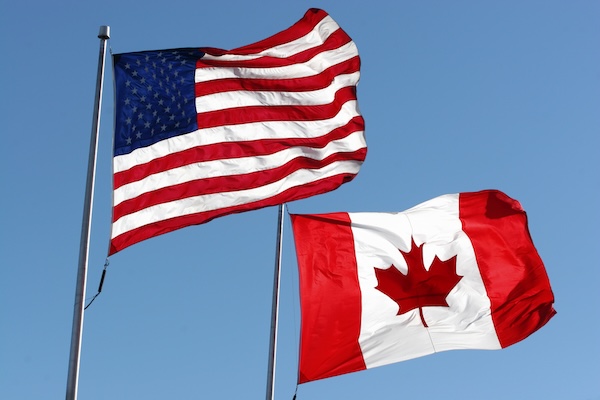
Any signs of progress being made on the trade front between the United States and its second-largest trade partner, Canada, appear to be squelched, based on a social media post issued by President Trump last night.
The reason for that is related to a television commercial airing in Canada financed by the province of Ontario, including the late former President Ronald Reagan saying that “tariffs hurt every American.”
In his social media post, President Trump stated that this commercial was released by the province of Ontario to interfere with the pending decision of the United States Supreme Court, and other courts, in regards to the legality of the White House’s usage and implementation of IEEPA tariffs.
“Tariffs are very important to the national security and economy of the U.S.A.,” the post said. “Based on their egregious behavior, all trade negotiations with Canada are hereby terminated.”
For calendar year 2024, the value of U.S. goods exported to Canada were roughly $349.9 billion, according to the Office of the United States Trade Representative (USTR), with U.S. goods imports from Canada around $411.9 billion, with total goods, comprised of imports and exports, around $761.8 billion.
As previously reported by LM, in July, President Trump stated on a social media message he sent Canadian Prime Minister Mark Carney a letter stating that effective August 1, the U.S. would charge Canada a 35% tariff on products imported into the U.S. from Canada, separate from tariffs on specific sectors. Tariffs placed on Canada by the U.S. currently include: a 25% tariff on non-USMCA goods; a 10% tariff on energy resources and potash; a 50% tariff on steel and aluminum; and a 25% tariff on autos and auto parts.
In that letter to Carney, President Trump said that the U.S. initially imposed tariffs on Canada in an effort to combat the U.S. fentanyl crisis, with Canada subsequently replying in kind with tariffs on U.S. goods imported into Canada. On March 4, Canada implemented 25% tariffs on $30 billion worth of U.S. imports, including consumer and household goods, followed on March 12, with 25% tariffs on $29.8 billion worth of U.S. goods, including steel, aluminum, tools, computers, and other items.
And in late August, Carney announced that Canada will remove various retaliatory import tariffs on United States goods that are covered under USMCA (United States Mexico Canada Agreement). This marked a shift in policy compared to the high tensions between the nations going back to when President Trump re-entered the White House in January. But with President Trump’s social media post last night, it appears that the tensions have returned.
At the time, Carney said that this move helps to re-establish free trade between the U.S. and Canada, adding that while many retaliatory import tariffs will be removed, tariffs on autos, steel, and aluminum will remain intact.
“In this context and consistent with Canada's commitment to USMCA, I am announcing today that the Canadian government will now match the United States by removing all of Canada's tariffs on U.S. goods specifically covered under USMCA,” said Carney. “Canada and the U.S. have now re-established free trade for the vast majority of our goods,” he added, reiterating that compared with its trading partners, Canadian exports were still subject overall to a low level of U.S. tariffs.”
He added that Canada’s trade negotiations with the U.S. have been taking place as the U.S. has been in the process of fundamentally transforming all of its trade relationships. The actual U.S. tariff rate on Canadian goods is 5.6%, which Carney said is “well below” the global average, with more than 85% of U.S.-Canada freight being tariff-free.
What’s more, earlier this week, Carney laid out an objective for Canada to double its non-U.S. exports over the next decade, which reports said essentially paves the way for around $300 billion in non-U.S. exports, as more than 75% of Canadian exports are currently destined for the U.S.
An Associated Press report said that the driver for this effort was because, “American tariffs are causing a chill in investment,” with Carney saying, “The jobs of workers in our industries most affected by U.S. tariffs — autos, steel, lumber — are under threat. Our businesses are holding back investments, restrained by the pall of uncertainty that is hanging over all of us. The U.S. has fundamentally changed its approach to trade, raising its tariffs to levels last seen during the Great Depression. We have to take care of ourselves because we can’t rely on one foreign partner.”

Article Topics
3PL News & Resources
Union Pacific-Norfolk Southern merger application is filed with the Surface Transportation Board FedEx posts fiscal first quarter earnings growth U.S. rail carload and intermodal volumes are down, for week ending December 15, reports AAR DAT’s November Truckload Volume Index sees more mixed results November intermodal volumes see annual decline, reports IANA USPS bets on last-mile expansion to drive revenue and enable faster delivery for retailers and logistics providers Cass Freight Index sees annual declines in November More 3PLLatest in Logistics
Union Pacific-Norfolk Southern merger application is filed with the Surface Transportation Board FedEx posts fiscal first quarter earnings growth U.S. rail carload and intermodal volumes are down, for week ending December 15, reports AAR DAT’s November Truckload Volume Index sees more mixed results November intermodal volumes see annual decline, reports IANA Looking at the state of the parcel market with Robert Persuit, Sr. Director of Business Development, ShipMatrix Teamsters Rail Conference makes its case for the Union Pacific-Norfolk Southern proposed merger to not be approved by the STB More LogisticsAbout the Author

Subscribe to Logistics Management Magazine

Find out what the world's most innovative companies are doing to improve productivity in their plants and distribution centers.
Start your FREE subscription today.
December 2025 Logistics Management

Latest Resources