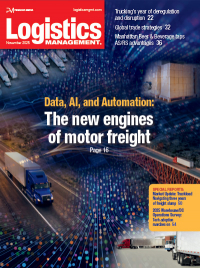
Data, AI, and Automation: The new engines of motor freight
Technology and data are helping shippers, carriers, and brokers cut costs, manage risk, and stay ahead in an increasingly complex freight market. From AI-driven routing to smarter load boards and real-time visibility, digital tools are reshaping how motor freight moves and how decisions are made.

Trucks keep rolling, but the rules of motor freight management keep changing. Shippers push for speed and savings while carriers juggle thin margins, stricter regulations and a freight environment marked by low rates and uneven demand.
And while the scales have tipped in the shippers’ favor this year in terms of available capacity and more competitive rates, the environment overall isn’t getting any easier to manage. Shippers have to control costs, carriers need to stay profitable, and freight brokers need to balance both sides in a shifting market.
With the current motor freight market presenting both challenges and opportunities, technology has become a focal point for shippers, carriers and brokers. Shippers adopt transportation management systems (TMS) to improve routing and visibility; 3PLs adopt digital platforms to coordinate across networks; and carriers use tools like real-time tracking, RFID and GPS to manage their assets.
Nathan Lease, research senior director in the logistics and customer fulfillment team at Gartner, says that companies are making steady progress with digital platforms that cut manual work and improve visibility. “One thing I’ve seen is a movement towards systematizing and automating manual tasks,” says Lease. “Driver dispatching, manual data entry and moving information from one field to another are now handled inside core software.”
Gartner’s “Future of Logistics Survey 2025” reinforces that message. High-performing companies cite efficiency gains, sharper decision-making and stronger asset utilization as outcomes of digital investments. Lease says culture plays a role too, with organizations that align people and processes to their technology seeing the greatest benefit.
Automation and AI add another layer. Lease points to machine learning, analytics and AI-enabled devices such as cameras, RFID tags and GPS trackers as tools that expand accuracy and speed. “I see AI advancing, but not in full motion yet,” he says. “For now, most companies focus on practical steps that give managers clearer data to act on.”
Gartner’s survey also shows that some companies are pulling ahead while others lag behind. Lease says that high performers report stronger returns—while others struggle to capture the full value of their systems.
“One of the top challenges we saw was limited value realized from existing technology investments,” explains Lease. “For some, the gap isn’t about the tools themselves but about how organizations prioritize and support digital initiatives.”
Balancing spot, contract freight
Angela Acocella, Ph.D., research scientist at the MIT Center for Transportation and Logistics (CTL), says this shift marks a structural change in how freight is managed.
“Historically you’d see about 5% of volume going directly to the spot market,” Acocella explains. “During COVID, that went up to 10%, and it hasn’t gone back down.” Shippers now need systems that can weigh contract against spot dynamically instead of treating the spot market as a short-term fallback.
That evolution is putting new demands on TMS platforms. Acocella says shippers are turning to digital tools that can produce dynamic price quotes, integrate more seamlessly with broker platforms, and offer autonomous or AI-driven procurement.
The goal is to make spot freight a strategic lever rather than an emergency option. For example, tools that weigh cost, capacity, and service levels in real time give shippers the flexibility to adjust quickly as conditions shift.
Visibility tools also play a role here, though Acocella notes that much of the early adoption on that front happened years ago. Larger companies with clean, well-structured data have advanced visibility platforms in place, while smaller carriers and logistics providers often face obstacles. “Smaller companies struggle to access these tools because of how their data is stored or configured,” she says. “That makes it harder for them to realize the benefits.”
There are signs of progress for those smaller shippers. For example, Acocella points to solutions that help smaller and mid-sized companies measure their digital maturity and identify steps toward improvement.
Over the past three to four years, more providers have started offering diagnostic tools that show companies where they stand and what they need to do to reach a baseline level of capability.
Going forward, Acocella expects predictive technologies for freight management to become more targeted. The focus will not only be on replacing contracts or spot freight, for instance, but also on applying AI where it makes the most sense. “There’s still some hesitancy from shippers because they don’t always see the value,” Acocella adds. “The value comes when AI is applied to the right parts of a network.”
Risk management tools
Insurance isn’t necessarily the first thing that comes to mind when people talk about freight management, but it plays a bigger role than many realize.
Brian Fish, senior project manager at St. Onge Co., says that it’s surprising how often shippers move freight without confirming a carrier’s coverage. “It blows us away when we hear companies tendering freight to carriers that may or may not have their insurance qualifications up to snuff,” Fish says. “The risk is real, and too many shippers overlook it.”
The good news is that most TMS platforms come with tools that flag carriers when insurance information is missing or outdated. Brandon Hamilton, systems project manager for TMS/Transportation at St. Onge, says that more shippers are using those functions instead of relying on spreadsheets or manual checks. “Most TMS platforms have a baseline carrier management tool that will do that type of work,” he explains.
Independent providers also add another layer of protection. Registry Monitoring Insurance Services (RMIS) specializes in verifying carrier insurance, safety ratings and operating authority, while newer entrants like Highway offer identity verification and fraud prevention.
Hamilton says the latter had gained traction as shippers and brokers work to guard against “double brokering” (when a load is illegally re-brokered under false pretenses, often by fraudulent actors posing as carriers) and fraudulent setups that can put loads at risk.
“Over the last couple of years, Highway in particular has made a niche for itself,” Hamilton says. “It not only helps reduce liability, but also identifies fraudulent carriers as they try to slip into a network.”
As fraud schemes grow more sophisticated, shippers are paying closer attention to carrier compliance. Technology makes it easier to verify information in real time and avoid gaps that could put loads and relationships at risk.
“These systems give shippers confidence,” Hamilton says. “They know the carriers they’re working with are legitimate and properly covered, and can reduce unnecessary exposure.”
Smarter load boards, routing
Advances in load board automation are reshaping how carriers handle freight, and that shift matters to shippers. Instead of manually scanning for opportunities, carriers now use platforms that evaluate and bid on thousands of loads at once. The process reduces wasted time, speeds up transactions and creates more accurate pricing.
“Software helps carriers be more automated,” says Hamilton. “One person can bid on thousands of loads at a time and manage it from a higher level.”
For shippers, the payoff shows up in more consistent service and sharper rates. Routing tools that reduce deadhead miles give carriers better margins, which lowers pressure to pass along added costs.
“When you take a midsized carrier and reduce its deadhead mileage, you really improve profitability,” says Hamilton. “Going forward, the technology is only going to get better at helping networks work together more efficiently.”
The future?
The future of freight management looks bright, and much of that optimism comes from how data and technology are reshaping the industry.
Instead of reacting to market swings, more companies are starting to predict them and adjust earlier. The shift doesn’t happen automatically, though. It takes deliberate investment in data and in the systems that can turn that data into useful insight.
Acocella says the companies that make those investments will pull ahead. “It’s really the shippers who are investing in the data that are going to be the ones that can fully capture that value,” she explains. “Those organizations on the forefront of technology, looking at potential solutions and how they fit, are the ones that will capture that value more than others.”
Lease also stresses that digital freight management can’t succeed in a silo. Decisions about TMS, visibility or AI tools ripple across finance, operations and customer service. Shippers also shouldn’t treat freight technology as an IT project alone.
Bring people together across functions, Lease recommends, and you’ll be able to get consistent results and turn digital transformation into lasting advantage. “You need cross-functional collaboration to really deliver on the value of these investments,” he says.
Looking ahead, Lease says that the road ahead for freight management won’t be defined by flashy tools, but by how well companies connect people, processes and technology. Vendors continue to push AI, automation and advanced analytics, but shippers first need a solid foundation to capture lasting value.
“If you don’t bring all three—people, processes and tech—together, you won’t get the results,” adds Lease. “The only way to make digital transformation stick is to ground in that balance.”

Article Topics
Gartner News & Resources
Data, AI, and Automation: The new engines of motor freight Revolutionizing SCM Software: Real-time visibility, AI, and seamless integration 2025 YMS Update: How yard management systems are transforming the modern supply chain Evolution of the Connected Supply Chain: ERPs lead the charge with smart tech Gartner examines how supply chains are embracing the future AI in Supply Chain Software: Opportunities, Challenges, and the Future of Automation Gartner assesses ways to prepare supply chain for the Israel-Iran fallout More GartnerLatest in Logistics
Looking at the impact of tariffs on U.S. manufacturing UP CEO Vena cites benefits of proposed $85 billion Norfolk Southern merger Proposed Union Pacific-Norfolk Southern merger draws praise, skepticism ahead of STB Filing National diesel average is up for the fourth consecutive week, reports Energy Information Administration Domestic intermodal holds key to future growth as trade uncertainty and long-term declines persist, says intermodal expert Larry Gross Railroads urged to refocus on growth, reliability, and responsiveness to win back market share Q&A: Ali Faghri, Chief Strategy Officer, XPO More LogisticsAbout the Author

Subscribe to Logistics Management Magazine

Find out what the world's most innovative companies are doing to improve productivity in their plants and distribution centers.
Start your FREE subscription today.
November 2025 Logistics Management
Latest Resources