Tariffs, trade, and uncertainty drive supply chain strategy shifts, notes CSCMP EDGE panel
Executives from C.H. Robinson, Dollar General, and Inpro discuss nearshoring, China+1 missteps, and the real-world impact of evolving tariff policies on sourcing decisions.
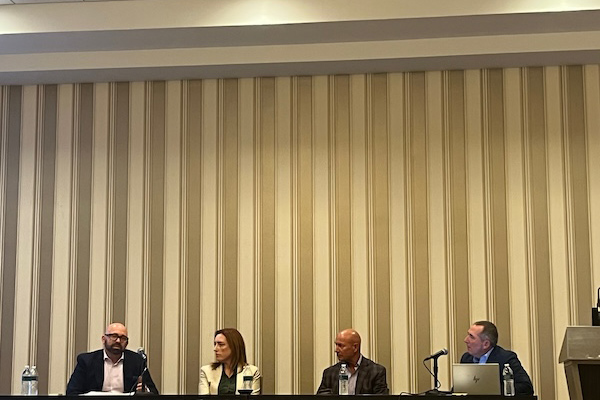
A session at this week’s Council of Supply Chain Management Professionals (CSCMP) EDGE conference in National Harbor, Maryland addressed various aspects related to the current state of the freight market, including the impact of various freight recessions, above-average inventory levels despite efforts to reduce them, the importance of maintaining shipper-provider relationships, as well the impact of tariffs, and other topics.
The session, entitled, “Trade, Tariffs, and Turbulence: Building Resilient Supply Chains,” featured Michael Castagnetto, President, North American Surface Transportation, at global 3PL C.H. Robinson, Chelsea Morris, Vice President of Global Inbound Transportation, at national discount retailer Dollar General, and Michael Sekula, Vice President of Global Supply Chain, at Inpro, a building products manufacturer. Ken Hoexter, Managing Director, Senior Transportation Analyst, at BofA Securities, served as moderator.
Looking at the ongoing freight recession, which moderator Hoexter observed has been intact for the past 3.5 years, he said this one is longer than the 54-week average seen in previous freight recessions in 2015-2016, 2019, and in 2020 during the pandemic, with inventories still heavy from an aggregate perspective, notably for retailers, industrial shippers, and manufacturers, which he said is not ideal as lighter inventories coming out of downturns are preferable, coupled with over-the-road capacity exiting the market.
When asked about where things stand in the current freight cycle, C.H. Robinson’s Castagnetto said that the first few years of the current freight recession were probably more capacity-driven, in terms of waiting for the excess trucking capacity in the market to exit.
“We've seen that start to decline, but for a lot of reasons, whether it was lack of a used truck market, banks not foreclosing on trucks, lot of money left over from the stimulus funding, they really didn't exit the market at the rate you normally would see during the downturn,” he said. “Over the last 12-to-18 months, we've really seen a shift to more of a demand-driven freight recession, and you see that with the Cass [Cass Freight Index] numbers starting to decelerate, as opposed to accelerate over the last couple quarters. We see this continuing for at least the foreseeable future. We'd like to see a demand uptick, whether that's in total loads per RRSP, whether it's in router degradation, but we're just not seeing it in the current numbers.”
Dollar General’s Morris explained that as a company that whose core customer base represents the lower third U.S. income level, Dollar General is focused on eliminating waste and creating as much value for customers as possible.
And she observed that in this type of environment, in which there are inflationary factors and other catalysts driving costs up, the best way to ensure her organization is driving demand is to make sure it is providing that value.
Addressing tariffs, Inpro’s Sekula said that when the White House put 50% tariffs on aluminum, it created a situation in which U.S. shippers can’t import finished aluminum more cheaply than it can be manufactured in the U.S.—and it is up more than 100% since the beginning of 2025, while leaving things on the same playing ground for all stakeholders.
“But the other side of the coin is what the administration is trying to do tariffs is to bring back manufacturing,” he said. “We were importing aluminum products from China, and a lot of that did come back to the United States and is being manufactured locally. However, we don't make aluminum or enough of it in the United States. I think it’s around 10% of our own in the United States, 80% of it coming from Canada. We're not going to turn on smelters overnight, if at all, in our lifetime. So that is not going to change the game, anytime soon.
On the other side of imports, in 2016, we had a move to get everything out of China as much as possible, and we did. And then in 2022 we ended up buying a company that had another $5 million worth of imported product. So, we did move a lot of that product to Vietnam and other countries, with some of that now being tariffed as well, too. However, because the president was talking about that before he went into office, we were looking at that and saying, ‘All right, well, what is the impact of the tariffs?’ And believe it or not, with a lot of the product that we're importing from China, we had to go to a 200% tariff before becoming competitive to buy locally. And the local product that we would buy is actually worse quality than we do buy now, than the China product. The product is still coming in from China, because there isn't a better source. It's fabric so not everybody's getting into the fabric manufacturing business. Maybe that will change, maybe it won't, but right now, that's what's currently happening. We're competing with other customers that some of their products being imported, some of it's being purchased locally, some of it is being manufactured and brought over the border from Mexico, and we're competing as best as we can now.”
As for shippers are shifting their supply chains amid the uncertainty and shifts in policy, as well as how quick the market can react, Castagnetto explained that supply chains have been moving for many years prior to tariffs being implemented, especially over the last nine-to-12 months, in various ways, including things like a China plan and China plus One and also a shift to nearshoring over the last 10-to-15 years that has moved a tremendous amount of where goods are produced and what supply chains need to support that production.
Over the last nine months, he observed that what has been very noticeable is the speed in which things are changing, coupled with volatility and variability making it more difficult for customers to understand how to handle different scenarios.
“The best example was a lot of companies moved from China and Vietnam, and then during the initial round of tariffs, Vietnam had higher tariffs than China, so a lot of folks who had done the China plus one strategy found themselves in a worse spot that they would have been had they just stayed in China,” he said. “What we're trying to do with customers is do a lot of scenario planning focused on what does your current supply chain look like, what are your options, where are your vendors that you could choose to, and what do the costs and the efficiencies look and then what's the timeline to set that up? Because a big fear of a lot of folks is even if you wanted to start production, it's probably four or five years away before you're doing meaningful volume production.
And there's a lot of unknowns of what does the landscape look like by the time your facility is up and running. For us, it's really helping customers pick what's the best scenario now, and the options six months-to-12 months from now. I think that's what we've learned so far, is outside of trying to predict where it will be, we can just feel pretty confident that it will be different. And what we're hearing from most of our customers is they just need some stability so they can plan around it, and then we'll figure out the marketplace. But right now, it's just been really difficult for folks to feel like they can set a plan without having to reset and reset.”
As for ways shippers can adjust inbound supply chains, Morris said that the market has different options, including moving to a different sourcing location, with a move offsetting previous instability, as well as working closely with vendors, and price increases—with the latter only as a last resort.

Article Topics
C.H. Robinson Co. News & Resources
Tariffs, trade, and uncertainty drive supply chain strategy shifts, notes CSCMP EDGE panel Global companies are planning more regional approaches to manufacturing, sellingLatest in Logistics
FTR’s Shippers Conditions Index shows modest growth Trucking executives are set to anxiously welcome in New Year amid uncertainty regarding freight demand ASCM’s top 10 supply chain trends highlight a year of intelligent transformation Tariffs continue to cast a long shadow over freight markets heading into 2026 U.S.-bound imports see November declines, reports S&P Global Market Intelligence FTR Trucking Conditions Index shows slight gain while remaining short of growth AAR reports mixed U.S. carload and intermodal volumes, for week ending December 6 More LogisticsAbout the Author

Subscribe to Logistics Management Magazine
Find out what the world's most innovative companies are doing to improve productivity in their plants and distribution centers.
Start your FREE subscription today.
December 2025 Logistics Management
Latest Resources