
NorthShore Care’s new application for autonomous mobile robots (AMRs)
NorthShore Care Supply is using AMRs to automate pick-to-cart processes, while still using the cart.

Few would argue that robots, especially autonomous mobile robots (AMR), are moving from an emerging technology to another tool in the materials handling tool kit. That is especially true in the third-party logistics (3PL) industry, where Modern has featured AMR implementations at industry leaders like DHL, GEODIS, Rakuten Super Logistics and, in the July issue, UPS.
See a detailed inside look at the moving parts of the NorthShore Care distribution center.
Those articles highlighted some of the leading AMR solution providers that are now becoming household names, including Locus Robotics, inVia Robotics and 6 River Systems. While each of those providers brings different strengths and strategies to the table, what they share in common is the problem they aim to solve: A more efficient way to do e-fulfillment in facilities handling pretty standard products in standard packaging. In that application, AMRs have evolved from the exotic to a best practice in the right environment.
So, what’s next? After recent visits to the Nashua, N.H., headquarters of Waypoint Robotics, and NorthShore Care Supply’s new 173,000-square-foot distribution center in Green Oak, Ill., I think the industry is moving to a new phase. This is one where a different set of AMRs will be deployed to address a different set of fulfillment issues, using unique products and unique packaging sizes. And, as the technology becomes more mainstream, it is also now in reach of small to mid-sized organizations and not just industry giants. You may not put a $1,000,000+ multi-shuttle in a mid-sized company’s DC, but you can now implement AMRs. 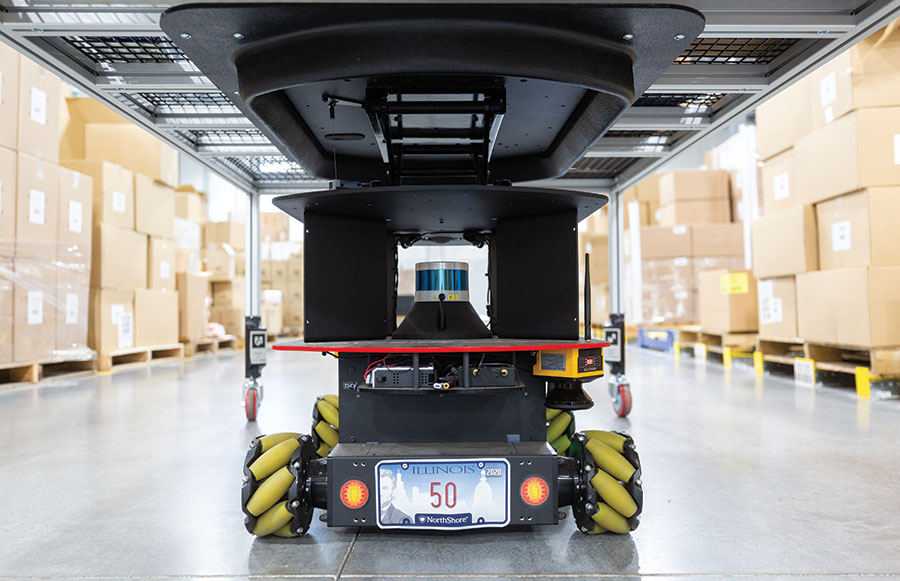
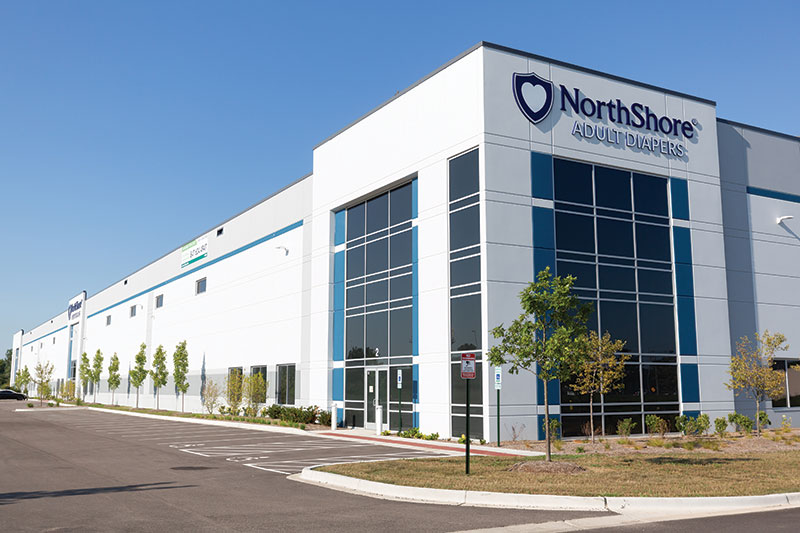
NorthShore Care Supply is an illustration of both those ideas. The company is the leader in the distribution of super-premium incontinence supplies and adult diapers, sold online for home delivery but also with a growing channel shipping to institutions. Either way, orders are stored at the case level rather than the unit level and mostly picked in cases, with a small percentage of item-level picks.
Given the products handled, the cases are large and bulky. And, given the urgent need for the supplies, NorthShore Care Supply’s policy is to ship the same day orders are received. Fulfillment speed is critical to make parcel carrier cutoff times. Before building the new facility, associates picked cases to three-tier carts they pushed through the old warehouse. The work was slow and demanding. 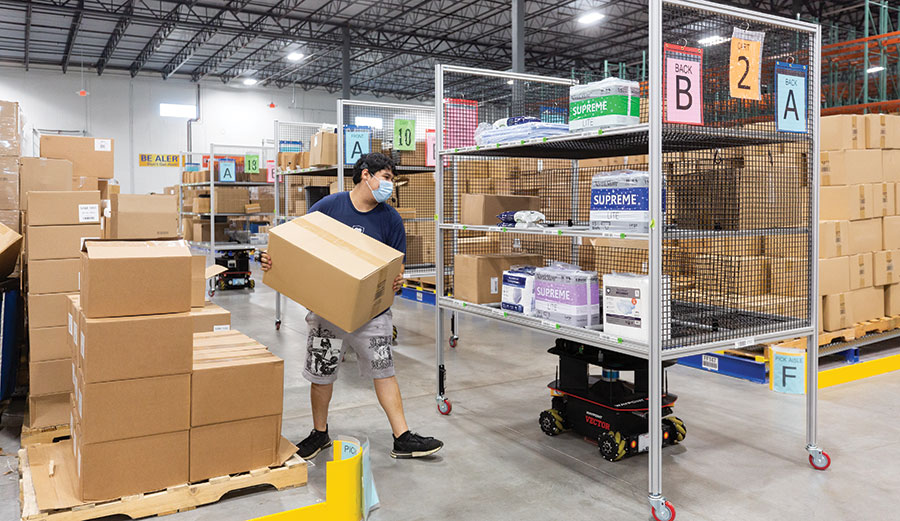
“The carts were heavy and the process wasn’t scalable to keep up with our growth,” recalls Adam Greenberg, the president, owner and founder of the company. The new facility was designed for growth but also to address the shortcomings of the old facility. But instead of replacing carts, NorthShore Care Supply found a way to automate the process and move payloads of up to 700 pounds relatively quickly through the DC.
The ultimate design from NorthShore Care Supply’s solution provider (Numina Group) features AMRs (Waypoint Robotics,) capable of moving very large carts that can carry up to a 700-pound payload while keeping order selectors in designated pick areas like the more conventional AMRs we’re familiar with. A fleet of six AMRs can process approximately 3,500 orders a day. Dan Hanrahan, president of Numina Group, estimates that using a more conventional AMR solution would have required a fleet of 30 robots.
The design also incorporates floor-level pallet flow rack in the pick zones. That allows for the storage of multiple pallets of the fastest-moving SKUs that can be easily accessed by order selectors and easily replenished from the rear as needed.
The solution is delivering on Greenberg’s goals for the facility, which were to design for growth, reduce the need for labor, and reduce the number of touches of the product. That’s become more important during the Covid-19 pandemic, given the intimate nature of the products handled.
“We wanted to be leading edge, not bleeding edge,” Greenberg says of the decision to implement the robots. “We don’t want to be the first use case for a technology, but we do very well with companies that have a leading technology looking for another site to Beta test and further validate their technologies.” 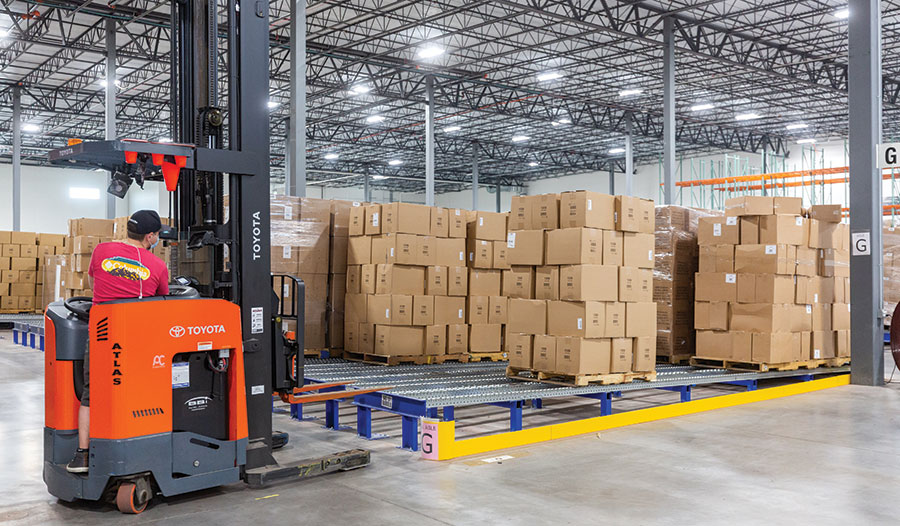 The pick module features floor-level pallet flow rack for fast-moving products.
A better product
Incontinence afflicts millions of adults and children. If that wasn’t the case, grocery and drug stores wouldn’t devote entire aisles to the category. Anyone with elderly family members and friends undoubtedly knows someone in need of adult diapers, whether for a night-time issue or one that affects them around the clock. At the same time, it’s a condition that most of us prefer not to talk about, which means that for many, essential supplies are an embarrassing purchase many prefer to avoid. At least in a store.
That realization led Greenberg to found NorthShore Care Supply in 2002. At the time, he was working on his MBA at nights and on the weekends at the University of Chicago and looking into a startup venture. He learned about the need for and embarrassment around incontinence products from two family members. “One was reluctant to buy products at the grocery store and another was always running out of supplies,” he recalls. “It seemed that for reasons of convenience and privacy that home delivery of incontinence supplies made a lot of sense.” From that spark, the Internet-based business was launched.
Almost immediately, the business began to evolve from selling the same quality product you might find in the grocery aisle to a higher quality product with better sizing and better performance that you can’t find in your neighborhood store. “As soon as we turned the website on, we got comments from customers telling us the reasons that a product like Depends didn’t work for them,” Greenberg recalls. “We began to scour the world for higher quality products.” He also learned early on that a caring and knowledgeable customer service department was key.
“Customers call us because what they’re using isn’t working, and they don’t know what will work,” Greenberg says. “They’re frustrated, and we’re patient.”
The third revelation that shaped the direction of the company was that customers tended to order only undergarments on their first order, and not complimentary products like wipes and mattress pads. To build demand for those other products, NorthShore Care Supply launched a sample program. “Almost from the start, we threw samples in with orders and a Post-it note,” Greenberg recalls. “Customers liked having something in front of them that they could see and use.”
Since then, they have refined the process, with a questionnaire that customers can fill out and that is then evaluated by an algorithm that recommends sample products. The company sends out 100 to 200 sample orders every day in addition to adding free samples to most paid orders.
The company has also launched a subscription service to automate the re-ordering of what are essential products. Today, the average order is about three picks with a $100 value. That might consist of a large carton of diapers and a smaller box with two to four trial sample items to try.
From a distribution standpoint, the company worked closely with FedEx to develop services that could compete with Amazon. A first step was putting in place processes so orders could be picked and shipped the same day they were ordered; that was followed by weekend pickups and then seven-day-a-week deliveries. Instead of positioning inventory in multiple facilities around the country, “one central U.S. distribution center is viable for us.” The subscription model creates more predictable demand and reduces the number of rush orders.
Over time, the company outgrew four facilities before the new DC went live in March 2020. The immediate predecessor was an 86,000-square-foot facility located about 10 miles away. It featured the shipping conveyor and print-and-apply line being used in the new facility, but no system-directed processes—no voice or bar code scanning, and no pallet flow rack. And, no robots, of course.
Order selectors picked to a smaller cart than is being used in the new facility, and picking was often in conflict with replenishment in the same aisle, which meant disrupting one to complete the other. With sales growing by 30% a year and a lease set to expire in the former facility, Greenberg realized it was time to “move into a facility with an infrastructure that can scale up to handle many times our current sales volume as our brand awareness increases.”
In 2019, Greenberg met with the Numina Group at ProMat. Together, they toured the show, looked at the available technologies and began the process of designing a new facility.
A new design
Design got underway following that meeting at ProMat. Greenberg knew he wanted a solution that could scale to meet the company’s anticipated growth over the next 7 to 10 years—currently, about 40,000 square feet is available to sublet. He also wanted a solution that would allow him to manage current order volumes on one shift; that would allow adding a second shift at a later date without expanding the facility.
Last, he knew then that reducing touch points was important: In 2018, during the design stage, that was more related to the availability of warehouse labor in Chicagoland, but now, during Covid-19, reducing the number of times an essential medical supply is touched is an unexpected benefit.
While at ProMat, Greenberg had looked at numerous alternatives to manual push carts, including tuggers, automatic guided vehicles (AGVs) and AMRs. While he didn’t know what was the right technology, Greenberg knew that the new facility needed automation in order to scale, and it needed to be flexible.
“We wanted the flexibility of a system that could pick up and drop off a heavy cart without an operator having to be involved,” Greenberg says. And, as noted earlier, he was willing to implement a leading-edge technology, but not a bleeding edge solution.
The design study lasted between 6 and 9 months. The task was to present multiple, alternative designs. The first design used a multi-level pick module. That design was rejected. The second design was conventional, using pick-to-cart optimized through a better layout and voice technology and bar code scanning. Greenberg felt that was too much like the facility he was trying to move away from.
Conventional AMRs were ruled out because they would either require too large a fleet moving a few cartons at a time—one estimate was up to 30 robots.
“We knew we were going to use a cart,” recalls Numina Group’s Hanrahan, “and it would have to hold at least 500 pounds, and we speced it at 700 pounds. That meant we were looking at vehicles that could move pallet loads.”
AGVs could handle the anticipated payloads but they were ruled out as too hard to add extra AGVs in the future as the business grew.
Still on the search for a solution, Hanrahan came across Waypoint Robotics on the second or third page of a Google search. Following a telephone call with the company’s founder and a trip to New Hampshire to see the robots in action in the company’s tech center, they felt they had a solution ready to move forward.
Hanrahan was particularly impressed by the depth of functionality in Waypoint Robotics’ software and the experience of the engineering team. “They had at least five people who had worked on two other robots before this one,” he recalls.
One of the first steps was to design a large cart on wheels that could be picked up by the robot and transported to a pick location or a pack station. NorthShore wanted the biggest cart it could get, Waypoint wanted the smallest and Numina balanced the two. Because the carts are on wheels, the facility can revert to system-directed manual picking if the automated system goes down.
The next step was designing processes that minimized the required labor at current volumes. Based on initial modeling, the design team anticipated six order selectors in the pick zones. Greenberg wanted to minimize the amount of labor—with the current design and software, the facility operates with four order selectors for a few hours on peak days, but the usual requirement is two order selectors.
Another key to the design was maximizing storage space, not just in the reserve storage area but in the pick modules. Most e-commerce companies have a small representation of a large number of SKUs. NorthShore is the opposite of that, with a high representation of just 400 SKUs.
To maintain enough inventory in the pick zone of the fastest-moving SKUs, pallet flow rack was installed on the floor. That allows NorthShore to index multiple pallets of those SKUs.
Once order fulfillment gets underway, the warehouse management system (WMS) drops a group of orders, including the weight and cube of the cartons. Priority orders are also flagged. With that information, Numina Group’s warehouse control system batches the order to generate the highest pick density in a zone with least amount of travel for the robots and order selectors. Multiple robots are dispatched at a time.
When a robot is in route to its first pick location, an order selector is also dispatched to the location by the voice system—another new innovation for the company. Picks are confirmed by a ring scanner. The order selector follows the robot as it moves to subsequent pick locations until all of the picks in that selector’s zone are complete.
Meanwhile, the next robot for that zone is queued at a pick location. Greenberg says his fastest selector can do 300 picks per hour, but the typical rate is 175 picks per hour. Just the addition of voice and bar code scanning improved the accuracy of picks and led to a significant improvement in speed.
According to Greenberg, temporary workers were concerned about the impact of automation on their jobs, but given the number of distribution centers in his area, temp workers are nomadic. “Our long-term staff knows our company values are to go above and beyond in everything we do,” he says. They were eager to be part of the process, and they continue to give us ideas to improve our processes.”
With nearly five months of operational experience at the time I visited the facility, Greenberg says the company is relying less on temporary labor as well as some attrition from associates who chose not to make the move to the new location. Still, the boxes moved per labor hour has greatly improved and the number of returns due to picking errors has been reduced.
Perhaps the biggest benefit has been the control of fulfilling all orders out of one central facility rather than rely on 3PLs to ship to some parts of the country. “We have control over all of our sales channels, including Amazon Prime,” he says, noting that they are an Amazon-certified Prime warehouse. “We can ship our Amazon Prime orders directly from here, and bypass Amazon’s warehouses,” he says. “I’m not aware of any of our competitors who can do that.
System suppliers
- System design & integration, voice recognition, warehouse control system, and print & apply: The Numina Group
- Robotics: Waypoint Robotics
- Motor driven roller conveyor: TGW
- Extendable conveyor: Caljan
- WMS: NorthShore Care Supply
- ERP: Syspro supported by BT Partners
- Mobile computing & bar code scanning: Zebra Technologies
- Pallet rack: Ridg-U-Rak
- Pallet flow and carton flow rack: Mallard Manufacturing
- Shelving: Western Pacific Storage Solutions
- Lift trucks: Toyota Material Handling

Article Topics
Warehouse News & Resources
PwC report indicates transportation and logistics dealmaking activity is focused on strategy, not scale ASCM’s top 10 supply chain trends highlight a year of intelligent transformation Federal Reserve moves forward with its third consecutive rate cut IKEA moves more manufacturing to U.S. as tariffs raise costs Logistics growth sees mild decline in November, states LMI DHL’s 2025 Peak Season approach includes more planning and less panic Services economy remains on growth track in November, reports ISM More WarehouseLatest in Logistics
PwC report indicates transportation and logistics dealmaking activity is focused on strategy, not scale ShipMatrix reports strong Cyber Week delivery performance results National diesel average falls for the fourth straight week, reports EIA FTR’s Shippers Conditions Index shows modest growth Trucking executives are set to anxiously welcome in New Year amid uncertainty regarding freight demand ASCM’s top 10 supply chain trends highlight a year of intelligent transformation Tariffs continue to cast a long shadow over freight markets heading into 2026 More LogisticsAbout the Author

About the Author
Subscribe to Logistics Management Magazine

Find out what the world's most innovative companies are doing to improve productivity in their plants and distribution centers.
Start your FREE subscription today.
December 2025 Logistics Management

Latest Resources












