
Coastal Pet Products transforms its inventory management processes
Lacking real-time visibility and saddled with manual processes, a growing pet product manufacturer partnered with a WMS provider to improve productivity, streamline inventory management, and scale without increasing headcount.

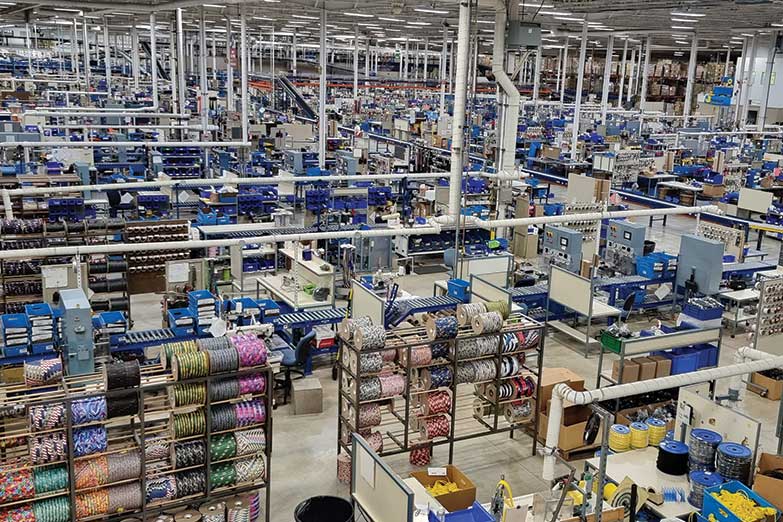

Founded in 1968 by a pair of brothers who started out with $300 and some extra space in the basement, Coastal Pet Products has been making premium pet products in the United States for the last 55 years. Jim and Tom Stout started out making collars and leashes, but soon expanded their product line to include harnesses, beds, toys, treats, and other pet-related products.
With pet ownership in the United States increasingly significantly over the last three decades, the Stouts were onto something when they launched their startup from a basement. As of 2023, 66% of U.S. households (86.9 million homes) own pets. According to Forbes Advisor, 78% of pet owners welcomed their new furry family members into their homes during the pandemic.

These are all positive trends for a company that’s made a name for itself serving the needs of pet owners nationwide. But managing growth isn’t always easy, particularly in the midst of an ongoing national labor shortage.
With 6,000 saleable stock keeping units (SKUs), Coastal Pet Products ships out about 90,000 items per day from its 400,000-square-foot warehouse in Alliance, Ohio. Managing that order volume, reconciling inventory quantities and ensuring ample stock to cover orders was becoming increasingly more difficult as the company grew.
“Doing cycle counts was difficult because we lacked real-time visibility into our storage locations,” says Steve Caruso, project manager. “Also, the delivery paths we used to take product from our warehouse to our production lines were inefficient.”
Because the company had no inventory backup locations, it would put items in totes destined for forward picking locations. Those totes were often stored on the floor until they were needed.
“As the pick locations depleted, our associates had to track down the correct totes and use them to fulfill at the pick locations,” Caruso explains. “We were wasting a lot of time trying to track down inventory that should have been stored in a specific location. We just didn’t have the space for it or the system to manage that.”
Physical searches, manual label printing
Coastal Pet Products’ inventory challenges didn’t end there. The company also had no directed put-away capabilities for inbound shipments. “We had to physically search for open locations when we unloaded trucks—that took a lot of time,” says Caruso.
And because the company prints custom UPC labels on each of its outbound products, it was printing those labels in advance, sorting the labels by region and then distributing them to the pickers. The pickers then had to carry the labels around with them as they picked—and applied the labels to—the products.
To manage its operations, Coastal Pet Products uses the Infor (JBA) System21 enterprise resource planning (ERP) system. When it purchased the ERP in 1999, the company also rolled out the system’s built-in warehouse management module (WMS).
“Our WMS didn’t have much functionality, so we struggled with inventory management, inventory accuracies and the basic best practices of running a warehouse,” says Caruso. “We ended up purchasing the Vocollect [now Honeywell] voice add-on that acted kind of as a makeshift WMS for us.”
“Doing cycle counts was difficult because we lacked real-time visibility into our storage locations…Also, the delivery paths we used to take product from our warehouse to our production lines were inefficient.”
Because the company never implemented “a true WMS,” it continued to struggle under the weight of its inventory management challenges. As Coastal Pet Products added new products to its lineup and more distributors/retailers to its network, the company’s inventory management woes increased exponentially.
Everything clicked
Coastal Pet Products knew that a change was in order, so it started looking around for a WMS that could both manage its growing order volumes and integrate with its existing systems. According to Dana Duff, IT manager at Coastal, the company evaluated Infor’s WMS and the PkMS WMS before selecting Indigo Software’s WMS solution.
Duff says that one of the deciding factors was the solution provider’s in-depth knowledge of Coastal Pet Products’ existing ERP system. “Not only did Indigo have the knowledge and programming skillset, but they also had the connections in place between their software and our ERP system,” says Duff.
Indigo’s WMS could also be integrated into Coastal Pet Products’ existing voice setup for both picking and put-away. When we found Indigo,” Duff adds, “everything just seemed to click.”
Accurate inventory counts wanted
Today, Coastal Pet Products has the real-time inventory tracking capabilities that it previously lacked. Its pickers wear mobile printers that allow easy generation of custom UPC labels for every product (a capability that the company refers to as “warehouse light”).
The company is using voice for both picking and put-away, both in its raw material warehouse and in its forward finished-goods picking areas.
“We’re able to do on-the-fly cycle counts very easily, and that’s driven us to use a new set of best practices [i.e., getting team members to follow specific inventory-related procedures],” says Caruso. “As a result, our inventory counts are much more accurate—that was a big win.”
Coastal Pet Products is also using its WMS to manage inbound shipments. As trucks are unloaded, the system tells associates where the merchandise should be placed in the facility. And while that capability is fairly basic, Caruso says it has been yet another important win for an organization that previously lacked directed put-away capabilities.
Today, the voice system tells the associate where to pick the order. The pick is then confirmed and the custom labels are automatically generated by the mobile printer on their belt. The labels are affixed to the product, which is then put into the tote and packed for shipping.
“Not only is our inbound and outbound process streamlined,” says Caruso, “but we also now have reliable, real-time inventory tracking that we didn’t have before.”
Once in place, the WMS immediately began producing the following additional benefits.
Improved inventory management. The company started using real-time cycle counting and perpetual inventory management. As soon as products are picked, the operation is linked back into the cycle counting process and stock number changes immediately register in real time as a works order booking.
Automated overstocks tracking. Coastal Pet Products is using location-driven replenishment to key pick points. The WMS drives the whole process, directing pickers towards the relevant totes to complete an order. This has created major time savings compared to the company’s
previous, manual system.
Automated accuracy checks. The WMS builds quality checks into each order. The software requires each stage to be validated, which means mistakes are identified very quickly and incorrect orders never end up in the dispatch area.
Reduced waste. Coastal Pet Products was previously generating rolls of labels in advance of picking orders, regardless of whether the items were required. With the WMS, pickers use their mobile devices and mobile printers to generate labels on demand, creating substantial labor savings and reducing consumables waste during bulk print runs.
Picking the right partner
As Coastal Pet Products’ IT manager, Duff says he was particularly impressed with Indigo Software’s knowledge of System21 and its experience using the system. “That level of expertise really facilitated the initial implementation and interface discussion that we had with Indigo,” Duff recalls. “That removed a whole layer from the discovery process.”
Any issues that surfaced during the WMS implementation process were handled quickly, according to Duff, and the end result was a system that perfectly fit Coastal Pet Products’ needs. “We’ve had very little downtime at all, and their help desk and support have been great,” says Duff, who especially liked how Indigo was able to provide the integrations between its existing platforms and its new solution.
“Right from the outset we felt very confident that choosing Indigo as our WMS technology partner meant we would minimize implementation risks and maximize business continuity,” says Duff, who is now managing the manufacturer’s migration to the Oracle NetSuite ERP, which will go live during the first quarter of 2024.
“Indigo Software’s consulting team quickly developed an in-depth understanding of our business and how processes could be improved using their WMS technology, plus we are very reassured by Indigo’s ERP integration capabilities, which had been proven across many reference sites.”
Speaking to other growing manufacturers that are dealing with inventory management challenges, Caruso says his advice is to just do it now. “We procrastinated a bit when looking for a solution,” he adds, “but looking in the rearview mirror now, I can say I wish we would’ve started it earlier.”

Article Topics
WMS News & Resources
Despite billions invested, supply chain technology is still falling short, says DHL report 3PLs in the Fast Lane: Meeting the e-commerce surge with tech, scale, and smarts Revolutionizing SCM Software: Real-time visibility, AI, and seamless integration Tech-Clarity’s Warehouse Management Systems Buyer’s Guide 2025 Gartner® Magic Quadrant™ for Warehouse Management Systems Stord announces acquisition of UPS subsidiary, Ware2Go GXO and Blue Yonder herald new multi-year agreement More WMSLatest in Logistics
FTR’s Shippers Conditions Index shows modest growth Trucking executives are set to anxiously welcome in New Year amid uncertainty regarding freight demand ASCM’s top 10 supply chain trends highlight a year of intelligent transformation Tariffs continue to cast a long shadow over freight markets heading into 2026 U.S.-bound imports see November declines, reports S&P Global Market Intelligence FTR Trucking Conditions Index shows slight gain while remaining short of growth AAR reports mixed U.S. carload and intermodal volumes, for week ending December 6 More LogisticsAbout the Author

Subscribe to Logistics Management Magazine

Find out what the world's most innovative companies are doing to improve productivity in their plants and distribution centers.
Start your FREE subscription today.
December 2025 Logistics Management

Latest Resources












