To Efficiently Unload Trucks, You First Need to Dance
A Winning Collaboration Between DHL Supply Chain and Boston Dynamics.
Boston Dynamics has established a reputation as one of the most innovative and advanced robotics companies in the world. Much of this reputation has grown through the many videos of its dancing robots. And, while the videos are fun, they also serve a very real purpose in spurring innovation and advancing robotic technology.
The videos, as well as Boston Dynamics’ approach to innovation, is one of the reasons DHL Supply Chain collaborated with the company to design robots for demanding supply chain applications. The strategic collaboration has resulted in the first commercial application of Boston Dynamics’ Stretch™ robot.
Innovation that makes a difference
Marc Raibert, founder and chairman of Boston Dynamics, explained it best: “An athletic performance like dance stresses the mechanical design of the robot, and it also stresses the algorithms in the software.” Teaching the robots to dance is a way for engineers to discover new potential movements and improve their balance and precision.
In a 2021 blog post, a Boston Dynamic roboticist further explained that putting together a dance video “gives developers a creative target that leads to rapid innovation in how the robot can move. Dance uncovers potential improvements in the physical design of the robot.” He referred to the dancing as a form of highly accelerated lifecycle testing for the hardware. “When we do these projects, we always have two goals. One is to use the video as motivation to improve the product. The secondary goal is to have fun making the video.”
It was this approach to automation and innovation that attracted the attention of DHL Supply Chain, a company that takes great pride in its own culture of continuous innovation.
Collaboration that is evolving the supply chain
DHL Supply Chain has a proven process we put into action when assessing and integrating leading-edge technologies to ensure they bring value to our customers. This includes a thorough examination of the available technology, as well as its operation and potential use cases throughout the entire supply chain. It’s not enough to just deploy advanced technology for one application, we need the right people in place who understand how it performs within a supply chain environment and can identify additional tasks or processes it can enhance.
As part of this process, we’ve been working in partnership with Boston Dynamics since 2018 on the development of its Stretch mobile robot for application in the warehouse. This agreement—in which DHL is the first commercial customer for Boston Dynamics’ Stretch—is the culmination of a four-year strategic collaboration between our two companies.
DHL Supply Chain provided invaluable insight on the demands of the complex supply chain environment and applications, which enabled Boston Dynamics to hone in on the needed design of the Stretch robot. At the same time, Boston Dynamics taught us a lot about how robots are developed and built.
During this process, the Boston Dynamics team visited several of our facilities to better understand the environment and processes. As they started developing prototypes of the robot, we tried them out in our operation. The Boston Dynamics team then observed the performance, took them back into the lab and made modifications. This collaborative, in-the-field development process got us from the first prototype to the actual Stretch design we have today.
Currently, the Stretch robot is designed to do carton unloading at a high rate of speed. Unloading boxes is a strenuous, physically demanding work process. There’s a lot of lifting and twisting involved for associates. By automating this process, we are removing the strenuous activity and moving our skilled labor to focus on value add, strategic tasks.
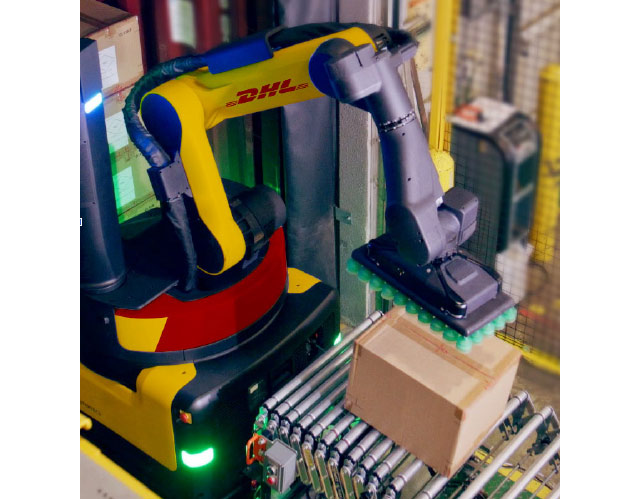
In this application, Stretch takes the package from the back of the trailer and places it on a flexible or telescopic conveyor. The custom-designed, lightweight arm of the robot has seven degrees-of-freedom, which grants long reach and large workspace to allow it to reach cases throughout the trailer or container. Advanced sensing and controls enable it to handle a variety of package types and sizes while operating at high speeds to maximize pick rates.
The robot also includes Boston Dynamics’ computer vision technology, which enables it to identify boxes easily and without any pre-programming. Stretch is capable of working autonomously through complex situations like disordered stacking configurations and recovering fallen boxes.
With this first deployment, our strategic collaboration with Boston Dynamics is only beginning. We plan to work closely to gradually scale Stretch for additional tasks and across multiple facilities over the next few years. As we progress to other use cases, we will look to integrate the robot with our warehouse management system so it can receive instructions on where to go and what to pick.
We will also continue to work together to use the experience and insight gained to continue our strategic collaboration, creating and deploying additional innovative robotic technologies that can help boost operational efficiency, increase the flow of goods, enhance associate safety and improve service for our customers.
Learn more about DHL Supply Chain’s collaboration with Boston Dynamics.

Article Topics
3PL News & Resources
Looking at the impact of tariffs on U.S. manufacturing Proposed Union Pacific-Norfolk Southern merger draws praise, skepticism ahead of STB Filing Domestic intermodal holds key to future growth as trade uncertainty and long-term declines persist, says intermodal expert Larry Gross Q&A: Ali Faghri, Chief Strategy Officer, XPO Sizing up reasons for why 2026 demands a new freight playbook European shippers expect disruptions to last two more years, states Maersk survey October intermodal volumes trend down, reports IANA More 3PLLatest in Logistics
Looking at the impact of tariffs on U.S. manufacturing UP CEO Vena cites benefits of proposed $85 billion Norfolk Southern merger Proposed Union Pacific-Norfolk Southern merger draws praise, skepticism ahead of STB Filing National diesel average is up for the fourth consecutive week, reports Energy Information Administration Domestic intermodal holds key to future growth as trade uncertainty and long-term declines persist, says intermodal expert Larry Gross Railroads urged to refocus on growth, reliability, and responsiveness to win back market share Q&A: Ali Faghri, Chief Strategy Officer, XPO More LogisticsSubscribe to Logistics Management Magazine

Find out what the world's most innovative companies are doing to improve productivity in their plants and distribution centers.
Start your FREE subscription today.
November 2025 Logistics Management
Latest Resources