
Supply Chain’s Cloud-first Strategy
More companies are shifting toward the use of public, private and hybrid Clouds to run their supply chains.


On the whole, Cloud computing has taken over as a software delivery method in ways its originators probably didn’t imagine. Defined by Gartner as a style of computing in which “scalable and elastic IT-enabled capabilities are delivered as a service using Internet technologies,” Cloud computing comes in three flavors: public, private and hybrid.
Public Cloud is provided as a service to “external customers” who share its computing power. This shared-resources environment creates economies of scale because those companies tap into the same infrastructure (and without guarantees about where data is located and stored), according to Gartner. Private Cloud is used by a single organization, while hybrid Cloud computing combines multiple delivery methods (private, on-premise, public, etc.) into a single offering.
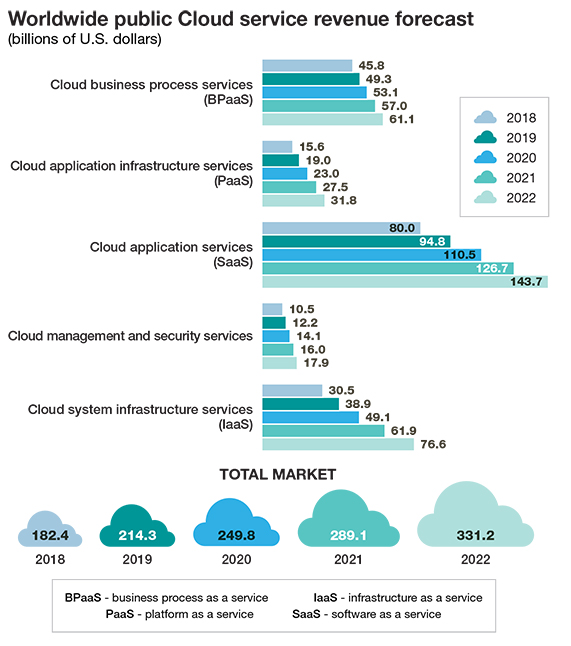
Calling Cloud the “fastest-growing market segment,” Gartner expects it to grow by 27.5% this year to reach $38.9 billion (up from $30.5 billion last year). The research firm expects the second-highest growth rate (21.8%), to be achieved by Cloud application infrastructure services, or platform as a service (PaaS), when a third-party provider delivers hardware and/or software tools via the Internet.
“Cloud services are definitely shaking up the industry,” says Sid Nag, Gartner research vice president. “We know of no vendor or service provider today whose business model offerings and revenue growth are not influenced by the increasing adoption of Cloud-first strategies in organizations.”
TMS and beyond
What started out as a viable means for shippers to tender their loads, negotiate rates and communicate with carriers on a common software platform has since expanded across much of the supply chain management software space.
Where transportation management systems (TMS) and global trade management systems (GTM) were two of the first applications to make their way into the Cloud, the rest of the SCM lineup soon followed. With the exception of warehouse management systems (WMS), which is just beginning to gain traction on the Cloud computing front, most of these applications have continued their steady progression into the Cloud.
“TMS lends itself well to the Cloud, but WMS, not so much,” says Ian Hobkirk, president at Boston-based Commonwealth Supply Chain Advisors. “In the last 10 years, we haven’t worked on a single Cloud-based WMS project. Some shippers have considered it, but they’ve never come back and said to us: ‘We really see the value in doing this.’” That’s probably because WMS focuses on activity within a warehouse’s four walls and because much of that activity is specific and customized for the shipper in question.
“Warehouses are just so custom and unique—much more so than transportation,” Hobkirk continues. “Transportation is very transactional and consistent.” A transportation transaction, for example, can be expressed mathematically (e.g., origin, destination, zip code, brake class, number of pallets, weight, etc.). That makes transportation much more consistent across multiple companies, and sets it up for success in the Cloud.
“With warehousing, it’s difficult to have multiple shippers using the exact same instances of the software,” says Hobkirk, “and to get everyone’s needs met in terms of customization.”
Survey says
According to Peerless Research Group (PRG), 48% of companies are using Cloud-based applications (up from just 39% in 2018). Another 18% are evaluating their Cloud-based options, or plan to do so within the next year or two. Just 10% of shippers say Cloud isn’t an option for their companies (down from 12% in 2018).
In citing the benefits of moving their supply chain applications into the Cloud, 34% of survey respondents say it’s because the delivery method gives everyone access to the same information and data. Thirty percent point to security as their key driving factor (up from 12% in 2018) and 28% say it’s because Cloud-based applications are easy to implement, deploy or upgrade.
Shippers also see the Cloud as being more cost-effective than other delivery methods, while others say it enables good collaboration with suppliers and customers. Of the companies that are currently evaluating Cloud-based applications, most of them (64%) are interested in WMS, TMS, labor management systems (LMS), slotting, order management and planning applications. Another 34% want Cloud-based applications that can monitor systems, manage information and predict system failures for their automated equipment.
Cloud benefits
Clint Reiser, research analyst with Boston-based ARC Advisory Group, says that one of the biggest value drivers in Cloud computing is the fact that it delivers connectivity via a single, centralized system. That value proposition hasn’t changed much over the last few years, and is augmented by the delivery method’s ability to “push” out updates and software patches automatically. The Cloud’s subscription model is equally as attractive because it requires less upfront capital expenditures than on-premise software installations.
 Reiser is bullish on the slow trek of WMS into the Cloud computing space, and expects to see more traction on that front over the next year or so. “WMS Cloud adoption was sort of [late] in the supply chain world, but that’s definitely picking up and showing good signs of growth going forward,” he says. “It’s still a very small part of the total revenue of the [Cloud] market, but it looks like the hesitancy and the issues regarding latency have subsided; acceptance of the model has increased.”
In assessing the benefits of Cloud in SCM, Reiser says at least one global shipper in the food industry has reportedly been able to centrally-govern processes across its multiple locations using the Cloud. “A company that’s using various different enterprise resource planning (ERP), WMS and TMS systems can’t have standardized processes,” says Reiser, “but it can leverage a centralized Cloud solution across those locations and then control processes centrally by using a single-instance Cloud solution.”
More traction ahead
Looking around at the SCM vendor space, Bob Hood, a Capgemini principal and lead for the group’s Move Domain practice, says that the vast majority has taken their on-premise software solutions into the Cloud. Not all of those offerings are 100% Cloud-based, says Hood, but they do help vendors tick the box that says “yes, we do use the Cloud.” “Many of those platforms aren’t fully developed or running in the Cloud at this point,” he points out.
Even with these blips, SCM continues to gain traction in the Cloud. “TMS was an early mover in terms of the Cloud, with all the rest of the functional SCM areas now moving in that direction,” says Hood. “For example, Oracle has been working very hard on its stack from a supply chain module perspective, and now has quite a bit of software available beyond just TMS and WMS.”
Hood points to Manhattan’s order management system as another example of an early-mover into the Cloud space. “Manhattan continues to build out additional functionality incrementally in the Cloud,” Hood continues. “For example, if the company has new features to build—like a new WMS functionality—it’s using the Cloud to develop that.”
Another vendor that’s making strides in the Cloud is JDA, which is using its Luminate platform to embrace the Cloud, Internet of things (IoT) and advanced analytics, and cross-platform integration with artificial intelligence (AI) and machine learning (ML).
“There’s quite a bit of discussion on JDA’s Control Tower solution, which is focused on supply chain visibility; that’s definitely getting a lot of interest,” says Hood. “The company is also moving other functionalities into the Cloud, including task management which is now available on the Luminate platform.”
Hood expects this momentum to continue, with vendors helping to lead the Cloud charge by experimenting with and rolling out new SCM offerings via the Cloud. But even with this positive energy working in its favor, it could be some time before we see 100% of SCM being deployed via the Cloud.
Going forward, Hood also sees opportunity for some of the newer, smaller players in the SCM space, with FourKites and project44 being two of the vendors that continue grow. “There’s a continual flow of new players in the space, with companies like FourKites and project44 offering Cloud-native visibility tools and enjoying a fair amount of success and buzz,” says Hood. “That’s definitely the future.”

Article Topics
Cloud News & Resources
Emerging trends in logistics technology adoption 2025 Robotics Application Conference rolls out session, speaker lineup Key characteristics of emerging digital supply networks Leveraging Artificial Intelligence (AI) to Transform Supply Chain Planning and Resilience Steady march into the cloud Technology Issue: Evaluate first, then apply Warehouse/DC Automation & Technology: It’s “go time” for investment More CloudLatest in Logistics
Union Pacific-Norfolk Southern merger application is filed with the Surface Transportation Board FedEx posts fiscal first quarter earnings growth U.S. rail carload and intermodal volumes are down, for week ending December 15, reports AAR DAT’s November Truckload Volume Index sees more mixed results November intermodal volumes see annual decline, reports IANA Looking at the state of the parcel market with Robert Persuit, Sr. Director of Business Development, ShipMatrix Teamsters Rail Conference makes its case for the Union Pacific-Norfolk Southern proposed merger to not be approved by the STB More LogisticsAbout the Author

Subscribe to Logistics Management Magazine

Find out what the world's most innovative companies are doing to improve productivity in their plants and distribution centers.
Start your FREE subscription today.
December 2025 Logistics Management

Latest Resources












