
State of Global Trade Management: Taking it to the next level
As more and more shippers finally turn to technology to help them tackle their most pressing global trade issues, the software sector that supports it is looking ahead and figuring out what lies around the next corner.

They go by names like Amber Road, Descartes, Aptean, and Infor, and they’ve carved out a niche for themselves by providing the software engines that help today’s global supply chains run with less friction. As the makers of global trade management solutions (GTM), these and other vendors help shippers stay in compliance with the many regulations that govern cross-border shipments, and in a very automated manner.
Adept at screening against sanctioned party lists, managing export licenses, maintaining export classification, handling embargo checks, managing classification codes, generating import/export documents, and ensuring import controls, GTM is best known for how it helps shippers reduce the costs that come when shipments are non-compliant. These solutions also streamline and automate business processes and help shippers determine the “total landed cost” of their global shipments.
“With trade becoming global, it became imperative for vendors to make their production and supply chains as efficient as possible,” says a recent GTM report from technology market research firm Technavio. “Quick and efficient communication between intermediaries such as transportation and logistics service providers, custom brokers, foreign trade agents and third-party service providers is imperative. GTM solutions can only help organizations better achieve this and help them gain an edge over their competitors.”
Over the next few pages we’ll explore the current state of GTM in the broader realm of supply chain software, discuss how shippers are leveraging these mainly Cloud-based platforms, and highlight a few new capabilities that may soon work their way into the GTM landscape.
Global trade on a tear
Global trade is on a tear, and it’s taking the world’s shippers right along for the ride. According to the World Trade Organization’s (WTO) most recent predictions, the volume of world merchandise trade volume grew by 3.6% in 2017 (up from 1.3% in 2016), and is on track to grow by 3.2% this year. According to the WTO, stronger growth in China and the U.S. boosted demand for imports, which “spurred intra-Asia-trade as demand was transmitted through regional supply chains.”
And as world trade volume ebbs and flows over time, GTM remains a stalwart in the pool of supply chain software applications that help shippers work smarter, better and more efficiently in the current business environment.
This year, Will McNeill, principal research analyst with Gartner, says that he’s seeing high demand for track-and-trace capabilities on the global trade front, where companies like Sendum, TransVoyant and FourKites are providing more real-time visibility and location-based services to their users. “We’re definitely seeing a renewed interest in hardware-based options like GPS, RFID and sensors,” he says.
That renewed interest is being driven by lower hardware/device costs and easier access to the technology itself. But there’s still room to grow in this area, says McNeill, who points out that someone “still has to be responsible for the device.” In other words, if a shipper is using a carrier that provides ocean container tracking, an individual still has to put the tracking device on the container. In most cases, that responsibility falls on the supplier’s shoulders, but it can also be handled by a third-party logistics (3PL) firm or even by a customer.
“This is one area that presents a challenge, but the bottom line is that vendors are making it easier for shippers to do the tracking and tracing as a whole,” says McNeill, “with easier to use devices and Cloud-based platforms where everyone involved can share the information and data.”
Those Cloud-based platforms—which manage activity that happens outside of the four walls of the typical enterprise—are also having an impact on the GTM space and on how shippers use and interact with the software. “Thanks to the Cloud, users are getting more real-time, accurate information,” says McNeill, “and avoiding the latency associated with legacy systems like electronic data interchange (EDI), where it could be hours or days later before the information becomes available.”
Keeping them compliant
Import and export compliance is a complicated beast that’s not getting any easier to tame, and particularly as more country-to-country trade restrictions and rules emerge and existing trade rules (i.e., NAFTA) are either altered or done away with completely.
“Compliance is an ongoing, complex issue,” says Amit Sethi, senior manager for logistics and supply chain at Capgemini, “but I don’t think software vendors do enough to push the envelope on compliance solutions—they could be doing more in this area.”
In looking at current GTM adoption rates, Sethi says the fact that more vendors are offering Cloud-based platforms is helping to buoy those rates. That’s because today’s shippers tend to not think about activities like product classification and compliance in isolation, but rather as part of their overall supply chain processes. This is especially true within the context of the globalized supply chain, where a growing number of companies are trading with foreign business partners.
“From a shipper’s perspective, and particularly with the advent of e-commerce, the need for global trade classification, documentation, and export/import filing rules and regulations is only going to increase,” says Sethi. “As a result, GTM is beginning to get a bit more traction than it has in past years.”
That traction should continue gaining momentum in 2018, and mainly because “there’s no way the compliance requirements are going down from this stage,” adds Sethi, who points to the Oracle GTM, which is built on the vendor’s transportation management system (TMS) platform, as one example of a cloud-based platform that’s gaining popularity among shippers. Also, he says vendors like GT Nexus, that allow shippers to manage their global trade activities in a very collaborative way on the web, are fulfilling companies’ needs for flexible, connected GTM solutions.
Also driving the market right now are a number of emerging technologies that range from machine learning to artificial intelligence to blockchain, all of which are expected to have continued impact on many different facets of business and life.
“I think we’re going to start to see some GTM vendors talking about how they’re applying machine learning (i.e., when computers can learn and take actions without being explicitly programmed) in their solutions,” McNeill predicts. Applying machine learning to real-time visibility, for example, can provide “all kinds of new insights,” he adds, such as improved estimated time of arrival (ETA) calculations.
“You can always call your carrier and find out when a shipment is slated to arrive and then calculate the total time that it’s going to take to get to its destination,” says McNeill. “Combine real-time visibility with machine learning, however, and you’ll get more accurate, faster results—immediately.”
However, this example just scratches the surface of how we might see machine learning applied in the supply chain space, McNeill notes, adding that “right now, every single Gartner analyst is talking about machine learning to some degree.”
The Global Blockchain: Supply chain of the future?
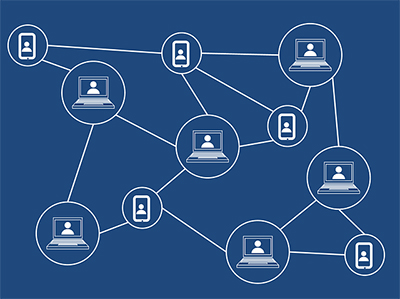
Currently, many industry analysts are also talking about blockchain—a digitized, decentralized, public ledger of all cryptocurrency transactions—and the role it will play in the supply chain in 2018 and beyond.
As part of those conversations, Gartner, in its “2018 Top 8 Supply Chain Technology Trends You Can’t Ignore” report, says that while most supply chain management related blockchain initiatives are nascent at this point, it’s ripe
territory for blockchain concepts because of the distributed, multi-enterprise nature of complex global value chains that routinely conduct business among multiple parties.
“Supply chain management trails other areas in consideration of blockchain technologies. However, certain highly decentralized supply chain management functions are prime candidates for this technology, such as smart contracts or traceability and authentication,” the Gartner report states, pointing out how Walmart is using blockchain to track packages of mangoes from farm to store shelves and Maersk Line is using it to share shipping data and enable multiple parties to select insurance terms.
“I’m skeptical about blockchain because more than 50% of inbound messages are still in EDI format—technology that’s 30 years old—and expecting those same companies to use blockchain is unrealistic,” says Gartner’s McNeill. “However, we’ve already identified a few use cases where the technology may be applicable, although overall adoption is going to be slow and low.”
Capgemini’s Sethi has a slightly rosier outlook, but admits that the integration of blockchain and global trade is still very much in its infancy. “Some software providers have made progress in this area, and I personally think blockchain is the technology that will power global trade in the future,” he says,” especially with most of that activity coming to the Cloud versus through on-premise software. I’m confident that once vendors start incorporating blockchain technology into their software solutions, shippers will get excited about it.

Article Topics
Global Trade News & Resources
Logistics growth sees mild decline in November, states LMI CBP launches five-year pilot allowing non-asset-based 3PLs Into CTPAT for the first time DHL’s 2025 Peak Season approach includes more planning and less panic U.S. Chamber of Commerce-led letter to USTR reiterates support for USMCA European shippers expect disruptions to last two more years, states Maersk survey POLA and POLB volumes see October declines Descartes report points to flattish U.S.-bound imports in October More Global TradeLatest in Logistics
Logistics growth sees mild decline in November, states LMI CBP launches five-year pilot allowing non-asset-based 3PLs Into CTPAT for the first time DHL’s 2025 Peak Season approach includes more planning and less panic Union Pacific–Norfolk Southern merger filing with the STB is delayed delayed until mid-December Old Dominion Freight Line issues November operating metrics update Services economy remains on growth track in November, reports ISM Looking at the LTL market with Scooter Sayers More LogisticsAbout the Author

Subscribe to Logistics Management Magazine

Find out what the world's most innovative companies are doing to improve productivity in their plants and distribution centers.
Start your FREE subscription today.
December 2025 Logistics Management

Latest Resources












