
2024 WMS Update: At the intersection of warehousing and e-commerce
We explore the role that WMS plays in today’s e-commerce fulfillment centers and how it will continue to drive these busy operations in the future as it becomes more intelligent—and, in some cases, intertwined with other applications within the warehouse’s four walls.
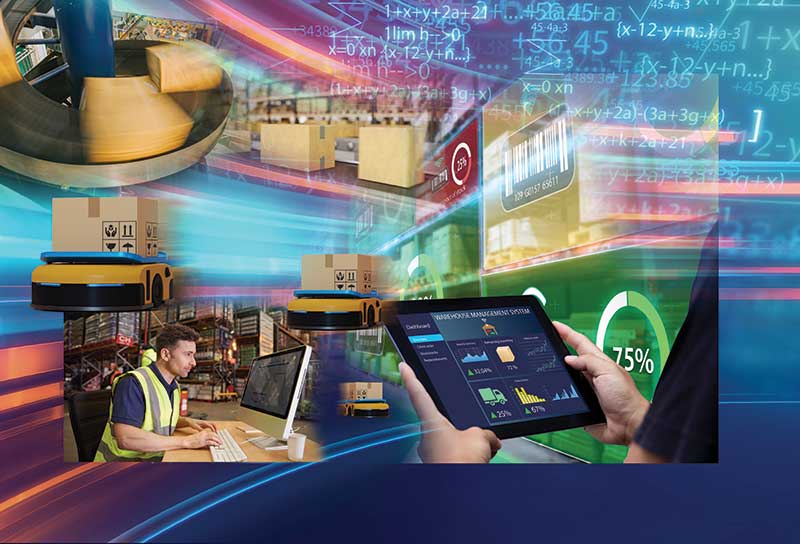

Let’s face it, without an efficient warehouse or distributions center (DC) there wouldn’t be an efficient, profitable e-commerce operation. Sure, a very small online seller may be able to work out of a stockroom, or in some cases even their garage, but growing e-commerce companies that serve a wide breadth of customers need more than that.
Enter the warehouse—a place where most of the “magic” happens behind the scenes with the contribution of people, processes and systems. The warehouse management system (WMS) is one supply chain management (SCM) application that’s stepped up to the plate as U.S. e-commerce sales volume skyrocketed from $52 billion in 2018 to a current $1.3 trillion, according to e-commerce market research firm Insider Intelligence.
Software that helps companies optimize and streamline their warehouse operations, WMS automates the tracking of stock levels, picking and packing, processing of orders, tracking order of status, shipping manifest management and report generation, to name just some of its core responsibilities. The applications also help identify areas of improvement in the warehouse, integrate with a host of other systems and help companies comply with industry regulations.
The problem right now is that many of the WMSs currently in use are older, on-premises systems that weren’t built to handle the constraints and intricacies of the modern e-commerce warehouse. These legacy systems were designed for traditional brick-and-mortar operations, so they lack the scalability needed to be able to handle e-commerce’s high order volumes, demand fluctuations and the “eaches” order fulfillment approach—versus pallets and caseloads.
“There’s still a high degree of companies with legacy WMS systems, some of which are ‘aging out’ more rapidly than others,” says Norm Saenz, partner and managing director at St. Onge Co. “Because of this, a lot of companies are looking at replacing those aging systems with the newest systems available on the market.”
For example, St. Onge is currently working with several different companies that have had their current WMS in place for 30 years to 40 years (Fun fact: the first WMS was developed and installed by retailer J.C. Penney in 1975), and now need more functionality, advanced technologies and integration capabilities. “They’ve had legacy systems in place for their entire lives and their ‘systems of the day’ can no longer keep up,” Saenz explains. “E-commerce is one of the key drivers behind these changes.”
Other drivers include the desire for better inventory visibility, improved warehouse labor management and to simply have more efficient operations. Saenz says the need to compete effectively within the constraints of a tight labor market is another driver behind companies’ search for new WMS platforms. In an interesting twist, he’s seeing more companies exploring best-of-breed WMS with the goal of moving away from their legacy systems.
“Best-of-breed WMS platforms are available at more attractive rates than in years past, and many of them are cloud-based and come with more options,” says Saenz. “Complex e-commerce fulfillment operations need more automation and integration points to remain competitive. I think this area of WMS will continue growing rapidly.”
You can’t just throw more people at the problem
As Gartner’s Dwight Klappich ponders the role of WMS in the e-commerce fulfillment center of the future, he sees the software becoming even more intelligent and, in some cases, intertwined with other applications within the warehouse’s four walls.
According to Klappich, Gartner’s research VP, the focus will be on managing work more effectively and intelligently, and using advanced analytics, artificial intelligence (AI) and other advanced technologies to optimize the work queue. Hey says that robotics and automation also come into the picture here, and that many companies are investing in both to help augment their human workforces during this period of labor constraints.
“Complex e-commerce fulfillment operations need more automation and integration points to remain competitive. I think this area of WMS will continue growing rapidly.”
These considerations are especially critical in the e-commerce fulfillment environment. “If you’re just moving pallets and cases, using advanced analytics and AI for activities like labor forecasting is less of a priority,” says Klappich. “But e-commerce operations are very interested in adding that other intelligence to WMS.”
Fast-paced e-commerce operations are also using more “indoor locating” technologies that help them better understand where their people are, where the actual work is taking place, and then using that intelligence to do a better job of assigning work. Klappich is also seeing renewed interest in radio frequency identification—an “RFID 2.0” movement, so to speak—with much of that momentum being driven backward from physical store locations.
“Sourcing tagging, where the factory or supplier puts RFID tags on merchandise, was primarily meant to help stores,” says Klappich. “Now, warehouse operators are saying: ‘Wait a second. If I have all of these RFID tags on all these products, how can I put them to use in the warehouse?’”
Klappich says most of these revelations and advancements are being driven by the uptick in e-commerce and direct-to-consumer (D2C) sales volumes. It wasn’t long ago that huge CPG companies like Procter and Gamble and Gillette were loading goods onto pallets and into cases to ship to stores where the shipments were broken down and items sold to individual customers.
Today, much of that “breaking down” has to take place either at the point of manufacture or distribution, based on the fact that a D2C order may be for a single pack of razor blades.
“Companies have had to figure out when customer A is supposed to get his pack of razor blades that are being sent direct,” says Klappich. “That’s just one example of how high-volume, high-velocity fulfillment environments are forcing companies to rethink their strategies at a time when ‘throwing more people at the problem’ isn’t a viable option.”
Playing well with others
Cloud computing, application programming interfaces (APIs), and interoperability have all made it easier for software systems to “talk” to one another. And while the WMSs that were put in place 30 years to 40 years ago may still struggle in this area, newer systems were built to be able to play well with others.
Amarendra Phadke, CTO at Capgemini Engineering, sees this trend continuing and expects it to favorably impact warehouse operations that want to be able to manage more from a single platform.
“It’s about establishing independency between [systems] so that WMS can be more modularly linked with individual warehouse sizes and operations,” says Phadke, who also envisions a time when WMS is more closely linked with warehouse control systems (WCS) and warehouse execution systems (WES) to create a closed loop that includes all three core systems.
Realistically, however, he says that there’s still much work to be done before such integrations become commonplace. Here’s why: From the WMS perspective, the inputs are orders, labor sites, and enterprise resource planning (ERP) systems; and the outputs are the company’s manual, semi-automated or automated labor force. Marrying the two in a cohesive way requires quite a bit of system engineering.
“Figuring out how to solve the end-to-end problem requires multiple algorithms,” Phadke explains, “that can then be used to design software systems that interact with hardware-based, controls-based, automation-based and/or manual labor-based operations.”
Phadke also expects to see more companies using WMS to coordinate orders and picks across their part-manual/part-automated workforces—something that WMS hasn’t really had to deal with in the past. And the more e-commerce companies use AGVs, AMRs and other automated or semi-automated material handle equipment, WMS is now being asked to step in and handle these non-traditional tasks.
“Historically, WMS only had to deal with human actors, as in people moving items using forklifts or other means,” Phadke points out. “Now all of a sudden you have an entity that has an automated, semi-automated, and manual labor force. The question is: How do you coordinate orders, picks, and other activities across all three?”
The solution may be that WMS providers incorporate the functionalities into their own systems or create integrations with existing WES and WCS applications. “This is still futuristic in nature,” says Phadke, “and probably we’ll begin to see happening within the next one to three years.”
Operations management for WMS
In surveying the current e-commerce fulfillment landscape and the innovation taking place on the WMS front, Howard Turner envisions a time when WMS and other systems work together to become the “decision-making brains” behind a busy warehouse operation.
This probably won’t happen for another five years or so, but, at that point, operations management tools may be used to orchestrate different warehouse “zones” that are being manned by both human and automated labor forces.
“An e-commerce operation may have some goods-to-person, pick assist or robotics automation in place, but probably also has some traditional pick-to-belt zones. Some WMS companies are starting to say, ‘We’re developing highly-intelligent tools within our platform that are either standalone or connected to a WMS.’ These tools can be used to orchestrate everything that’s happening in the warehouse.” - Howard Turner, director, supply chain systems at the consultancy St. Onge Co.
For example, companies will be able to use the operations management tools to balance labor right down to the hour based on expected order volumes, and then allocate the human and automated labor resources accordingly.
“Companies struggle with having all of the data across all these different areas or zones of the warehouse, and then trying to figure out how to manage and run it effectively,” says Turner, “so this is one futuristic area that holds a lot of promise.”

Article Topics
Capgemini News & Resources
Revolutionizing SCM Software: Real-time visibility, AI, and seamless integration Evolution of the Connected Supply Chain: ERPs lead the charge with smart tech AI in Supply Chain Software: Opportunities, Challenges, and the Future of Automation Warehouse Management Systems (WMS): The ultimate e-commerce warehouse orchestrator The Rise of the Intelligent Supply Chain: Driving efficiency with data and automation Beyond the horizon: What’s next for supply chain management (SCM) software? Yard Management Systems (YMS) Update: Optimize your yard, optimize your business More CapgeminiLatest in Logistics
ISM forecast sees a manufacturing rebound in 2026 as services maintain steady expansion PwC report indicates transportation and logistics dealmaking activity is focused on strategy, not scale ShipMatrix reports strong Cyber Week delivery performance results National diesel average falls for the fourth straight week, reports EIA FTR’s Shippers Conditions Index shows modest growth Trucking executives are set to anxiously welcome in New Year amid uncertainty regarding freight demand ASCM’s top 10 supply chain trends highlight a year of intelligent transformation More LogisticsAbout the Author

Subscribe to Logistics Management Magazine

Find out what the world's most innovative companies are doing to improve productivity in their plants and distribution centers.
Start your FREE subscription today.
December 2025 Logistics Management

Latest Resources












