
Reverse logistics in need of some love
Whether manual, automated or somewhere in between, reverse logistics operations deliver maximum return only with an organized and efficient process. Don’t wait any longer to make your move.

So many decisions. So little time.
That’s the story of reverse logistics—aka returns.
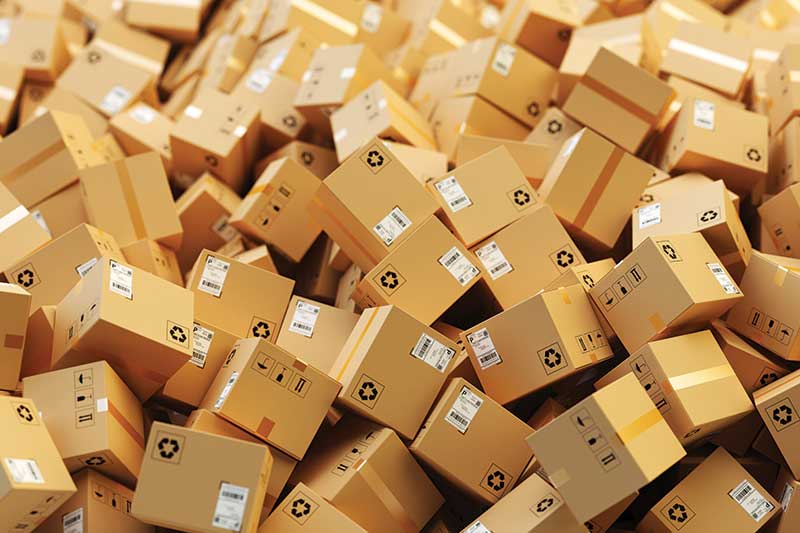
Regardless of the name you prefer, it’s all about what to do as soon as possible with all those items consumers sent back and now sit in an unruly pile in the corner.
Some are kind enough to call it organized chaos. The National Retail Federation (NRF) calls it an $800 billion drag on retailers.
While even the NRF calls returns inevitable, that pile in the corner is not. Solutions are out there, both manual and automated.
The first step in any returns process is to examine each item. Then a decision has to be made to restock/repair/redirect/discard/trash it. Then all the items in the pile need to be dispatched to the designated next stage. It could be inside the DC for restocking or shipment to a secondary retail channel or off to auction or liquidation.
Then you’re on to the next pile. And you think shoveling snow during a blizzard is hopeless?
Worse yet, it’s a pile (and process) no one really wants to own.
“Nobody ever got rich handling returns except for some third-party logistics provider (3PL) specialists,” points out Bryan Jensen, chairperson and executive vice president of consultant St. Onge Co.
A ray of hope: Maybe there is a way to actually manage returns if 3PLs can make money at it.
“You have to find a way to make returns easier to handle at lower cost in as little time as possible,” explains Martin Thomas, principal consultant at Dematic. Then he goes one step further. “You also have to figure out how to marry the returns process to the order fulfillment process in the facility.” Now we’re onto something.
Returns not going away
“Retailers understand their customers. They want easy options to return items that they decide were a bad purchase for whatever reason,” explains Jensen.
Or put another way: “retailers don’t like to say no,” says Kevin Ledversis, vice president of sales at Newcastle.
That’s for sure.
Retail sales in 2022 hit $4.95 trillion, says the NRF’s December 2022 Consumer Returns Survey. Total returns were 16.5%, or $816 billion, and were flat from 2021 to 2022.
That means for every $1 billion in sales, the average retailer incurred $165 million in merchandise returns annually each of two years in a row.
“For the first time since 2019, when online data was captured as part of this survey, online return rates are in line with overall return rates and have dropped by 21%,” continues the report on the NRF survey.
This last set of stats is worth noting. Until this latest NRF survey, most people recited a return rate of 10% for brick-and-mortar and 30% for online.
But while the overall rate of returns between stores and e-commerce has leveled out, no one is expecting total returns to diminish in any way. Instead, they are most likely to increase right along with any increase in retail sales, which continue stronger for longer these days.
Taking control
Clearly, the trick here is to manage the returns rather than letting returns manage you.
“Retailers understand that returns are significant, but don’t necessarily understand the problem of processing them,” explains Drew Stevens, vice president of global business development and marketing at OPEX.
Fortunately, solutions range from manual to automation. Here are four diverse options.
OPEX offers its Sure Sort small item sorter. Dematic talks about its Pouch System that transports, sorts and sequences items.
Meanwhile, Newcastle’s mobile powered workstations process items in real time with inventory systems including warehouse management systems (WMS).
Over at ORBIS, Mike Garcia, market manager of reusable packaging management systems, focuses on a closed-loop system for managing and maintaining reusable containers that transport returned items during processing.
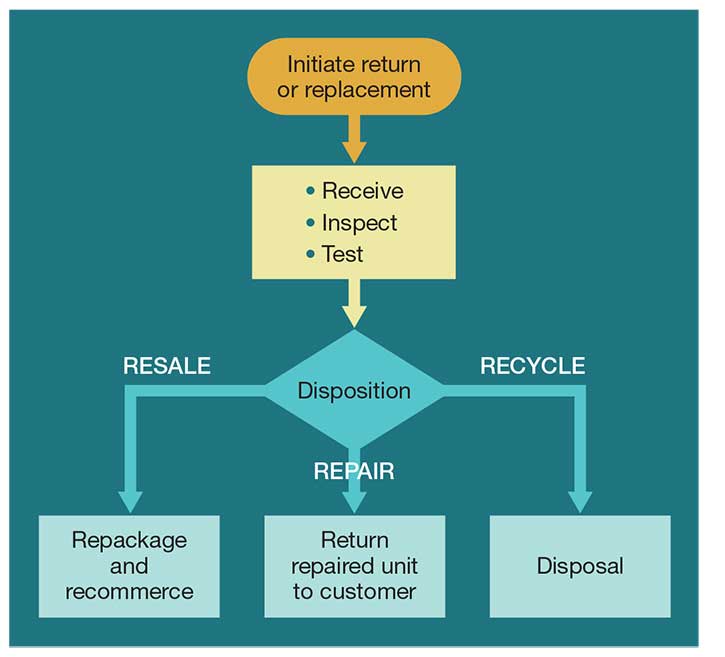
Details on these options in a bit. But to start, let’s establish what a good returns process looks like. A general framework is featured in the diagram below
Here’s Kira Bilecky’ take on that. She’s senior supply chain consultant at St. Onge. It starts with receiving and inspection guidelines as well as any testing procedures, Bilecky says. Then there’s the matter of disposition: repackage and re-commerce; return of a repaired item to the customer; or disposal.
Repackage and re-commerce are all about preparing the item to be reintroduced to the sales chain, giving it a second chance to be sold. It might happen, says Bilecky, with the original retailer or with a different retailer that operates in the secondary channel, both brick-and-mortar and e-commerce.
If the customer returned the item because of damage to it, can it be repaired? If so, make the appropriate repairs and return it to the customer.
Disposal, Bilecky adds, is taking on new dimensions. It’s not just a matter of trashing an unsalvageable item, but handling it in an environmentally conscientious way.
Bilecky explains that “organizations today are earning customer trust by providing transparency around their attempts to being more circular…Reverse logistics and disposition plans are increasingly shared publicly with customers.”
Jensen of St. Onge continues on to say the circular supply chain has started to focus on reverse logistics in the past 18 months. “It’s part of the environmental, social, and corporate governance [ESG] conversation, and it’s only in the very earliest stages. The challenge is to close the loop on the returns cycle when disposal is the final step in the process. This is definitely something to watch going forward,” says Jensen.
Drilling down
This is where the nitty gritty starts. How do you structure an efficient returns process within the four walls? Thomas at Dematic starts with a few questions.
- What are the separate operations in the reverse logistics process, including the movement between of items between each of those operations?
- How long does it take to process a returned order from receipt until it is ready for resale? On an average day? On a peak day? What are your volumes on an average and peak day?
- What is the total cost and operator time needed to process a return, including all steps and touches?
- How many different possible dispositions are there for returns? What percentage of all returns is each disposition type?
- How much space in the facility do reverse logistics operations require?
- What is the highest priority in the current process—crediting the customer or making the item ready for processing?
Thomas points out that the current processes may work well currently. However, they may not be integrated with other workflows in the facility.
Creating that integration, says Thomas, is an important step toward making reverse logistics more efficient, less costly and less time consuming. “Making that jump is a critical leap toward overall returns efficiencies,” adds Thomas.
Four options to consider
While no statistics are available to support this claim, there are probably no returns facilities that are entirely automated. That means someone or many someones have to physically handle each item at least once in the process.
But regardless of how manual the operation, everyone would like to reduce the number of touches along the way, explains Thomas.
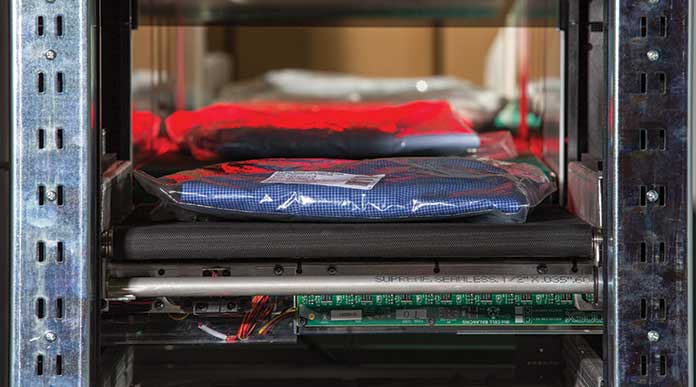
Stevens of OPEX says fewer touches are the path to greater speed and efficiency and reducing labor, regardless of the level of automation. OPEX offers a small item sorter called Sure Sort with the capacity to process 2,400 items an hour with just two people. That’s roughly the same hourly throughput of five put walls with 10 people, two on each side.
Ibots manage each item in the short (45-foot) aisle, automatically sorting each to a designated takeaway conveyor. Capacity is added by adding Sure Sort units. Steven says ROI is about two years.
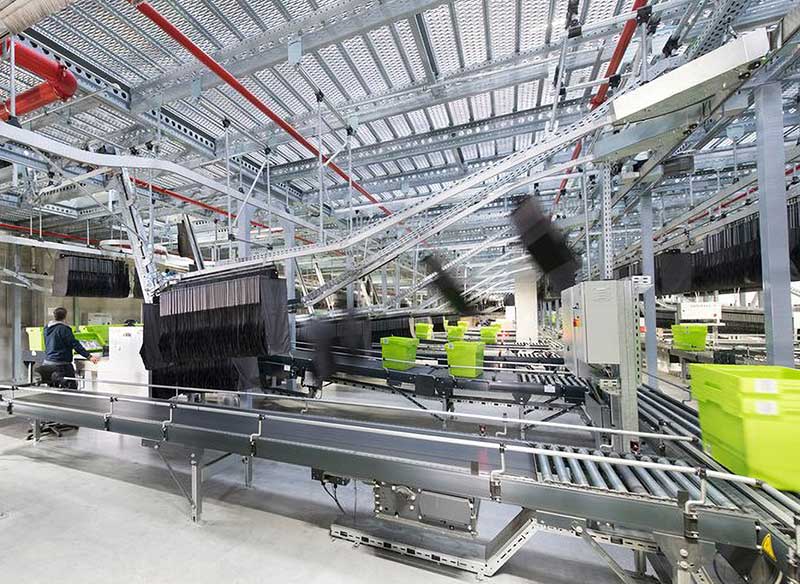
Looking nothing like a Sure Sort is the Dematic Pouch System. Thomas explains this flexible, scalable automation solution consists of pouches hanging on a hook suspended from rollers that travel on an overhead track. Each pouch carries a single item between workstations in the returns process. While the pouch system is automated, loading and unloading of items is a manual process. Thomas says the benefit is a smooth and continuous flow of returned items as they move at a rate as high as 12,500 items an hour.
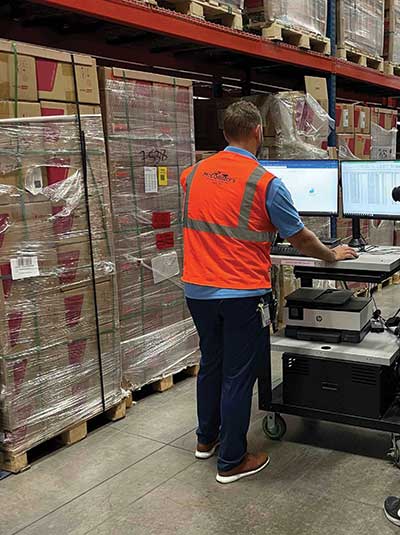
Decidedly different tech are mobile workstations from Newcastle. Ledversis says these powered platforms provide up to 11 square feet to process returns alongside a bar code scanner to collect data, label printer and a mobile terminal that communicates directly with the WMS.
“It’s always going to be easier to bring the station and its data connection to the work than the other way around,” says Ledversis. “These powered workstations keep people on task and double output right away,” he adds.
Totes and containers of all sizes are a staple of organizing and moving returns. And ORBIS has a different twist on efficiencies here. As Garcia explains, the company offers a reusable packaging management (RPM) service that ensures all containers are maintained for maximum usefulness. “RPM protects a return operations’ investment in packaging and extends its useful life,” he adds.
This is a closed-loop system. Garcia says containers are sent to an RPM facility where they are cleaned, repaired, and repurposed if necessary before being redistributed to the returns processing center. In addition, each container can be outfitted with an RFID tag that collects data about its use and travels, explains Garcia. “This is the future of managing containers. The more information we collect the better we can manage the containers, maximizing their usefulness in the returns process,” he adds.
Clearly, you have a range of options to tame that returns pile. All it requires of you is a little love to get started.

Article Topics
Capgemini News & Resources
Revolutionizing SCM Software: Real-time visibility, AI, and seamless integration Evolution of the Connected Supply Chain: ERPs lead the charge with smart tech AI in Supply Chain Software: Opportunities, Challenges, and the Future of Automation Warehouse Management Systems (WMS): The ultimate e-commerce warehouse orchestrator The Rise of the Intelligent Supply Chain: Driving efficiency with data and automation Beyond the horizon: What’s next for supply chain management (SCM) software? Yard Management Systems (YMS) Update: Optimize your yard, optimize your business More CapgeminiLatest in Logistics
PwC report indicates transportation and logistics dealmaking activity is focused on strategy, not scale ShipMatrix reports strong Cyber Week delivery performance results National diesel average falls for the fourth straight week, reports EIA FTR’s Shippers Conditions Index shows modest growth Trucking executives are set to anxiously welcome in New Year amid uncertainty regarding freight demand ASCM’s top 10 supply chain trends highlight a year of intelligent transformation Tariffs continue to cast a long shadow over freight markets heading into 2026 More LogisticsAbout the Author

Subscribe to Logistics Management Magazine

Find out what the world's most innovative companies are doing to improve productivity in their plants and distribution centers.
Start your FREE subscription today.
December 2025 Logistics Management

Latest Resources












