Top 25 Freight Forwarders: Gaining momentum
By most reliable measures, the world’s freight forwarding sector is brightening considerably for the second straight year. But many analysts also maintain that only intermediaries with the most sustainable practices will thrive in tomorrow’s marketplace.
Latest Logistics News
How Warehouse Leaders Turn Uncertainty into Advantage 2025 Salary and Compensation Study Warehouse/DC Operations & Automation: Time to transform operations 2024 Less-than-truckload Research Study 2024 Salary Survey Research Report More Special Reports
According to The Stifel Logistics Confidence Index, the freight forwarding sector is gaining momentum, with bookings on all modes surging upward. The findings correlate closely with those of the London-based think tank Transport Intelligence (Ti), which recently produced its annual Global Freight Forwarding 2015 report.
Volume growth was robust in the year, says TI economist David Buckby, who notes that the top tier players in both sea and air saw average growth of about 5 percent in 2014. Was the weak sector performance in 2013 just an aberration?
“While the sea forwarding market was once again bogged down by year-on-year rate declines which meant another 12 months of negative revenue growth overall, air forwarding rates on average declined only very slightly, permitting market expansion for the first time since 2011,” says Buckby.
On average, forwarders gained volumes, but translating these numbers into profits proved difficult for some. Meanwhile it appears the focus on global trade is shifting towards regional flows. The top three trade flows in terms of value are intra-regional within Europe, Asia, and North America. Combined, these intra-regional flows comprised almost 50 percent of global trade in value terms for 2014.
According to Buckby, merger and acquisition activity will be on the rise with quickening introductions of new products and multi-modal transportation to support these growing demands.
“Finally, the application of technology and data analysis is having a transformative effect on the forwarding market,” says Buckby. “Many forwarders are in the midst of upgrading and enhancing their individual systems. Some have been successful while others continue to struggle.”
And as forwarders focus on their IT systems, Buckby says that they’re facing competition in the e-commerce marketplace by start-ups that enable shippers to compare rates, book shipments, track in real-time, and perform data analysis. These factors, he adds, have the possibility of disrupting the freight forwarding market—just when it appears to be reversing its decline from 2013.
Issues with “sustainability”
Yet another “transformative effect” may be imposed by shipper demand for sustainable practices, say officials and policy-makers at the International Federation of Freight Forwarders Associations (FIATA).
At the recently concluded 2015 High Level Political Forum in Vienna, FIATA delegates were told to expect new compliance standards imposed to enhance “Connective-logistics” sustainability. Two years ago DHL, the world’s largest forwarder, was in the forefront of this movement with its study titled Toward Sustainable Logistics. At the time, it said that even “erstwhile competitors would cooperate more closely in a common effort to reduce carbon emissions.”
Since then, however, the mega forwarder has embarked on a “softer” public relations effort by launching its new brand campaign with the tagline “The Power of Global Trade.” The campaign’s guiding theme this time is the deep connection between trade and logistics and the impact it has in improving people’s lives.
“We want to emotionalize the brand DHL more strongly to differentiate us from our competitors,” explains Christof Ehrhart, executive vice president of corporate responsibility at Deutsche Post DHL Group. “Global trade is the engine that drives economic growth as well as individual prosperity across all continents on the planet.”
However, DHL’s effort is not without its skeptics. “Sustainability is one of the buzzwords people and organizations use, but even though it’s an important issue, it is not consistently applied,” says Albert Saphir, president of trade compliance firm ABS Consulting. “Many global forwarders create public relations campaigns to further their goals and objectives.”
Saphir adds that some refer to these as “green initiatives,” designed to reduce the carbon footprint of shipping and logistics. “Even for asset-based carriers this is quite a challenging exercise,” he says. “But once you look at non-asset based forwarders, it’s almost impossible to truly determine what this means and how to measure or compare.”
For example, a smaller forwarder would not likely have the resources to accurately calculate a carbon footprint for an air shipment from Miami to Frankfurt, Saphir points out. “There are more than 20 routes an air forwarder can use just between these two destinations,” he says. “And what about an airline operating two different aircraft types between two city pairs?”
Finally, Saphir maintains that forwarders of any scale would be better off improving their internal communications with transport divisions and the shipper. “At the end of the day, the key factors are price and service reliability,” he says. “Sustainability is still a ‘feel good’ idea that’s losing currency with most forwarders, no matter what FIATA says.”
Brandon Fried, the executive director of the Airforwarders Association, notes that many shippers are now requiring some sort of environmental sustainability metric within the freight transportation proposal process.
“Regarding performance metrics, a few forwarders have adopted some general emissions calculation tools as a means of proving their carbon burn reduction efforts,” says Fried. “Also, many have made a commitment by joining the Environmental Protection Agency’s SmartWay program where suggestions, metrics, and energy saving tools are readily available.”
By their very nature, however, forwarders tend to not own many transportation assets, but are able to exert some influence through their vendor management process, Fried adds. “Shippers are being pressured by their own customers as global warming creates an increased awareness of carbon footprint reduction,” he says. “But for the most part, many are primarily focused on getting the freight to its destination on time, intact, and at the lowest possible price.”
Top 25 imperatives
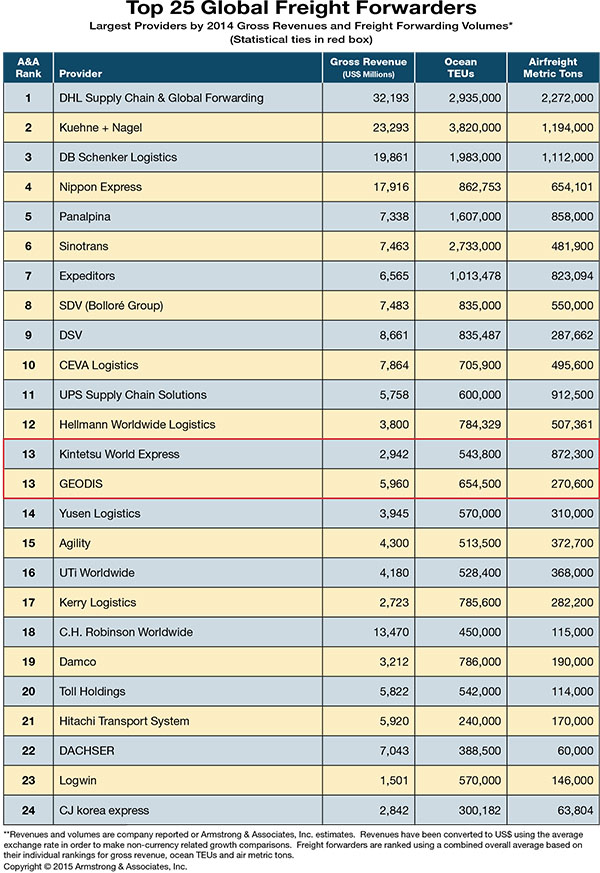
However, there is strong evidence that the mega-forwarders comprising Armstrong & Associate’s annual Top 25 list compiled for Logistics Management continue to emphasize sustainability as a competitive differentiator.
DB Schenker Logistics, for example, recently inked a six-year strategic agreement with Hyundai Merchant Marine (HMM) to reduce CO2 emissions from ocean freight. After agreements with Maersk, Hapag Lloyd, and Hamburg Sud, this is the first agreement of its kind with an Asian carrier. Seoul-based HMM says that it will aim to reduce the CO2 emissions of every container it ships on behalf of DB Schenker Logistics until 2020 by 17 percent compared to 2014 levels.
“This is the first agreement between a global logistics services provider and an Asian container shipping company,” says Dr. Karl-Friedrich Rausch, management board member for transportation and logistics at DB Mobility Logistics AG and chief sustainability officer of Deutsche Bahn AG. “The agreement is a further milestone due to the fact that we manage to build mutual committing relationships on sustainability targets with carriers across the globe.”
Nippon Express, Japan’s largest freight forwarder, has been steadily expanding its global footprint through mergers and acquisitions while telling the shipping community that it is “mindful” of environmental and social responsibility.
After buying the Italian mega-forwarding firm of Franco Vogo two years ago, it formed an alliance with NEC Logistics Limited by seizing a 49 percent stake in the Japanese Electronics company. But during the same time frame, it revised its Environmental charter, observe Nippon executives.
“We successfully implemented numerous modal shift initiatives, switching from truck-centered transportation to one that makes more use of railways and ships,” says Nippon’s president Kosuke Tabuchi, who adds that the company is also expanding modal shift activities overseas as well as within Japan.
Metrics matter
For other top players who have firmly established their “sustainable” credentials, there may be a sudden shift to a focus on performance. For example, Expeditors International was recently recognized by the GT Nexus Shipper Council, a group of supply chain executives representing multiple large global enterprises, for dramatically improving sustainable benchmarks this past year.
Mike Ellerby, the chairman of the council chairman and international transportation systems manager at Sears, says that his constituency demands granular examination of posted results. “Detailed performance metrics around data quality, responsiveness, on-boarding times, and customer service is crucial,” he says.
Industry analysts say that popular portals like GT Nexus, INTTRA, and Cargosmart are giving smaller forwarders a leg up, too. Arsenio Martinez-Simon, Principal at A.T. Kearney is among those who contend that if industry dynamics are not addressed soon, freight forwarders will be condemned to slash prices as their only competitive option.
“The market is still fragmented with a mix of global providers, thousands of small competitors, and a rash of market forces disrupting business as usual,” says Martinez-Simon. “These disruptive forces range from shifting demand patterns, more complex and global supply chains, an evolving customer base, and changing relationships with shippers.”
Laurent Guerard, a partner with A.T. Kearney, agrees with Martinez-Simon, noting that forwarders must protect revenues with innovation by developing “sticky” differentiated services.
“This means that forwarders must try to maximize profits by adapting the offering to serve the most attractive customer segments,” Guerard says. “At the same, they must win new business by bringing in shippers from developing markets. In the long run, forwarders had better provide more value-added services that can be accurately measured.”
Future talking points
A.T. Kearney analysts have come up with a blueprint for forwarders to better serve shippers in the coming year. One of the chief insights is for them to capitalize on size.
They observe that larger forwarders get better rates from carriers, can book capacity well in advance due to their ongoing large bookings are dependable business, and receive preferential treatment if it’s ever necessary to move a load. Furthermore, size dilutes fixed costs because carrier management—and to a lesser extent customer service—is scalable.
They also advise forwarders to focus on gaining critical mass by region and industry to develop a level of operational and market expertise well beyond their competitors.
“Forwarders serving a defined region gain administrative and marketing expertise which translates into higher profits,” says Guerard. “In addition, intermediaries who also concentrate on one industry vertical typically enjoy the most success. They become experts in moving specific products, which is an advantage in gaining and retaining new business.”
But what about retaining that business in a fickle “shop around” world? “A shipper is more likely to maintain a relationship with a company that furnishes both freight forwarding and customs clearance services,” says Guerard, who notes that on average, customs clearance customers have longer relationships with their providers and are less likely to seek new alternatives.
A happy consequence of bundling services, add analysts, is that shippers tend to be less concerned about the forwarding fee, and the freight forwarder has an opportunity to learn more about the shipper’s international flows and transportation needs—all of which can open up additional business opportunities for the Top 25 as well those middlemen who aspire to break into the ranks.

Article Topics
Special Reports News & Resources
How Warehouse Leaders Turn Uncertainty into Advantage 2025 Salary and Compensation Study Warehouse/DC Operations & Automation: Time to transform operations 2024 Less-than-truckload Research Study 2024 Salary Survey Research Report Warehouse/DC Automation & Technology: It’s “go time” for investment 31st Annual Study of Logistics and Transportation Trends More Special ReportsLatest in Logistics
Looking at the impact of tariffs on U.S. manufacturing UP CEO Vena cites benefits of proposed $85 billion Norfolk Southern merger Proposed Union Pacific-Norfolk Southern merger draws praise, skepticism ahead of STB Filing National diesel average is up for the fourth consecutive week, reports Energy Information Administration Domestic intermodal holds key to future growth as trade uncertainty and long-term declines persist, says intermodal expert Larry Gross Railroads urged to refocus on growth, reliability, and responsiveness to win back market share Q&A: Ali Faghri, Chief Strategy Officer, XPO More LogisticsAbout the Author

Subscribe to Logistics Management Magazine

Find out what the world's most innovative companies are doing to improve productivity in their plants and distribution centers.
Start your FREE subscription today.
November 2025 Logistics Management
Latest Resources