
U.S. Ports Update: A matter of scale
While the expanded Panama Canal will be able to handle larger vessels, the next generation of mega-ships must be deployed on all-water routes. However, the nation’s premier ports will still have to compete by providing customized service—no matter how much volume steams in.
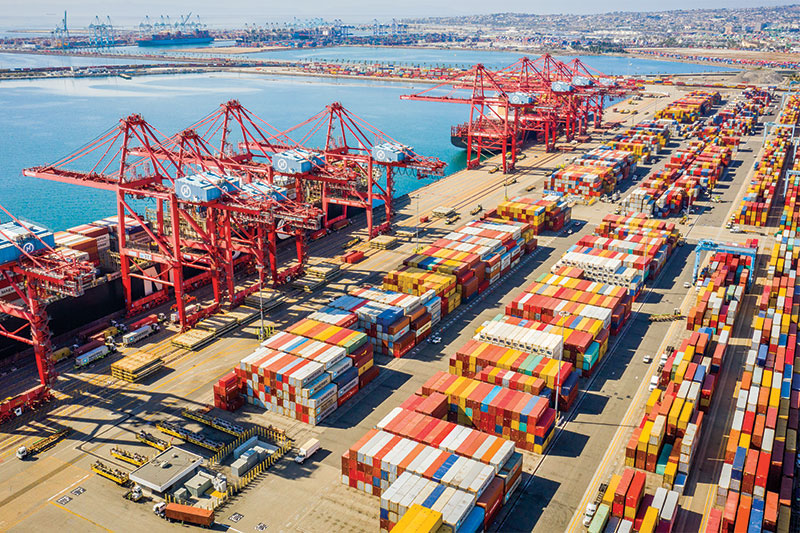

The era of the “mega-vessel” was ushered in last month for U.S. shippers as the world’s largest carriers called on deep-water West Coast ports.
The San Pedro Bay gateways of Los Angeles and Long Beach will attract most of the initial calls, but the Port of Oakland is also a key destination. Meanwhile, The Northwest Seaport Alliance—comprising Tacoma and Seattle—are moving toward “big-ship readiness.”
Some East Coast and Gulf ports are capable of handling these vessels as well, but most are anticipating a surge of traffic through the expanded Panama Canal this spring. So, with everything getting bigger, will economies of scale cease to matter? Experts we spoke with contend that ports can still compete by offering enhanced service and velocity regardless of size.
“The rapid emergence of mega-ships unhinged the ocean side of maritime supply chains from the land-side infrastructure,” explains Jock O’Connell, international trade advisor at Beacon Economics. “The Panamanians failed to anticipate just how huge the newest generation of vessels would be. As a result, the Canal can handle carriers loaded with 5,000 containers to 8,000 containers, but many of the East Coast and Gulf Coast ports might be swamped by the sudden shift in deployments.”
“Now, loading has become more random, in effect shifting the responsibility for sorting containers to congested U.S. ports.”
— Jock O’Connell, Beacon Economics
Compounding the impact of larger ships at West Coast ports were other moves by the shipping lines, O’Connell says. One involved how containers are loaded onto vessels at Asian ports. “Before, containers were sorted by final destination and then stowed aboard the ship,” he says. “Now, loading has become more random, in effect shifting the responsibility for sorting containers to congested U.S. ports.”
Solving that problem will require major alterations in port infrastructure and to the transportation systems serving the ports, maintains O’Connell. “It will also necessitate an unprecedented level of cooperation between public and private stakeholders with varying agendas, conflicting interests, and little history of harmonious relations,” he adds.
Christopher Koch, who just retired from a 15-year tenure as president and CEO of the World Shipping Council, agrees that last year’s West Coast labor disruptions unquestionably gave the industry a black mark in the eyes of American exporters, importers and foreign buyers of American goods. The healing may have begun, he says, but the bruises linger.
“Shippers have asked Congress for legislation to mandate greater transparency in port operational metrics,” says Koch. “They will want even more from the government if the employer/longshore labor collective bargaining process cannot figure out a way to address its issues without disrupting the American economy.”
According to Koch, some shipper representatives have suggested that the Federal Maritime Commission (FMC) consider “doing something proactively,” although there are few practical specific suggestions.
Furthermore, the FMC would face enormous challenges trying to tell industry participants how to sort out the cost implications of port operations and congestion.
“Improving port efficiency and throughput will require changes and investment,” says Koch. “Systems engineering can identify how to improve cargo flows. It’s not that the issues to improve throughput can’t be identified or addressed.”
Koch adds that blaming big ships is too simple and does little to alter market dynamics. More importantly, it fails to recognize that America’s supply chains are a string of interdependencies—all of which must be more closely examined.
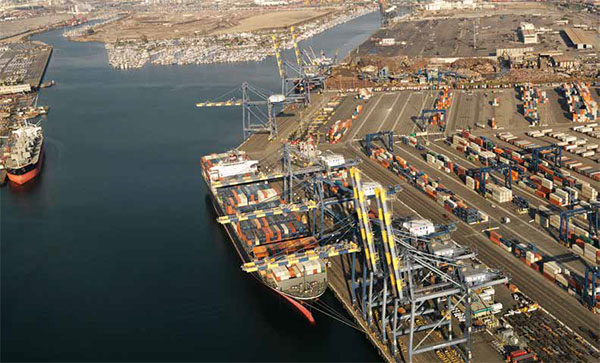
Panama Canal update
The expansion of the Panama Canal will be the headline event in shipping in 2016. The $5 billion project promises to reorient the landscape of the logistics industry and alter the decision-making calculus of the shippers that the canal serves.
The expansion of the Panama Canal, which began in 2007 and was originally scheduled for completion in late 2014, is now expected to be finished “around the month of May,” says Juan Carlos Varela, the president of Panama. Meanwhile, he is urging contractors and the Panama Canal Authority (ACP) to put aside their legal disputes for the time being in order to keep the project on schedule.
The president’s message comes after an adjudication board ruled the ACP should pay Grupo Unidos por el Canal (GUPC), the construction consortium responsible for the project, $17 million to cover budget overruns and extra labor costs. The canal’s widening to accommodate post-Panamax containerships with up to 13,000-TEUs of capacity, was initially expected to cost $5.3 billion, but reports suggest the actual budget for the project has far exceeded that figure.
Jorge Quijano, the chief executive officer and administrator of the ACP, says that the authority expects to conduct transit trial tests in April and inaugurate the expanded canal in the second quarter of 2016. The official commercial opening of the Panama Canal would follow shortly thereafter.
Volume shift
According to research conducted jointly by The Boston Consulting Group (BCG) and third-party logistics provider C.H. Robinson, as much as 10% of container traffic between East Asia and the United States could shift from West Coast ports to East Coast ports by the year 2020.
The report “Redrawing the Logistics Map” maintains that small percentages translate into big numbers in container traffic on high-volume lanes between East Asia and the United States.
This trade represents more than 40% of containers flowing into the United States. Rerouting 10% of that volume, therefore, is equivalent to building a new port roughly double the size of the ports in Savannah and Charleston.
Dustin Burke, partner and managing director for BCG in Chicago, says that this shift will have profound effects. “The larger ports on the West Coast will experience lower growth rates, altering the competitive balance between West Coast ports and East Coast ports,” he says.
With global container flows rising, West Coast ports will still handle more containers than they do today, adds Burke. It will also shape the investment and routing decisions of rail and truck carriers, magnify the trade-offs that shippers make between the cost and the speed of transportation, and potentially alter the location of distribution centers.
“Shippers still have questions about the gate charges that will be imposed by the Panama Canal Authority”
— Dustin Burke, BCG
“West Coast ports currently receive two-thirds of container flows from East Asia, with much of that cargo moving by rail and truck as far east as the Ohio River Valley, about three-quarters of the way across the United States,” says Burke. “But once the big, efficient ‘post-Panamax’ container ships begin passing through the wider, deeper canal, the shipping dynamics will change.”
For shipping to many destinations, using West Coast ports will still be the fastest option—but it won’t necessarily be the cheapest. For price-sensitive cargo that is relatively expensive to move, routing shipments through East Coast ports to inland destinations will become more cost competitive and increasingly attractive.
“The most startling aspect of our study was the fact that there was so little consensus,” says Burke. “Shippers still have questions about the gate charges that will be imposed by the Panama Canal Authority, and they also don’t know how frequently the really big ships are going to be used in the trans-Pacific.”
Those two big issues will have to be addressed before peak season preparations are made in late spring, add analysts at Datamyne (formerly Zepol), a global trade and intelligence provider. As the latest statistics clearly indicate, the volume through leading ocean cargo load centers in the United States is down significantly year-to-date, giving these mega-ports something they may not have planned for: mega-headaches.
See Related: The Panama Canal Expansion: Time Versus Cost Trade-Off

Article Topics
Special Reports News & Resources
How Warehouse Leaders Turn Uncertainty into Advantage 2025 Salary and Compensation Study Warehouse/DC Operations & Automation: Time to transform operations 2024 Less-than-truckload Research Study 2024 Salary Survey Research Report Warehouse/DC Automation & Technology: It’s “go time” for investment 31st Annual Study of Logistics and Transportation Trends More Special ReportsLatest in Logistics
ISM forecast sees a manufacturing rebound in 2026 as services maintain steady expansion PwC report indicates transportation and logistics dealmaking activity is focused on strategy, not scale ShipMatrix reports strong Cyber Week delivery performance results National diesel average falls for the fourth straight week, reports EIA FTR’s Shippers Conditions Index shows modest growth Trucking executives are set to anxiously welcome in New Year amid uncertainty regarding freight demand ASCM’s top 10 supply chain trends highlight a year of intelligent transformation More LogisticsAbout the Author

Subscribe to Logistics Management Magazine

Find out what the world's most innovative companies are doing to improve productivity in their plants and distribution centers.
Start your FREE subscription today.
December 2025 Logistics Management

Latest Resources












