
Port-focused initiatives are major driver for White House in Infrastructure Investment and Jobs Act
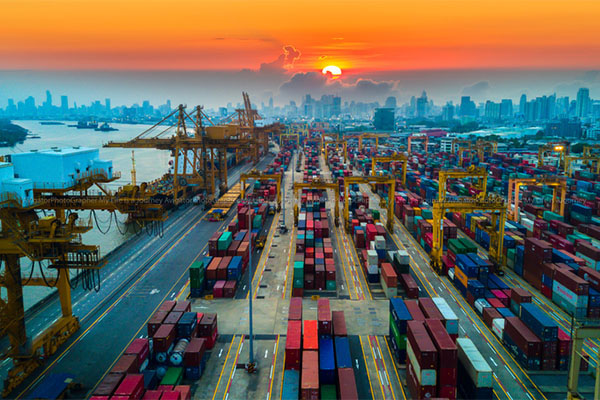
The United States ports-related components of the $1.2 trillion Infrastructure Investment and Jobs Act (IIJA), which is set to be signed into law by President Biden, are front and center, given the heavy amount of attention being given to the ongoing supply chain challenges.
The importance of ports was highlighted by how the IIJA allocates $17 billion focused on improving infrastructure at coastal ports, inland ports and waterways, and land ports of entry along the border, the White House said yesterday
“These resources will deliver near-term assistance and make long-term investments to strengthen supply chain resiliency,” the White House said. “Along the way, these investments will create good paying jobs and help America outcompete China. Together, the Bipartisan Infrastructure Deal is the single largest federal investment in our ports in U.S. history.”
As for next steps, the White House said that it has rolled out what it called a “set of concrete steps to accelerate investment in our ports, waterways, and freight networks,” with multiple goals and objectives, including: increasing federal flexibilities for port grants, accelerating port infrastructure grant awards, announcing new construction projects for coastal navigation, inland waterways, and land ports of entry, and launching the first round of expanded port infrastructure grants through IIJA.
With a sharp eye on the ongoing supply chain issues, the White House rolled out various port-related action items, including:
- allowing U.S. port authorities to redirect project cost savings toward tackling supply chain challenges, with the Biden-Harris Administration continuing to look for additional flexibilities and other solutions to support infrastructure needs in the goods movement supply chain;
- alleviating congestion at the Port of Savannah by funding the Georgia Port Authority pop-up container yards project. The Georgia Port Authority will be able to reallocate more than $8 million to convert existing inland facilities into five pop-up container yards in both Georgia and North Carolina and transfer containers via rail and truck further inland to be closer to their final destination, which will make available valuable real estate closer to the port. The effort will free up more dock space and speed goods flow in and out of the Port of Savannah, which leads the nation in containerized agricultural exports;
- launch programs to modernize ports and marine highways with more than $240 million in grant funding within the next 45 days. The Port Infrastructure Development Grant program is the first and only federal grant program wholly dedicated to investments in port infrastructure. DOT will award $230 million in funding for this program and $13 million for the Marine Highway Program to support waterborne freight service;
- identify projects for U.S. Army Corps of Engineers construction at coastal ports and inland waterways within the next 60 days. This plan will provide a roadmap for more than $4 billion in funding to repair outdated infrastructure and to deepen harbors for larger cargo ships;
- prioritize key ports of entry for modernization and expansion within the next 90 days. This plan will identify $3.4 billion in investments to upgrade obsolete inspection facilities and allow more efficient international trade through the northern and southern borders; and
- open competition for the first round of port infrastructure grants funded through the bipartisan infrastructure deal within 90 days. DOT will announce more than $475 million in additional funding for port and marine highway infrastructure
These efforts are in line with what the American Association of Port Authorities (AAPA) has been requesting for years.
In a recent interview with LM in May, AAPA President and CEO Chris Connors explained that it is imperative for freight program funding to be made 100% multimodal, as well as the continuation of planning through state freight plans with an elevated national strategic freight plan, and within the Department of Transportation, establishing an office of infrastructure and multimodal policy.
“I think the industry is thrilled that the Biden administration and the Republicans are actually mentioning ports,” he said. “It was a grand day when Joe Biden as a candidate and as a President-elect and Secretary Buttigieg are specifically mentioning ports. That was a word we did not [previously] hear. We always heard a lot about highways, bridges, tunnels, schools…all very important but we never heard about ports.”
In terms of the AAP’s wish list for what it wanted to see included in a new infrastructure authorization earlier this year, Connor outlined the following: $20 billion for deep-draft port infrastructure and intermodal freight connectors; funding for electrification of dock side ship connections and zero emission port equipment; $6 billion for U.S. Army Corps of Engineers coastal navigation program to complete already-started programs or start programs awaiting funding; and $500 million for port development of offshore wind energy in order to catalyze that evolution at scale.

Article Topics
3PL News & Resources
USPS-Amazon contract uncertainty grows as reverse auction plan raises stakes for 2026 renewal Logistics growth sees mild decline in November, states LMI CBP launches five-year pilot allowing non-asset-based 3PLs Into CTPAT for the first time DHL’s 2025 Peak Season approach includes more planning and less panic Old Dominion Freight Line issues November operating metrics update Services economy remains on growth track in November, reports ISM U.S. Chamber of Commerce-led letter to USTR reiterates support for USMCA More 3PLLatest in Logistics
USPS-Amazon contract uncertainty grows as reverse auction plan raises stakes for 2026 renewal Preliminary November Class 8 truck orders see another month of declines U.S. rail carload and intermodal volumes are mixed, for week ending November 29, reports AAR Logistics growth sees mild decline in November, states LMI CBP launches five-year pilot allowing non-asset-based 3PLs Into CTPAT for the first time DHL’s 2025 Peak Season approach includes more planning and less panic Union Pacific–Norfolk Southern merger filing with the STB is delayed delayed until mid-December More LogisticsAbout the Author

Subscribe to Logistics Management Magazine

Find out what the world's most innovative companies are doing to improve productivity in their plants and distribution centers.
Start your FREE subscription today.
December 2025 Logistics Management

Latest Resources












