
2020 Virtual Summit: Time to turn the corner
2020 marks the 15th year that we’re offering our readers a line up of educational sessions (going live on Dec. 10) designed to prepare logistics and supply chain operations for the year to come.


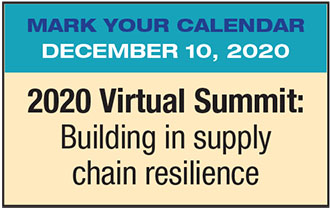 Every year around this time, the editorial staffs of Logistics Management and sister publication Supply Chain Management Review set out to program our Virtual Summit. In fact, 2020 marks the 15th year that we’re offering our readers a line up of educational sessions (going live on Dec. 10) designed to prepare logistics and supply chain operations for the year to come.
Considering what we’ve all been through and where we find ourselves here in early fall, a theme focused around building resilience into our logistics and supply chain operations for the future seemed like the right way to go this year.
And considering current freight volume data, peak season activity and recent conversations we’ve had with carriers, service providers and logistics managers on capacity availability, it certainly appears that we’ve turned the corner—and now need to learn from what we just experienced.
On that note, our team has programmed sessions that put some of today’s game-changing strategies and digital solutions into perspective and offer practical tips for evaluating, implementing and leveraging today’s new thinking to build resilience into our supply chain operations through recovery—and beyond.
“For most, the pandemic brought about major shock and disruption to logistics and supply chain operations, and it exposed the weaknesses of the current supply chain paradigm,” says Steven Melnyk, Ph.D., professor of operations and supply chain management at Michigan State University and this year’s keynoter.
However, he says that there’s a silver lining. “The pandemic is giving us a chance to rethink supply chain resilience and to rebuild it into a better system while also creating an improved, stronger supply chain,” says Melnyk. “The good news is that the foundations for doing so have been there all along and most systems and people are now simply ready for change.”
He defines those “old school” foundations for improving supply chain performance, risk, and resilience as three pillars: prioritization; supplier relationships; and supplier development. “While these elements are familiar, how they’re carried out now is something new—and how to do that is what we’ll explore.”
And while Melnyk will touch on the overall strategic silver linings coming out of the last seven months, professor Yossi Sheffi, the director of MIT’s Center for Transportation and Logistics, offers us a session that takes a look at how the pandemic has actually accelerated the acceptance of new supply chain technology and intelligence tools.
“Think about the technologies such as artificial intelligence, real-time data analytics and communications platforms that facilitate telecommuting, provide visibility into supply chains and enable contactless, paperless operations,” says Sheffi. “And although these technologies were used to deal with the immediate impacts of the pandemic, they will have long-term benefits for the performance and resilience of supply chains and businesses.”
This year’s program is packed with some of the industry’s top minds in the area of risk and resilience planning, so keep an eye on logisticsmgmt.com for more details on all of the sessions and registration information.

Article Topics
Mobile & Wireless News & Resources
2025 Robotics Application Conference rolls out session, speaker lineup Descartes introduces new tool to more effectively catch freight fraud Echo subsidiary Roadtex opens up two new locations Real World Solutions for a Mobility Manufacturer Connected Workers: A Key Imperative for Distribution Centers Tightening up on your inventories How to Optimize Your RFID Mandate Labeling within the Supply Chain More Mobile & WirelessLatest in Logistics
Looking at the state of the parcel market with Robert Persuit, Sr. Director of Business Development, ShipMatrix Teamsters Rail Conference makes its case for the Union Pacific-Norfolk Southern proposed merger to not be approved by the STB USPS bets on last-mile expansion to drive revenue and enable faster delivery for retailers and logistics providers Cass Freight Index sees annual declines in November Zebra Technologies is looking at strategic options for its robotics automation business ISM forecast sees a manufacturing rebound in 2026 as services maintain steady expansion PwC report indicates transportation and logistics dealmaking activity is focused on strategy, not scale More LogisticsAbout the Author

Subscribe to Logistics Management Magazine

Find out what the world's most innovative companies are doing to improve productivity in their plants and distribution centers.
Start your FREE subscription today.
December 2025 Logistics Management

Latest Resources












