
Micro-Fulfillment Centers (MFCs): How retailers can deliver on same-day expectations
It’s a profitable and sustainable solution to SDD and NDD that can help retailers remain competitive in today’s demanding environment.

In the competitive world of e-commerce, speed is key. Customers want their orders to show up fast—the next day or, increasingly, the same day. Yet many retailers are struggling to meet these expectations. Just under half (49%) of retail executives told Accenture that their organizations were meeting customer expectations for order fulfillment last year.
The fulfillment experience can now be the most important point of distinction and competitive advantage in e-commerce. Amazon’s same-day delivery (SDD) and next-day delivery (NDD) are a hit with customers, and other retailers are struggling to keep up. Many are limited by traditional fulfillment centers and third-party logistics (3PL) providers, which make it difficult to offer SDD and NDD.
Companies can’t afford to be content with traditional multi-day delivery windows in this environment. If they want to keep and grow their e-commerce customer base, they need to handle higher online volumes, process orders faster, and deliver on SDD and NDD profitably and sustainably—but their current fulfillment capabilities stand in the way.
The good news is that there’s an alternative option: micro-fulfillment centers (MFCs).
An MFC for SDD and NDD
Many retailers use stores as online order fulfillment points, often resulting in inferior in-store experiences and higher operational inefficiencies. Most retailers are constrained by traditional fulfillment centers and technology systems that limit new fulfillment options and make it impossible to provide same-day or next-day delivery. Building large, automated customer fulfillment centers can take years and a lot of money.
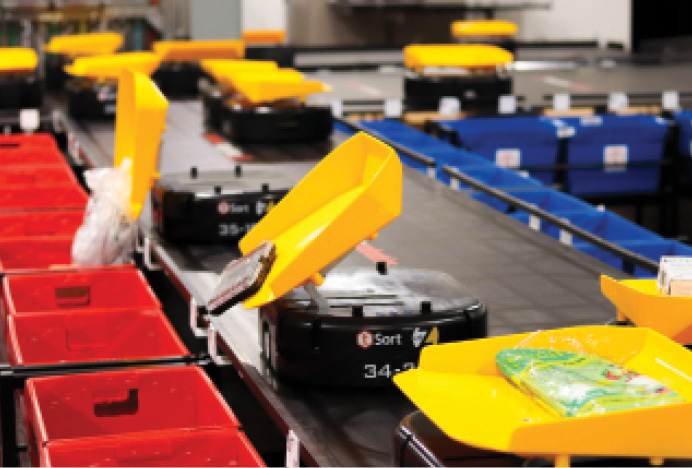
An MFC is a small, automated fulfillment center that specializes in fulfilling online orders and is geographically located within city limits to put inventory closer to customers to allow faster delivery and returns.
A good example of how an MFC can work for a retailer is for online grocery orders, which connects an advanced warehouse management system (WMS) with a robotics solution. The MFC supports high SKU assortments in smaller warehouses by using vertical space to house six times as much product as a traditional warehouse floor.
It also increases order accuracy and reduces human labor by 75%, reducing the total cost-per-unit. And it can be quickly implemented, scaled, and customized to a specific retailer’s needs.
MFCs offer three significant advantages over traditional fulfillment approaches that can help retailers provide the NDD or SDD today’s customer demands:
They reduce cost to serve. Retailers’ stores were never built to be fulfilment centers. While stores can take the pressure off distribution centers (DCs), the amount of labor and time required to manually pick and pack individual orders adds significant cost to fulfilment. As a result, this model isn’t sustainable over the long term, especially for retailers with razor-thin margins, such as grocers.
In contrast, an MFC optimizes its operations to reduce delivery cost. It provides high-density storage in the center of a highly populated area, fast retrieval of orders, higher order aggregation, and optimized delivery van loading. It reduces the cost of storage as well as errors in handling, order processing, and delivery, which minimizes the overall cost to serve.
They improve the customer experience, loyalty and revenue. A significant majority of retailers rely on traditional DCs for online fulfillment, are dependent on 3PLs, have a DC or store presence only in specific geographies, or are constrained by legacy technology systems that limit new fulfillment options.
It’s virtually impossible for these retailers to provide faster delivery services such as SDD and NDD. Further, those using stores for fulfilment face physical size and operational technology limitations that restrict the size of assortment they can offer online customers.
An MFC can hold more than 20,000 SKUs in automation, which boosts inventory accuracy, avoids stock-outs or substitutes, and increases order processing accuracy. MFCs also contribute to maintaining a positive in-store experience, as shoppers are not competing with e-commerce shoppers for the products on the shelf. That keeps existing customers coming back for more and attracts new ones.
They reduce carbon footprint. Customers are increasingly judging brands on how well they’re meeting carbon-reduction goals. Last-mile delivery has a massive impact on carbon footprint, from packaging waste to multiple delivery trips per order.
A recent Accenture study on the impact of currently used last-mile delivery options found that they result in a multiple-fold increase in vehicles on the road and contribute to higher mileage, increased congestion, and a much higher carbon footprint.
An MFC cuts the distance products need to travel and aggregates demand for higher vehicle load and route efficiency, significantly lowering the carbon footprint associated with product delivery. And the immediacy of SDD will make consumers think twice before taking their car to go shopping. If they decide not to, it reduces fuel consumption, congestion, and pollution.
Retailers’ growth in e-commerce order volumes and customers’ same-day and next-day delivery expectations are putting pressure on traditional supply chains and systems. Single retailers may not be able to generate the volume to provide SDD and NDD and can’t justify the build-out of the necessary infrastructure.
Customers likely aren’t willing to wait and will jump to another provider that can meet their needs. A multi-tenant MFC can allow retailers to offer SDD and NDD while optimizing costs and improving the customer experience. It’s a profitable and sustainable solution to SDD and NDD that can help retailers remain competitive in today’s demanding environment.

Article Topics
E-commerce News & Resources
ShipMatrix reports strong Cyber Week delivery performance results DHL’s 2025 Peak Season approach includes more planning and less panic Q&A: Ali Faghri, Chief Strategy Officer, XPO Logistics real estate demand hits an inflection point, reports Prologis Industrial Business Indicator DHL eCommerce report finds logistics subscriptions and multi-carrier strategies are key to 2025 Peak Season success Fed delivers second straight rate cut as growth slows and job market softens New JLL report highlights strong Q3 industrial leasing activity More E-commerceLatest in Logistics
ISM forecast sees a manufacturing rebound in 2026 as services maintain steady expansion PwC report indicates transportation and logistics dealmaking activity is focused on strategy, not scale ShipMatrix reports strong Cyber Week delivery performance results National diesel average falls for the fourth straight week, reports EIA FTR’s Shippers Conditions Index shows modest growth Trucking executives are set to anxiously welcome in New Year amid uncertainty regarding freight demand ASCM’s top 10 supply chain trends highlight a year of intelligent transformation More LogisticsSubscribe to Logistics Management Magazine

Find out what the world's most innovative companies are doing to improve productivity in their plants and distribution centers.
Start your FREE subscription today.
December 2025 Logistics Management

Latest Resources












