
Logistics & Transportation Management “2025 Must Reads”
As the logistics and freight transportation landscape continues to evolve, the Logistics Management editorial staff has selected the “Must-Read” features from 2025.

The Logistics Management editorial staff has selected the “Must-Read” features from 2025—articles that stand out for their insight, relevance, and impact. Each of these pieces offers a deeper understanding of the key forces shaping the market and provides valuable guidance as shippers prepare their logistics operations for the challenges and opportunities ahead in 2026.
Together, these stories capture the year’s most important developments across Transportation Trends, Logistics Technology, and Global Logistics—making this collection an essential refresher for industry professionals looking to stay ahead.
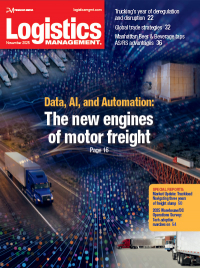
Data, AI, and Automation: The new engines of motor freight (LM Nov 25)
Technology and data are helping shippers, carriers, and brokers cut costs, manage risk, and stay ahead in an increasingly complex freight market. From AI-driven routing to smarter load boards and real-time visibility, digital tools are reshaping how motor freight moves and how decisions are made.
E-commerce: Logistics redefined (LM March 25)
The rise of e-commerce continues to disrupt logistics and supply chain operations, driving the need for faster, more efficient delivery models. As consumer demands evolve, traditional freight methods are being replaced by innovative solutions to keep pace with unprecedented growth in parcel shipments. Here’s a look at where we are.
Reverse Logistics in 2025: Turning returns into a competitive advantage (LM March 25)
Reverse logistics is not only about managing returns; it’s about creating a more sustainable and efficient supply chain. So, whether you’re a retailer, a tech company, or a manufacturer, it’s time to rethink your reverse logistics strategy and stay ahead of the curve.
Talent Reinvention: Making the urgent case for people-centric supply chains (LM June 25)
Digital tools are transforming logistics, but it’s human talent that ultimately drives success. To stay agile and competitive, companies must put people at the center of their technology strategy.
The Great Disconnect: Bridging the knowing/doing gap in logistics (LM Sept 25)
Our 34th Annual Study of Logistics and Transportation Trends survey team discovers a persistent gap between knowing what’s possible in logistics and actually putting it into practice. From AI adoption to talent development and technology integration, leaders understand the path forward, but action still lags behind insight.
36th Annual State of Logistics Report: Navigating uncertainty amid rising costs and global disruptions
As the global logistics market nears $6 trillion by 2030, U.S. shippers are navigating a turbulent environment marked by economic, geopolitical, and environmental challenges. The 36th Annual State of Logistics (SoL) Report reveals a supply chain in flux, with fragile optimism for the future. While e-commerce shows promise, persistent tariff tensions, rising costs, and global disruptions continue to impact the logistics industry.
2025 Parcel Express Roundtable: Shippers navigate flat growth and price pressures (LM May 25)
As carriers grapple with stagnant demand and shifting economic conditions, parcel shippers must stay agile to maintain negotiating power in a market still defined by rising rates and strategic recalibration. Three top parcel industry experts weigh in on the most consumer-facing sector of freight logistics.
Tariffs, Trade, and Tension: What’s ahead for cross-border logistics in North America (LM June 25)
As tariff policy shifts and the USMCA faces renegotiation, carriers and shippers are bracing for more uncertainty—even as North American trade continues to grow.
15th Annual Rail/Intermodal Roundtable: Seeking growth drivers amid big M&A questions (LM Oct 25)
Three of the nation's top freight rail and intermodal analysts explore the market’s current state, covering service performance, regulatory developments, and pricing dynamics.
2025 Logistics Technology Roundtable: AI, Automation, and the Future of Supply Chain Innovation (LM May 25)
From AI-powered transportation management systems (TMS) to warehouse robotics and end-to-end automation, this expert roundtable explores how logistics and supply chain operations are being transformed by technology. Four leading analysts share insights on the current state of tech adoption—and where innovation is heading next.
AI in Supply Chain Software: Opportunities, Challenges, and the Future of Automation (LM July 25)
Artificial intelligence is gaining traction in SCM platforms, offering predictive insights and autonomous operations in some cases. Yet, concerns over data quality, cost, and complexity are keeping many companies from realizing its full potential.
Using tech to tame the transportation chaos (LM Jan 25)
Changing customer expectations, increased competition, and a focus on sustainability are all driving shippers to rethink their transportation strategies. Transportation management systems are helping shippers streamline their logistics operations and manage this still highly uncertain logistics environment.
Automating global trade compliance in an era of uncertainty (LM Feb 25)
Amid shifting trade requirements, evolving tariffs, and the threat of trade wars, shippers are leaning on global trade management (GTM) solutions to automate compliance and navigate an increasingly unpredictable business landscape and vendors are responding to their needs.
The “T” Word: How tariffs shook global trade (LM Nov 25)
It’s been a year of starts, stops, and uncertainty in trade compliance. Here’s how logistics and supply chain professionals can prepare for 2026 while staying compliant, efficient, and resilient.
Strategies in Flux: The C-suite responds to shifting tariff policies (LM Aug 25)
We spoke to 18 executives to understand how they’re adapting to the evolving tariff landscape.
Navigating the Evolving U.S. Tariff Landscape: Strategic moves for importers in 2025 (LM Aug 25)
Our insider explores the evolving tariff landscape and discover essential strategies for U.S. importers to stay competitive, compliant, and resilient in 2025. With a structured, informed approach, businesses can successfully navigate tariff complexities and uncertainties
Freight Forwarding’s Next Phase: Managing instability with innovation (LM May 25)
With softening demand and economic headwinds, freight forwarders are leaning on technology and value-added services to maintain their edge.
3PLs Under Pressure: Growth collides with global logistics disruption (LM June 25)
As tariffs rise, labor tightens, and supply chain costs climb, 3PLs are reworking operations across warehousing, transport, and value-added services to stay competitive.
The Great Disconnect: Bridging the knowing/doing gap in logistics (LM Sept 25)
Our 34th Annual Study of Logistics and Transportation Trends survey team discovers a persistent gap between knowing what’s possible in logistics and actually putting it into practice. From AI adoption to talent development and technology integration, leaders understand the path forward, but action still lags behind insight.
Truckload 2025: How carriers are navigating a three-year freight slump (LM Nov 25)
The $387 billion U.S. truckload sector remains mired in a three-year freight recession. Carriers face soft demand, rising bankruptcies, and potential disruption from a proposed transcontinental rail merger, while savvy operators pursue new strategies to rebuild volume and protect profitability.
Regulatory Reset: How deregulation is disrupting trucking in 2025 (LM Nov 25)
The first year of relaxed trucking regulations under the Trump administration is reshaping the $1 trillion industry. From language enforcement and speed limiter rollbacks to autonomous truck trials and emissions reversals, shifting policies are redefining safety, technology, and environmental standards across the nation.
Breaking Down Silos: The rise of integrated supply chain ecosystems (LM May 25)
Standing at the intersection of interconnected physical assets and automated processes is supply chain management (SCM) software, which serves as the connective tissue in today’s ever-evolving landscape.
Ocean carriers navigate rising geopolitical risk and route disruptions (LM June 25)
Geopolitical conflict, rerouting, rising costs, and tariff pressure are rewriting the rules for global container shipping—well into 2025 and beyond.

Article Topics
Latest in Logistics
Union Pacific–Norfolk Southern merger filing with the STB is delayed delayed until mid-December Old Dominion Freight Line issues November operating metrics update Services economy remains on growth track in November, reports ISM Looking at the LTL market with Scooter Sayers U.S. Department of Transportation targets ‘CDL Mills’ as thousands of training providers removed from federal registry Key Ocean, Air, and Trade Trends as We Approach the New Year National diesel average falls 7.3 cents, down for second consecutive week, reports EIA More LogisticsSubscribe to Logistics Management Magazine

Find out what the world's most innovative companies are doing to improve productivity in their plants and distribution centers.
Start your FREE subscription today.
November 2025 Logistics Management
Latest Resources












