
36th Annual State of Logistics: Tariffs and market uncertainty challenge LTL carriers’ profitability
The $66 billion less-than-truckload (LTL) market is facing a turbulent year, with tariffs and economic uncertainty significantly impacting profitability.
Latest Logistics News
FTR’s Shippers Conditions Index shows modest growth Trucking executives are set to anxiously welcome in New Year amid uncertainty regarding freight demand U.S.-bound imports see November declines, reports S&P Global Market Intelligence FTR Trucking Conditions Index shows slight gain while remaining short of growth DOT revokes licenses of 17,000 non-domiciled CDL holders in California More Motor Freight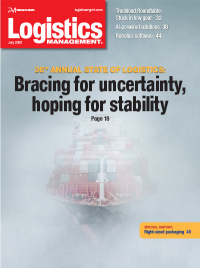
The $66 billion less-than-truckload (LTL) market is primed for what one leading analyst calls a turbulent year.
“It’s going to be a roller-coaster,” says Satish Jindel, principal of SJ Consulting, a leading trucking data and advisory firm. “And that’s because our economy is on a roller coaster due to the tariffs.”
According to Jindel, that forecast holds for the rest of 2025 and into next year: “I see a very uncertain environment for the carriers. In transportation, carriers have no influence on demand. The only thing they have control over in terms of capacity is supply.”
That supply includes not just the number of trucks and drivers, but terminals. A handful of the leading LTL carriers—notably, Estes Express, FedEx Freight, and Saia—scooped up a 100 or so old Yellow terminals when that carrier went out of business two years ago.
Jindel and other analysts have one piece of advice for the surviving carriers in the LTL space. “Don’t bring them online—keep them for a rainy day,” says Jindel.
That’s because, normally, when you’re trying to grow market share in a flat to negative market, the only way you can be competitive is on price. Jindel advises LTL carriers to eschew that strategy.
Combined revenue of the top 25 LTL carriers dropped 1.3% to $48.2 billion in 2024, according to figures supplied by SJ Consulting. The major difference between LTL and truckload freight is market share. The largest LTL carrier has almost a 10% market share, compared with TL where the largest carrier, Knight-Swift, barely has 1% share.
Another factor affecting pricing in the LTL market is the major changes coming to freight classifications under the National Motor Freight Classification (NMFC). In an attempt to significantly overhaul and modernize the system, it will primarily transition from commodity-based to density-based classification for LTL freight.
This shift will start July 19. While its aim is to simplify and standardize the process and improve transparency, it might lead to confusing shipping costs, at least at the start of the transition.
“The timing of the NMFC changes is awful,” says Jindel. At the start, NMFC is changing only about one-fourth of all commodities. “They should postpone it until next July and make it for all commodities. It’s a wasted effort in this market. Any carrier that pushes for dimension pricing now is half baked and poorly timed.”
If they don’t, adds Jindel, expect the list of LTL carrier bankruptcies to grow even further. Already in this century, grand old names such as Central Freight Lines, New England Motor Freight, Lakewood, Consolidated Freightways, A-P-A Transport and scores of others have disappeared.
“Improving the operating efficiency in our network is very difficult to achieve when a reduction in density is experienced,” ODFL president and CEO Kevin Freeman said on a recent analysts call. “That is why I'm proud that we improved our platform shipments per hour and pickup and delivery shipments per hour in the first quarter despite the 5% decline in our LTL shipments per day.”
Increasing profitability in a down market is what separates great, long-lasting carriers from those entering bankruptcy court.

Article Topics
Estes Express Lines News & Resources
36th Annual State of Logistics: Tariffs and market uncertainty challenge LTL carriers’ profitability State of Logistics 2024: Less than truckload (LTL) Estes’ $1.52 billion bid beats ODFL’s bankruptcy offer for Yellow terminals ODFL, Estes Express make stalking horse offers for defunct trucker Yellow’s assetsLatest in Logistics
FTR’s Shippers Conditions Index shows modest growth Trucking executives are set to anxiously welcome in New Year amid uncertainty regarding freight demand ASCM’s top 10 supply chain trends highlight a year of intelligent transformation Tariffs continue to cast a long shadow over freight markets heading into 2026 U.S.-bound imports see November declines, reports S&P Global Market Intelligence FTR Trucking Conditions Index shows slight gain while remaining short of growth AAR reports mixed U.S. carload and intermodal volumes, for week ending December 6 More LogisticsSubscribe to Logistics Management Magazine

Find out what the world's most innovative companies are doing to improve productivity in their plants and distribution centers.
Start your FREE subscription today.
December 2025 Logistics Management

Latest Resources












