
Lawson’s multi-purpose distribution center
Lawson Products built a new distribution center to optimize its network, package and kit products, and deliver better customer service to its branch DCs and customers.
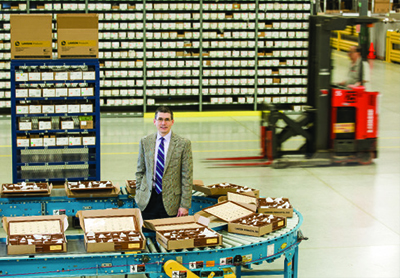
It’s a safe bet that just about everyone has a Swiss Army knife tucked away in a glove compartment, kitchen drawer or tool box. Whether you need a sharp blade, screwdriver, wine opener or tweezer in a pinch, it serves a multitude of purposes.
In McCook, Ill., Lawson Products worked with a supply chain consulting firm (Peach State) to design a multi-purpose distribution center. Sure, the distributor of supplies for maintenance, repair and operations (MRO) replenishes its branch DCs and ships orders to customers from the 308,000-square-foot facility near Chicago’s Midway Airport. But, like the Swiss Army knife, the DC also serves a multitude of purposes beyond order fulfillment.
For one, it is the hub of a network that also includes branch facilities in Suwanee, Ga.; Reno, Nev.; Mississauga, Ontario; and several smaller locations in Western Canada. In that role, the facility receives and inspects product from suppliers, crossdocks fast-moving products directly to branch facilities, and puts the rest into storage for replenishment and fulfillment. Taking things a step beyond, it also serves as a production facility where bulk deliveries are packaged into smaller order quantities on multiple workstations, while industry-specific item assortments are kitted together for a Vendor Managed Inventory program in another area. There is also a designated chemical distribution area.
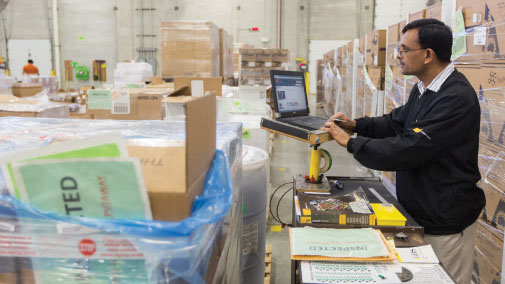
The Swiss Army knife approach allowed Lawson Products to consolidate its network, says Shane McCarthy, senior vice president of supply chain and business development for the MRO provider. “Prior to this building, we had three facilities in Illinois handling chemical distribution, small parts distribution, and kitting and repackaging,” McCarthy says. What’s more, while the majority of packaging was done in Illinois, about 20% was done in the branches. “Now, we do 100% of packaging and kitting in the hub,” McCarthy says. “We’re touching product just once to put it in user-friendly packaging right from the outset.”
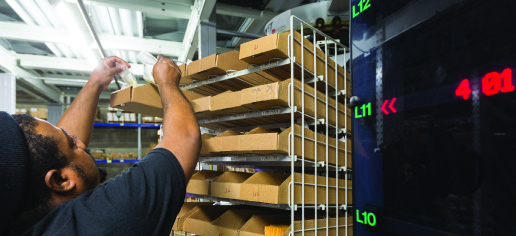
To bring it all together, Lawson Products’ design partner implemented automation that fit the demands of the facility, including goods-to-person picking from horizontal carousels, a two-level picking mezzanine using wrist-mounted mobile computers and ring scanners and a warehouse execution system (WES) that manages the automation and directs fulfillment activities once orders are received from Lawson Products’ enterprise resource planning (ERP) and warehouse management system (WMS) solutions.
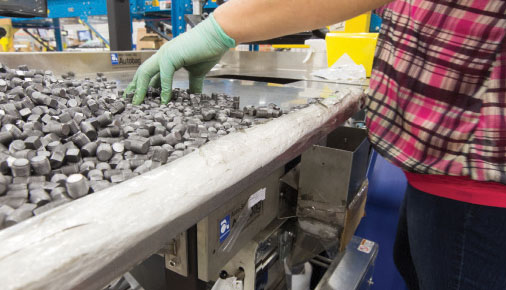
The result, according to McCarthy, has been better visibility across the network, improved inventory turns, and improved customer service. “Our customers, sales representatives and customer service can now see what product is available in our network,” McCarthy says, “and there’s no doubt that our packaging and kitting capabilities distinguish us when it comes to Vendor Managed Inventory, which is an important niche for our business. We have the best, most flexible and scalable system in the market.” He adds that the combination of an ERP system and weighing and cubing technologies has allowed the company to optimize its order picking, storage and shipment carton cube utilization. Packaging functions have also been enhanced across 22 hand pack and eight automated packaging stations.
Small parts, big on service
MRO is literally the nuts and bolts of the supply chain. That’s the world where Lawson Products has carved out its niche. While the big players like Grainger and MSC Industrial sell just about everything under the sun when it comes to maintenance and repair, Lawson focuses on high-quality small parts and consumables—like fasteners, nuts and bolts.
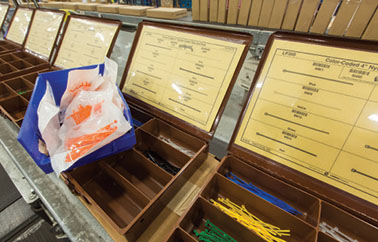 The company’s go-to-market strategy centers on being present—Lawson Products has more than 1,000 sales representatives throughout the United States and Canada—who take a consultative approach to helping their customers improve their uptime. Vendor Managed Inventory, or VMI, is an essential service.
“We differentiate ourselves on service and the technical knowledge we provide,” McCarthy says. “Our sales people are an extension of our customers’ maintenance departments. And, because we package and kit our products, we can sell in smaller quantities than the big players. A customer can have a small quantity of a lot of items on the shelf, which we physically replenish according to their needs.”
As with most verticals, the industry is changing. “Our customers are consolidating the money they spend on indirect MRO and looking more closely at their distributors than in the past,” McCarthy says. “They want consistent billing, consistent support and more capabilities, including search engines to find the specific products they need for their applications. They’re measuring us with supplier score cards, just like their OEM and direct suppliers.”
Lawson measures itself as well. A corporate-wide commitment to continuous improvement, beginning with the adoption of lean Six Sigma methodologies in 2013, has significantly reduced non-value added work in the DCs, identified areas for development, and informed strategies for advancement.
Prior to the McCook facility, there were two significant gaps in Lawson Products’ capabilities. First, the various DCs in the network were islands when it came to inventory visibility; individual DCs may have known what they had in stock but that information wasn’t readily visible to corporate inventory managers and buyers or to the sales teams and customers. “Inbound inventory was typically allocated to one or two DCs,” McCarthy says. “But that meant we were ordering inventory for Reno when the Suwanee facility had excess stock that could have been re-allocated to another location.” The result was less than optimal inventory turns.
A second gap was that product was touched more than was necessary. Some product might be received and packaged in one of the Chicago DCs, or, it might be shipped from Chicago to a hub DC, where it then had to be unloaded and packaged.
The first step in closing those gaps, as is true with many e-commerce retailers today, was a network study by Lawson Products’ supply chain consultants. They traveled with sales representatives to learn about the needs of the customer base; the supply base and SKU count; and how customers ordered and used products. “The most important thing to us is the ability to ship an order complete. Otherwise, given the weight of our products, shipping is expensive if we send out two shipments to complete an order,” McCarthy says. “We looked at where our facilities should be located and how many SKUs we wanted to stock in a building to get a high order completion rate. That drove the next decisions we had to make.”
The conclusion was that the network itself worked—the DCs were in the right locations. Instead, the supply chain transformation was to move from a push approach, where stock was ordered and pushed out to the hub DCs, to a pull environment where everything was processed in a central location in Chicago and, with better visibility, shipped to the hubs on an as-needed basis. “We wanted to get away from buying inventory before we needed it to handling it just once when it comes from the supplier and then sending it out to the market,” McCarthy says.
Finally, Lawson Products wanted to double its capacity for outbound orders to accommodate projected growth.
The answer was to consolidate all of the Chicago activities into one new multi-purpose facility, with packaging and kitting capabilities and visibility across the network.
See a detailed layout of Lawson Products’ redesigned distribution center.
Automation that fits
Central to the design of the new facility was the idea of automation that fits. “From the start, we told our consultant that we were completely agnostic when it came to technology,” McCarthy says. “That said, every business needs the right level of automation to match its order-to-delivery cycle. In hospital supplies, everyone wants to order up until 5 p.m. and get delivery by 5 a.m.—they need a high level of automation. Our sales reps, on the other hand, place orders throughout the day so that we don’t have a huge bottleneck of work at 4 p.m. That allowed us to have a less intense amount of automation.”
For that reason, the two-level pick module relies on conventional RF-directed picking to containers on conveyor and goods-to-person picking from horizontal carousels, rather than a mini-load or shuttle. Horizontal carousels fit the purpose.
Of greater importance was implementing systems that provided visibility into inventory levels and inbound shipments. The goal is to plan work 2-1/2 days out in the packaging area. “We manage 55,000 SKUs from 2,000 suppliers with a fairly small but dedicated team,” McCarthy says. “Our whole supply chain is predicated on a certain number of days of inventory in the system. When we cut a PO, they know they can be up to two days early and one day late.”
An ERP system, which includes warehouse management, gave Lawson Products the ability to build standard costs around packaging—that helps determine whether it’s more affordable to have a supplier do the packaging as a value-added service or do it in-house—and implement a supplier score card that tracks on-time shipping, complete orders, accuracy and product quality. The ERP system also interfaces with a cubing and weighing system that enabled more efficient outbound packaging and shipping and fewer pack-out stations. “In the old facility, we picked into a tote that was repacked into a box,” McCarthy says. “Now we can pick an optimal box size and pick directly into a shipping carton.”
The ERP system also creates job orders for packaging—say creating 500 bags of 10 items each from a delivery of 5,000 parts—and assigns the work to either the automated line for smaller parts or the hand packaging line for larger parts. And, while the ERP system receives orders and drops them into the warehouse, a WES functions as the interface to the conveyor system and horizontal carousels, and creates waves designed to optimize the flow of orders inside and outside of the automation.
The final consideration was a strategy for storage. “When we flipped the switch, we assumed that we wanted to put everything into stock and then pick from reserve storage,” McCarthy says. “What we realized is that our fast-movers might only sit in storage for a week before we were picking them.” Now, the highest-volume items are packaged and sorted by DC by seven or eight key suppliers. When they arrive in McCook, those shipments are received, inspected and then staged in a shipping lane for outbound delivery.” Lawson’s crossdock process allows for visibility across the entire supply chain, from initial pallet receipt to final put away. McCarthy adds that the McCook facility is located near a UPS facility that provides good coverage for parcel delivery.
“We compete with some very large companies,” McCarthy says. “We’re not going to out supply chain them. But by creating a pull strategy coupled with our packaging and kitting capabilities, we have what we believe is the best system out there from a pure VMI standpoint.”
System suppliers:
System Design & Integration: Peach State
Conveyor & Sortation: Hytrol
Enterprise Resource Planning (ERP): SAP
Warehouse Execution Software (WES): Numina Group
Horizontal Carousel: Sapient/ MDCI Automation
Lift Trucks: The Raymond Corporation
Bar Code Scanning/Wrist Scanning: Zebra Technologies (Motorola) Honeywell (LXE)
Cubing & Weighing: Cubiscan
Shipping Software: ADSI
Full Systems Report for Lawson Product’s DC

Article Topics
Latest in Logistics
PwC report indicates transportation and logistics dealmaking activity is focused on strategy, not scale ShipMatrix reports strong Cyber Week delivery performance results National diesel average falls for the fourth straight week, reports EIA FTR’s Shippers Conditions Index shows modest growth Trucking executives are set to anxiously welcome in New Year amid uncertainty regarding freight demand ASCM’s top 10 supply chain trends highlight a year of intelligent transformation Tariffs continue to cast a long shadow over freight markets heading into 2026 More LogisticsAbout the Author

Subscribe to Logistics Management Magazine

Find out what the world's most innovative companies are doing to improve productivity in their plants and distribution centers.
Start your FREE subscription today.
December 2025 Logistics Management

Latest Resources












