Labor Crisis: A proactive approach to filling Logistics Jobs
A tight labor market driven by the uptick in e-commerce, increased omni-channel distribution pressures, Baby Boomer attrition and the implementation of game changing technology are pushing logistics management professionals to rethink the way they hire, train and retain valued employees.

As the pool of available talent continues to shrink in the United States, logistics and supply chain organizations are sharpening their skills and getting more creative about finding, recruiting and training new employees.
The good news is that supply chain and logistics is becoming a more mainstream career path for new graduates entering the workforce. And while traditionally thought of as more of a manual labor job, it’s becoming more white collar as time goes on. “No longer equated to heavy, manual work, today’s manufacturing and distribution environments are highly automated and reliant on technology,” says Tisha Danehl, vice president of Ajilon, a national professional staffing agency serving the supply chain and logistics industries.
The not-so-good news is that supply chain and logistics organizations got caught off-guard by the labor shortage, and now lack the resources they need to fill all of the available positions.
For example, according to the U.S. Bureau of Labor Statistics (BLS), jobs in logistics are estimated to grow by 26% between 2010 and 2020. “We’re in a tight candidate market, with unemployment hovering near a 15-year low,” Danehl points out. “The lack of suitable workers available is leading to an increase in demand for supply chain and logistics professionals that the industry simply can’t keep up with.”
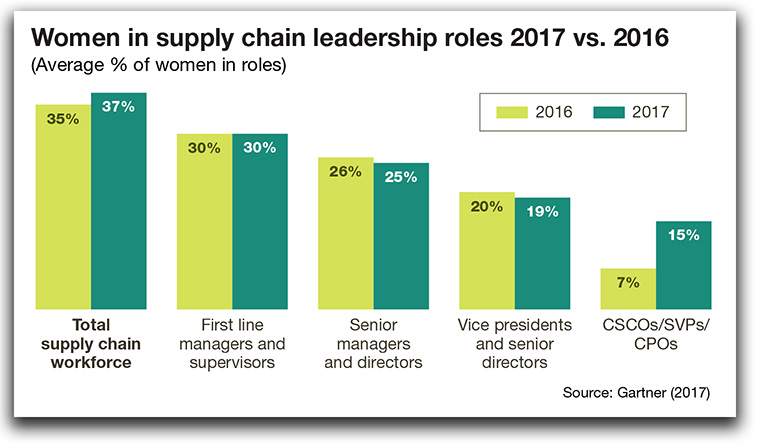
Some of the problem can be attributed to the supply chain and logistics workforce itself, which Danehl says has been historically male-dominated, with women making up only 37% of the labor pool, according to Gartner. Also, consumer expectations for faster delivery has sparked a far-reaching change in the way things are operating in both logistics and throughout the supply chain itself, with a stronger emphasis placed on speed and the use of enhanced technology.
“Amid this changing business landscape, specialized workers in supply chain and logistics are becoming more valuable than ever,” says Danehl, “and employers need to focus on and invest in recruiting, training and retaining the right talent.”
Looking for new opportunities
The dearth of quality logistics and supply chain talent is one factor that’s boosting salaries for the field’s most valued employees. According to Logistics Management’s 2018 Salary Survey, for example, the average reader’s salary is $114,250 this year, up from $113,175 last year and $105,675 in 2016. Sixty-four percent of survey participants said their salary increased over the prior 12 months, with logistics manager/director, operations manager/director, and vice president/general manager as the top three most common job titles among respondents.
However, as logistics salaries have risen, so too have the number of functions that these professionals are being asked to do. Seventy-seven percent of readers say that the number of functions they’re performing has increased over the last year, with just 21% saying their responsibilities have stayed the same—with just 2% saying functions have decreased. Thirty percent of readers say that they’re happy where they are career-wise, but 43% are “always looking for better opportunities” and 8% are “actively looking” for new jobs.
And it’s not always low salaries that prompt employees to seek out new positions. When asked what factors affect their job satisfaction, for example, readers listed “feeling of accomplishment” and “relationships with colleagues” as their two top factors, followed by salary and the relationship they have with their bosses. Company politics, high stress levels, salary and a lack of room for advancement top the list of grievances with their current jobs.
In some cases, an onerous hiring process that makes it difficult for an employee to apply—and be interviewed—for a new position can be a major barrier in the current environment. A process that takes too long, for instance, could drive candidates off to greener pastures.
“One way for companies to attract the most promising candidates in today’s market is to streamline the hiring process,” says Danehl, who cites a recent Google Consumer Survey—conducted by Ajilon—of professionals employed across a variety of industries. Ninety percent said the hiring process should take less than four weeks from application to onboarding, and 54% said it should take two weeks or less.
“In reality, the average interview process currently takes about 23 days, and the average total hiring cycle spans nearly 43 days,” says Danehl. “With hiring taking almost two full weeks longer than candidates expect, there’s a tremendous opportunity for employers to tighten their hiring timeline to avoid missing out on valuable talent.
Garnering interest in logistics at a younger age
In an effort to get younger candidates interested in logistics and supply chain jobs, Nora Neibergall, senior vice president of certifications at Institute of Supply Management (ISM), says the organization has stepped up its 30-Under-30, Fledgling Stars and scholarship programs over the last few years.
“Those efforts target both practitioners as they come out of college and those who have been in the profession for three years to seven years as well as those who are choosing their next path and where they want to go,” says Neibergall.
And despite the obvious labor market challenges that all industries are grappling with right now, Neibergall says logistics and supply chain as a whole is garnering more attention and gaining momentum as a great potential career.
“People are being more deliberate about the choice to go into logistics and supply chain in general, and understand that it’s an attractive career offering,” Neibergall notes. “At the same time, more schools have added logistics and supply chain programs that make students aware of the opportunity much earlier in their careers.”
Stop chasing the “purple squirrel”
George Yarusavage, principal at Fortress Consulting and an APICS board of directors member, says too many companies are looking for the impossible candidate that meets every single criteria.
“Logistics management professionals need to stop looking for the purple squirrel,” says Yarusavage. For example, some firms are condensing positions across two or three different disciplines and then trying to fill those positions with candidates who have 12 different types of job experience or training. “Then, they won’t even consider a candidate who only has nine or 10 of those qualifies—they’re looking for a 12-out-of-12 fit.”
The problem is that some companies are scouring the labor pool for talent, but are unwilling to train for that talent. A better approach, says Yarusavage, is to find an individual who possesses at least the basic qualities or experience, and who has the ability to learn what he or she needs to in order to become that “purple squirrel.”
One way shippers can buck this trend is by looking at what some would consider unconventional or alternative pools of potential talent. Women, veterans and disabled workers have been largely left out of the logistics and supply chain wave, for instance, but they all make great job candidates for the right company.
“The role of women in the industry continues to expand, and a greater emphasis is being placed on reaching balanced representation,” says Danehl. She points to groups like AWESOME, a non-profit organization dedicated to advancing women’s leadership in logistics and supply chain, as a step in the right direction.
One way shippers can help to advance that effort is by targeting their recruiting messages to women or other “non-traditional” logistics and supply chain employees by offering benefits and initiatives that are specifically appealing to them, such as flex time, mentorships and on-the-job training opportunities.
“Implementing executive leadership programs that connect women with logistics and supply chain industry leaders for their guidance and support,” says Danehl, “is a great way for companies to communicate their commitment to helping women grow and advance their careers.”
9 ways to attract and retain employees in 2018
Tisha Danehl, vice president of Ajilon, offers this laundry list of tips for logistics managers that need help finding and retaining workers:
- Streamline the hiring process. With hiring taking almost two full weeks longer than candidates expect, there’s a tremendous opportunity for employers to tighten their hiring timeline to avoid missing out on valuable talent.
- Shift recruitment strategies to focus more on the benefits package. While salaries will continue to remain competitive, companies will increasingly need to evaluate their benefits to recruit top talent.
- Place a greater focus on retention strategies in an effort to stand out amongst your competitors and signal to employees that they’re invested in their professional growthand development.
- Offer formal mentorship programs in order to strengthen employee engagement.
- Make your recruiting message more friendly and focused to women by offering benefits and initiatives that are specifically appealing to them, such as flex time, mentorships and on-the-job training opportunities.
- Implement executive leadership programs that connect women with industry leaders for their guidance and support is another great way for companies to communicate their commitment to helping women grow and advance their careers.
- Turn to academia by partnering with local institutions in the area to build a pipeline of the next generation of talent. (Gartner publishes a biennial “Top 25 North American Supply Chain Undergraduate Programs” report.)
- Shift the talent search to cater to the younger generations. A recent Google Consumer Survey conducted by Ajilon found that 31% of employed Millennials are open to new job opportunities.
- Form relationships with local and national veterans’ groups to tap into this great source of talent. “Workers who have previous experience doing logistical work for the military will be particularly valuable in the coming years,” Danel says, “driven by the need for logistics in the transportation of goods in today’s global economy.”
10 years from now
Amid the generational shift occurring in today’s workforce, and with the introduction of Gen Z (people born from the mid-1990s to the early 2000s) and the steady retirement of Baby Boomers, Danehl tells logistics and supply chain management professionals to shift their recruitment strategies to focus more on their
benefits packages.
“While salaries will continue to remain competitive,” says Danehl, “companies will increasingly need to evaluate their benefits to recruit top talent.”
Companies should also begin placing a greater focus on retention strategies in an effort to stand out among their competitors, and to signal to their employees that their employers are invested in their professional growth and development. “Offering formal mentorship programs is one such way to strengthen employee engagement,” says Danehl.
Neibergall says developing very clear career paths and advancement opportunities, and then conveying that information to all employees can also go a long way in retaining talent in today’s labor-strapped environment. “This can be tough to do, and namely because organizations are a lot ‘flatter’ than they used to be, with few or no middle managers,” says Neibergall, “but it’s always good to at least try to talk about where that candidate or employee can be five, eight, or 10 years from now.”

Article Topics
Warehouse News & Resources
Looking at the impact of tariffs on U.S. manufacturing C.H. Robinson expands El Paso operations with 450,000 square-foot facility to meet rising Mexico trade demand Despite billions invested, supply chain technology is still falling short, says DHL report Logistics growth holds steady in October, states new edition of LMI Logistics real estate demand hits an inflection point, reports Prologis Industrial Business Indicator GXO posts record-setting Q3 earnings results Amid economic uncertainty, NRF forecast calls for a record retail holiday sales season More WarehouseLatest in Logistics
Looking at the impact of tariffs on U.S. manufacturing UP CEO Vena cites benefits of proposed $85 billion Norfolk Southern merger Proposed Union Pacific-Norfolk Southern merger draws praise, skepticism ahead of STB Filing National diesel average is up for the fourth consecutive week, reports Energy Information Administration Domestic intermodal holds key to future growth as trade uncertainty and long-term declines persist, says intermodal expert Larry Gross Railroads urged to refocus on growth, reliability, and responsiveness to win back market share Q&A: Ali Faghri, Chief Strategy Officer, XPO More LogisticsAbout the Author

Subscribe to Logistics Management Magazine

Find out what the world's most innovative companies are doing to improve productivity in their plants and distribution centers.
Start your FREE subscription today.
November 2025 Logistics Management

Latest Resources