
Global Trade Management Update: Simplifying complexity
As international trade volumes continue to hit records every year, shippers of all sizes are turning to applications to gain visibility and control of their global trade processes and GTM vendors are there to answer the call.


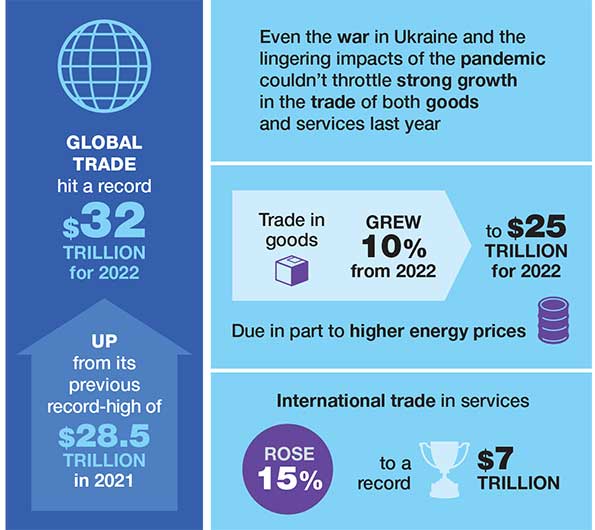
Global trade hit a record $32 trillion for 2022, up from its previous record-high of $28.5 trillion in 2021. According to UNCTAD’s latest , even the war in Ukraine and the lingering impacts of the pandemic couldn’t throttle strong growth in the trade of both goods and services last year. Trade in goods grew 10% from 2021 to an estimated $25 trillion for 2022, due in part to higher energy prices, while international trade in services rose 15% to a record $7 trillion.
In the meantime, new trade agreements, fewer ocean shipping snarls and a reduction in ocean freight rates may have all helped buoy global trade last year. For example, UNCTAD says the Regional Comprehensive Economic Partnership and the African Continental Free Trade Area both helped to “improve logistics” in 2022.
“Ports and shipping companies have now adjusted to the challenges brought on by the COVID-19 pandemic,” UNCTAD adds. “Freight and cargo rates are still higher than the pre-pandemic averages, but the trend is downward.”
As global trade volumes continue to climb year-over-year, a growing number of shippers are dipping a toe in international waters. What many quickly find is that doing business with overseas customers and suppliers is a lot different than transacting business within your own borders. Knowing this, global trade management (GTM) software providers are regularly honing and improving their platforms to meet the needs of today’s international shippers.
The platforms manage the logistical, regulatory and financial aspects of the import and export processes associated with international trade, and often for multiple modes of transportation. According to Oscar Sanchez Duran, senior principal research analyst for Gartner Supply Chain, GTM has become more important than ever as world events impacting supply chains are occurring with more frequency.
“There are different drivers for an increased adoption of GTM technology,” said Sanchez Duran. “For example, with the Russian invasion of Ukraine at the beginning of 2022 and the subsequent sanctions established by the different countries, many organizations had to review their current process to check if they were remaining in compliance.”
This event pushed some organizations to seek technology to automate or at least have better control of their denied party screening (DPS) process to avoid incurring any sanctions. A due diligence review of a company’s internal lists, the DPS process ensures transactions don’t involve any companies on a sanctioned, watch or concern list, or that are operating in a country that has been sanctioned or embargoed.
According to Sanchez Duran, the implementation of new regulations such as the U.S. Uyghur Forced Labor Prevention Act and the German Due Diligence Act will probably further accelerate the need for global trade management compliance—mainly because these and other laws require organizations to “know” their suppliers and business partners.
Along with the “low maturity” firms that may have been managing global trade compliance manually in the past, interest in GTM is also coming from “higher maturity” organizations that want to improve their global trade functions. In 2022, for example, the latter were mostly seeking technology to optimize costs, make better use of free trade agreements, calculate landed costs and otherwise save costs related to global trade.
Other companies were regionalizing their supply chains and reevaluating the rules of origin with regards to costs, legal requirements and the other complexities of exporting or importing products from a new location or supplier. This repositioning of production and sourcing is expected to continue in 2023.
According to Bloomberg’s transcripts of U.S. companies’ earnings calls and presentations, onshoring buzzwords were thrown around more often than ever in 2022. And according to a UBS survey of C-suite executives, 90% of respondents said their company was either in the process of or considering moving production out of China, with around 80% saying they were considering bringing some production back to the United States.
How shippers use GTM
Shippers are using GTM applications for different reasons, most of which focus on using technology to help stay compliant while also avoiding sanctions, penalties and fines.
Other reasons for implementing the software include reducing and optimizing the cost of goods using free trade agreements, duty drawbacks and free trade zones. Using a combination of analysis and landed cost calculations, the platforms also help shippers plan out their trade lanes and drive risk out of their global supply chains.
“Organizations also use GTM to optimize and automate processes, with some even using the software to do self-filing and digitize customs-related processes, versus relying on Customs brokers to do this for them,” says Sanchez Duran. “The platforms can also be used to manage and control export licenses, screen business partners against sanction lists or manage the classification of products.”
As he surveys the current GTM landscape, Sanchez Duran says software vendors are focusing mainly on Cloud deployments and managing platform-like development that incorporates microservice architecture.
Gartner defines microservice as an application component that is tightly scoped, strongly encapsulated, loosely coupled, independently deployable and independently scalable. Using this approach, software developers can independently make, test, deploy, scale and update parts of their platforms without having to disrupt the entire ecosystem.
Sanchez Duran says more GTM vendors are building advanced analytics into their platforms, with a focus on predicting potential risks and cutting costs. “They’re also using machine learning and artificial intelligence to help improve automation and data quality,” he adds, “and reduce end-user errors.”
Exploring GTM platforms
Michael McCullough, vice president, NA, and supply chain lead at Capgemini, has received more inquiries about GTM over the last six months. Some of the interest is coming from U.S. companies that want to onshore or near-shore some of their operations, but realize that those shifts can’t just happen overnight. To better manage their global supply chains in the interim, more of them are exploring GTM platforms.
“Despite the investments being
made in new planning and transportation
systems, many companies rely on
multiple different enterprise
resource planning and supply
chain planning systems…In these
situations, GTM can provide more
overall visibility and give companies
more control over their global trade
movements.”
With those platforms in place, companies can effectively automate the management of invoices, packing lists, certificates of origin and compliance. Global trade management systems also help companies avoid or reduce fines associated with compliance and reduce the costs of doing business globally. Finally, the software helps companies gain better overall visibility into their supply chain activities.
“Despite the investments being made in new planning and transportation systems, many companies rely on multiple different enterprise resource planning and supply chain planning systems,” said McCullough. If those systems can’t “talk” to one another and share data among themselves, he adds, companies are left to rely on manual processes, spreadsheets and phone calls to keep their global supply chains moving.
“In these situations, GTM can provide more overall visibility and give companies more control over their global trade movements,” says McCullough, who expects blockchain to begin playing a larger role in the global trade process in the near future. This may present opportunities for GTM providers that start moving in this direction sooner rather than later. “We’re seeing some discussion of blockchain being used to manage the various links in the global supply chain,” he adds, “and to better track product through those networks.”
Today’s shippers are also asking for more modular solutions, and particularly those that already have solutions in place to address some of their global trade needs. Vendors have also been actively acquiring and developing new capabilities, with most of the former focused on obtaining complementary capabilities.
For example, E2open increased its Customs network coverage in Europe with the acquisition of BluJay Solutions, says Sanchez Duran, “and vendors such as QAD Precision and Descartes added new capabilities in Foreign Trade Zone management to their portfolio by acquiring specialized vendors [FTZ Corp., and QuestaWeb] in these areas.”
More than a cost-center function
To shippers that are shopping for GTM solutions this year, Sanchez Duran says to look for automation and other capabilities that will not only help you stay compliant, but that also add value to the organization. This value often comes in the form of optimized resources or new ways to save money.
For example, the many shippers still using decentralized global trade functions and manual processes may not even be aware of the full spectrum of trade agreements that apply to their imports and exports. These types of information gaps not only make global trade more expensive than it has to be, but they also make shippers more prone to sanctions and fines.
With more shippers realizing the benefits of GTM applications, Sanchez Duran says that the current global geopolitical climate and COVID-19 outbreaks in producer countries like China may push more companies to explore their GTM options this year.
“Geopolitical tensions are still high not only in Europe but also Asia-Pacific; countries have implemented more regulations instructing organizations to know more about the working conditions and risks in their supply chains,” says Sanchez Duran, adding that GTM vendors are focused on developing more integration capabilities and innovating in areas that can drive efficiency and improve decision-making. “These innovations are very important and will help global trade to be more than [only] a cost-center function.”

Article Topics
Global Trade News & Resources
Tariffs continue to cast a long shadow over freight markets heading into 2026 U.S.-bound imports see November declines, reports S&P Global Market Intelligence 2026 Rate Outlook: Early signs of a new freight reality? Federal Reserve moves forward with its third consecutive rate cut National Electric Manufacturers Association calls for stronger enforcement, predictability in upcoming USMCA review U.S.-bound imports slide in November as seasonal slowdowns and tariff uncertainty weigh on volumes Port Tracker report points to ongoing import declines as 2025 ends and into 2026 More Global TradeLatest in Logistics
FTR’s Shippers Conditions Index shows modest growth Trucking executives are set to anxiously welcome in New Year amid uncertainty regarding freight demand ASCM’s top 10 supply chain trends highlight a year of intelligent transformation Tariffs continue to cast a long shadow over freight markets heading into 2026 U.S.-bound imports see November declines, reports S&P Global Market Intelligence FTR Trucking Conditions Index shows slight gain while remaining short of growth AAR reports mixed U.S. carload and intermodal volumes, for week ending December 6 More LogisticsAbout the Author

Subscribe to Logistics Management Magazine

Find out what the world's most innovative companies are doing to improve productivity in their plants and distribution centers.
Start your FREE subscription today.
December 2025 Logistics Management

Latest Resources












