
Global Trade Management: Ditch the paperwork, adopt the software
How more shippers are unlocking efficiency, avoiding fines and staying compliant with the help of global trade management (GTM) software.
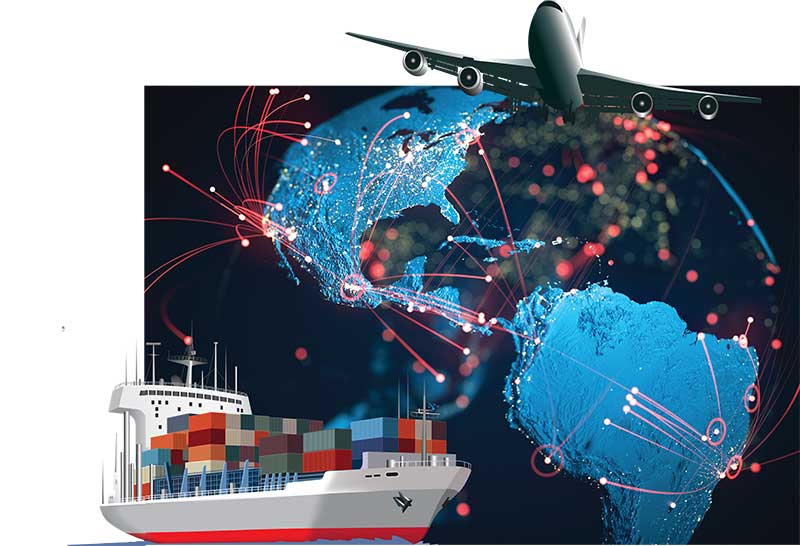
After hitting a record high of $29 trillion in 2021, global trade outdid itself the following year, with companies trading a new record high of $32 trillion in goods in 2022, according to data from The United Nations Conference on Trade and Development.
The pace slowed somewhat last year, with World Bank currently predicting that global trade growth will come in around 2.4% for the year (down from 2.6% in 2023). In spite of the obvious leveling off of pandemic-fueled growth, it’s clear that more organizations than ever are doing business on a global basis.
Credit the internet and the subsequent e-commerce boom with helping more companies expand past their traditional, domestic borders and into new terrain.
Improved transportation infrastructures, more affordable freight costs, the introduction of new free trade zones (FTZs) and higher rates of foreign direct investment (FDI) also provide a convincing case for organizations that want to break out of their traditional selling borders.
Companies making these moves quickly encounter a regulatory labyrinth that, in most cases, didn’t exist when they only did business within their own countries. Each country maintains its own trade laws, which means everything from import-export controls to tariff classifications to product packaging requirements are often handled differently from one country to the next.
This isn’t a one-and-done exercise either: trade regulations and policies are constantly evolving, driven in part by economic conditions, political shifts and geopolitical events.
Managing these and other global trade complexities on spreadsheets, clipboards and e-mail is a failed approach that only gets more difficult as a company adds new global customers and suppliers to its portfolio. Just one mistake could find a time-sensitive shipment stuck in customs for weeks; lost goods due to poor compliance and a subsequent seizure; or hefty fines imposed by government agencies.
Even with these and other perils hanging over their heads, a lot of companies continue to manage their global trade compliance activities manually, and without the help of a robust global trade management (GTM) platform.
According to a recent Thomson Reuters report, just 34% of companies are currently using the software for trade compliance. That means the other 66% are likely still manually preparing export documents, classifying goods, managing export controls and checking denied party lists.
“A lot of companies still have huge whiteboards with their transportation [activity] on them, and the same goes for global trade,” says Norm Saenz, partner and managing director at St. Onge Company, a leading supply chain consultancy. “It’s as if their transportation management system is a whiteboard filled with grids, truck numbers and scheduling, with no software being used to manage those activities.”
GTM fills in the regulatory gaps
Robust software solutions that streamline and optimize the complex international trade process, GTM acts as a central hub that organizations can use to navigate the complicated labyrinth of regulations, documentation and logistics associated with importing and exporting goods across borders.
According to Gartner, GTM supports the complex and unique logistical, regulatory and financial aspects of the import and export processes associated with international trade (e.g., cross-border trade).
The software comes in especially handy when single shipments need multiple modes of transportation to get from point A to point B. In a recent report, Gartner identifies CBX, SAP Global Trade Services, CargoWise, Infor Nexus, e2open and CargoSmart as some of the leading GTM platforms available on the market today.
These and other GTM platforms help companies stay abreast of ever-changing government regulations that may apply to their international shipments. Take the Uyghur Forced Labor Protection Act (UFLPA), for example.
The law, which went into effect in mid-2022, made it illegal for U.S. companies to import goods mined, produced or manufactured wholly or in part by forced labor. The law was enacted to stem the systematic use of forced labor in the Xinjiang Uyghur Autonomous Region of China, and shipments in non-compliance may be subject to seizure and a potential investigation of the importer.
Steve Banker, VP, supply chain management at ARC Advisory Services, says enforcement of UFLPA has “increased dramatically” during the last year. According to U.S. Customs and Border Protection (CBP), more than half-a-billion dollars’ worth of goods presumed to have been made by Uyghur slave labor have been detained and prohibited from entering the country since active enforcement of the UFLPA law began in 2022. The most-seized goods include electronics; industrial and manufactured goods; apparel, footwear and textiles.
Of course, the UFLPA is just one of many different regulations and requirements that can impact a company’s international trade activities.
In a recent overview of the top trade compliance trends shippers should be considering this year, Descartes Systems Group says the “burden of proof” is increasingly being shifted over to business to comply with trade sanctions. Companies must also comply with increased environment, social and governance (ESG) regulations and any geopolitical-related sanctions, such as those imposed on Russia.
Managing this ultra-dynamic environment on spreadsheets, clipboards and white boards is becoming more and more difficult. According to Banker, companies are increasingly turning to their GTM vendors to help gain better “visibility into risk.” This is an area where new software functionality is needed, he adds. “Companies find it very difficult to gain visibility into their end-to-end supply chains. A buyer knows who they’re buying from, but they usually don’t know their supplier’s supplier or their supplier’s supplier’s supplier.”
More integrated systems, please
Howard Turner, director, supply chain systems at St. Onge, says shipper interest in GTM usually surfaces when a company is evaluating transportation management systems (TMS). The software is generally of special interest to any company that’s receiving a lot of product from—or, shipping a lot of merchandise to—the Asia Pacific (APAC) region.
Turner says that he’s aware of the various standalone GTMs available on the market, but says that, at least, from his experience, the majority of shippers want a GTM that’s integrated into their broader supply chain software package.
“The goal is to have a single platform to work with and leverage TMS data to file Customs declarations, currency conversions, or other documentation…Companies that achieve this goal can expect the highest benefits from their GTMs.”
Shippers don’t always get what they’re looking for in their search for a TMS that includes global trade management capabilities. “Outside of the larger enterprise resource planning [ERP] providers that offer their own [GTM capabilities], we’re just not seeing that software being integrated with most TMS systems at this point,” says Turner.
To accommodate companies that want to automate the process of managing free trade agreements, FTZ and import controls, many TMS providers will “partner” with a GTM software provider and then provide an integration point to that third-party application.
Even in cases where the two different software providers offer systems that can be “connected” using application programming interfaces (APIs), Turner says the onus is generally on the shipper to purchase the GTM and get that application integrated into the transportation management system.
Turner says that there’s still more work to be done in this area, and that embedding GTM into TMS would likely drive up adoption and usage numbers for the former. “Global trade management is closely tied to transportation operations,” he points out. “While the larger ERP providers have already embedded GTM into their solutions, if more software vendors took that route and built out the functionality themselves it would be huge.”
Getting it all in one place
As more companies explore the benefits of international trade, the need for GTM solutions is expected to increase exponentially. Whether companies embrace the value of GTM, or whether they stick with their manual approaches to global trade management, remains to be seen.
For those that take the digital route, Turner says some of the core benefits include improved supply chain visibility and a streamlining of all the “red tape and bureaucracy” associated with doing business internationally.
Companies that automate global trade compliance in a way that integrates with their transportation management systems will be the biggest winners, according to Turner.
Not only can companies streamline their international trade activities and avoid penalties of up to $1 million per violation (for non-compliance with the Export Administration Regulation), but they can also free up logistics personnel to focus on more strategic tasks instead of poring over regulatory documentation.
“The goal is to have a single platform to work with and leverage TMS data to file Customs declarations, currency conversions, or other documentation,” says Turner. “Companies that achieve this goal can expect the highest benefits from their GTMs.”

Article Topics
ARC Advisory Group News & Resources
Automating global trade compliance in an era of uncertainty Global Trade Management: Ditch the paperwork, adopt the software 6 TMS Trends for 2024 Cloud Solutions Dominate Supply Chain TMS Update: Disruption fuels growth Global Trade Compliance: Ensure perfect delivery through minimized delays, costs, and trade risk Adaptive Logistics: Overcome Disruptions and Exceed Expectations More ARC Advisory GroupLatest in Logistics
FTR’s Shippers Conditions Index shows modest growth Trucking executives are set to anxiously welcome in New Year amid uncertainty regarding freight demand ASCM’s top 10 supply chain trends highlight a year of intelligent transformation Tariffs continue to cast a long shadow over freight markets heading into 2026 U.S.-bound imports see November declines, reports S&P Global Market Intelligence FTR Trucking Conditions Index shows slight gain while remaining short of growth AAR reports mixed U.S. carload and intermodal volumes, for week ending December 6 More LogisticsAbout the Author

Subscribe to Logistics Management Magazine

Find out what the world's most innovative companies are doing to improve productivity in their plants and distribution centers.
Start your FREE subscription today.
December 2025 Logistics Management

Latest Resources












