
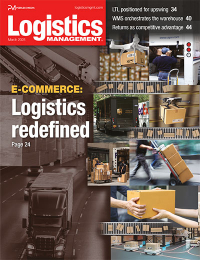
E-commerce viewpoint: Logistics redefined
“Logistics operators are now heavily investing in warehouse robotics to alleviate labor challenges and adopting AI-driven route optimization and predictive analytics to streamline order fulfillment,” says Bentz. “We’re even seeing autonomous vehicles and drones being tested to manage costs and accelerate delivery speeds. E-commerce ignited this transformation, and the shift is well underway. Logistics is being redefined.”

I’d love to travel back in time to wander the streets of 1920s Paris, that golden era between the wars when café culture thrived and the sounds of American-imported jazz spilled into cobblestone alleys. It was a time of transformation, when old-world traditions gave way to a free-spirited, bohemian lifestyle that reshaped society for decades to come. What a time to be alive.
I’d argue that today’s logistics and supply chain networks are experiencing a transformation just as profound—driven by the relentless rise of e-commerce. Sure, hearing Bix Beiderbecke’s horn in Montmartre must have been something, but real-time tracking of a same-day delivery? That’s a revolution of its own.
Like the jazz movement of the 1920s, e-commerce has fundamentally changed consumer behavior. We no longer flip through print catalogs, visit multiple stores to compare prices, or take days to make a purchase. Every option is at our fingertips, and we expect exactly what we want, exactly when we want it—often the same day. Convenience has become the baseline, and speed is non-negotiable. What a time to be alive.
As Logistics Management (LM) readers know, the B2C demand for instant gratification has seeped into B2B logistics operations. To track this evolution, we launched our first e-commerce-themed issue in March 2021, right as the market was weighing the full impact of the pandemic.
We turned to LM columnist and 40+ year freight industry veteran Brooks Bentz to provide perspective on how e-commerce has redefined freight logistics. Having witnessed numerous transformations in the freight markets, Bentz offers his take on how rapidly the freight industry is evolving due to the pressures of e-commerce, starting on page 24.
“Relentless demand for faster fulfillment, real-time visibility, and greater operational efficiency is reshaping traditional supply chain models at a pace few could have predicted,” says Bentz.
Bentz notes the profound impact of consumer-driven expectations from personal e-commerce, which have set new standards for B2B freight logistics. Businesses now expect the same speed, accuracy, and flexibility in deliveries that consumers demand—a shift that has occurred quickly and radically.
“Same-day delivery, real-time tracking, and personalized service are now the norm for consumers, and those same expectations are spilling over into how businesses want their freight to move,” says Bentz. “This shift is putting significant pressure on B2B logistics operations—but it’s also pushing traditional models to evolve.”
The shift is evident in how we see centralized distribution networks being replaced by regional and urban fulfillment centers to meet faster delivery demands for both B2C and B2B. Freight volume is also moving from traditional LTL and TL shipments to small-parcel networks, prompting parcel carriers to enhance last-mile efficiency.
Above all, Bentz believes this shift has sparked a technological transformation that will benefit the industry both inside and outside the four walls for years to come.
“Logistics operators are now heavily investing in warehouse robotics to alleviate labor challenges and adopting AI-driven route optimization and predictive analytics to streamline order fulfillment,” says Bentz. “We’re even seeing autonomous vehicles and drones being tested to manage costs and accelerate delivery speeds. E-commerce ignited this transformation, and the shift is well underway. Logistics is being redefined.”

Article Topics
E-commerce News & Resources
FedEx announces 2026 rate increases The Missing Link in B2B Growth Is Hiding in Your Order Management Blue Yonder announces its acquisition of Optoro Mugsy’s Seamless Transition: How a new 3PL partner drove efficiency and growth UPS Q2 revenue falls 2.7% amid economic uncertainty, Amazon volume glide down takes hold June retail sales see growth despite tariff worries Kenco rolls out new Contract Packaging Division More E-commerceLatest in Logistics
FTR’s Shippers Conditions Index shows modest growth Trucking executives are set to anxiously welcome in New Year amid uncertainty regarding freight demand ASCM’s top 10 supply chain trends highlight a year of intelligent transformation Tariffs continue to cast a long shadow over freight markets heading into 2026 U.S.-bound imports see November declines, reports S&P Global Market Intelligence FTR Trucking Conditions Index shows slight gain while remaining short of growth AAR reports mixed U.S. carload and intermodal volumes, for week ending December 6 More LogisticsAbout the Author

Subscribe to Logistics Management Magazine

Find out what the world's most innovative companies are doing to improve productivity in their plants and distribution centers.
Start your FREE subscription today.
December 2025 Logistics Management

Latest Resources












