
Supply Chain Disruption: A crisis yes, but an opportunity too
We’re in a perfect storm with the global supply chain—and 2022 is shaping up to be even more challenging.


We’re in a perfect storm with the global supply chain—and 2022 is shaping up to be even more challenging. The reality is that most companies lack the critical capabilities needed to overcome this disruption and ensure their supply chains are resilient, relevant and responsible.
They currently don’t have the right level of visibility into their full supply networks to see disruption as it’s unfolding and they struggle to predict and meet demand for their products and services.
Global growth is at stake
This is bad news for the global economy. According to a new research study, “Accenture: C-Suite Reactions to the Supply Chain Crisis,” not only will some businesses fail to meet basic needs, 88% of surveyed C-suite executives believe that the expected outcome from supply chain disruption will be continued price increases, causing consumers to cut spending just as businesses are hoping to make good on the losses of 2020.
Perhaps of most concern is that one-third (33%) of leaders believe the crisis could last for as long as three years.
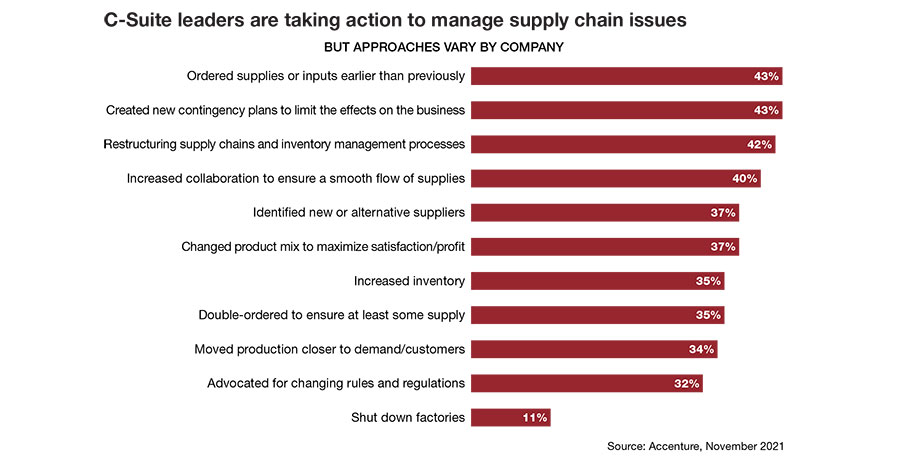
Maintaining stakeholder trust is key to mitigating potential losses. Customer expectations will remain high, and companies that fail to deliver against these expectations will lose brand capital. That’s why business leaders are already acting to address the threats posed by supply chain disruption. According to our research, top company actions include ordering supplies earlier than previously (43%), creating new contingency plans to limit the effects on the business (43%), and restructuring supply chains and inventory management processes (42%).
Opportunities in digital backed by Cloud
However, beyond the immediate measures that businesses will take now to lessen the pain of disruption, there are medium-to-long term changes that will yield value. Just as COVID-driven remote working improved the way many businesses operate for the better, so too will changes to supply chain management that arise as a result of the current crisis.
Chief among these is the adoption of data-driven technology and the Cloud. Thanks to advances in digital technology, businesses can for the first time weigh up every supply chain decision against a rich set of factors. Indeed, the intersection of automation, AI and robotics will enable businesses to build digital twins of their multi-tier supply networks and subject these models to stress tests and “what if” scenarios.
Doing so will uncover weak links and vulnerabilities in the supply chain and allow these to be addressed by, for example, switching partners or bringing manufacturing closer to home. Such an approach could also ensure that only a limited percentage of a critical item passes through the same supplier, port, or route, helping to build resilience.
Real-time data analytics will also provide greater flexibility to follow changes in demand. By setting up supply chain control towers and empowering managers with real-time demand and supply planning and digital management tools, businesses will be able to keep their finger on the pulse of customer requirements and ensure that good are getting to where demand is highest. Such capabilities will prove particularly useful during periods of peak demand, such as what businesses experienced in this most recent holiday season.
That digital thread, underpinned by the Cloud, consists of weaving multiple integrated technologies throughout your operations, so your people—in conjunction with AI and analytics—can predict and monitor the consequences of almost every action in real-time.
It’s a transformational way of running supply chains, and one that will make them more resilient, more relevant to customer demands, and sustainability practices. Significantly, our research suggests that it’s a model that many leaders expect to adopt: 79% of the people we spoke to said that the increased use of automation, AI and robotics to create full visibility is a likely outcome of the current disruption.
The Cloud is critical for this digital thread—providing vast amounts of computing power, with a simple, flexible and affordable data and digital architecture, that opens up myriad possibilities for the supply chain—and enables leaders to manage service levels and cost, build in resilience and ensure responsible operations.
Looking ahead
Supply chain leaders are figuring out how to go beyond just responding to but also thriving in this new reality. A digital foundation underpinned by the Cloud will be what allows them to concurrently handle fluctuating demand, the need for resilience, the pressure to manage costs and calls for greater responsibility for society and the environment.
The companies that scale their investments in digital and Cloud will be best placed to meet the expectations of customers and drive strong growth.

Article Topics
Global Trade News & Resources
Tariffs continue to cast a long shadow over freight markets heading into 2026 U.S.-bound imports see November declines, reports S&P Global Market Intelligence 2026 Rate Outlook: Early signs of a new freight reality? Federal Reserve moves forward with its third consecutive rate cut National Electric Manufacturers Association calls for stronger enforcement, predictability in upcoming USMCA review U.S.-bound imports slide in November as seasonal slowdowns and tariff uncertainty weigh on volumes Port Tracker report points to ongoing import declines as 2025 ends and into 2026 More Global TradeLatest in Logistics
ISM forecast sees a manufacturing rebound in 2026 as services maintain steady expansion PwC report indicates transportation and logistics dealmaking activity is focused on strategy, not scale ShipMatrix reports strong Cyber Week delivery performance results National diesel average falls for the fourth straight week, reports EIA FTR’s Shippers Conditions Index shows modest growth Trucking executives are set to anxiously welcome in New Year amid uncertainty regarding freight demand ASCM’s top 10 supply chain trends highlight a year of intelligent transformation More LogisticsSubscribe to Logistics Management Magazine

Find out what the world's most innovative companies are doing to improve productivity in their plants and distribution centers.
Start your FREE subscription today.
December 2025 Logistics Management

Latest Resources












