
Annual Study of Logistics and Transportation Trends: Puzzling path forward
The Annual Study of Logistics and Transportation Trends highlights the growing importance of technology adoption, talent management, and automation in logistics operations while emphasizing the need for continuous training and addressing the ongoing labor crisis.

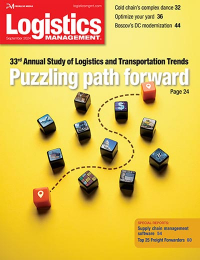
This marks the 33rd year that Logistics Management has partnered with Karl Manrodt, Ph.D., of Georgia College on our Annual Study of Logistics and Transportation Trends. Over those three decades, the study has become recognized as the “ultimate report card” on overall logistics operations performance, as shippers open up to share how they feel they’re managing amidst the continual disruption.
Manrodt is joined once again by Christopher Boone, Ph.D., of Mississippi State University. Over the past four years, Boone has taken the reins of the five-month survey process and has been instrumental in widening the breadth of the survey’s scope to encompass the state of technology adoption as well as how shipper organizations believe they’re managing the ongoing labor crisis and the challenges created for talent management.
We’re pleased to have Joe Tillman, manager of education programs at SMC3, rejoin our research team. His expertise helps us delve into the “human capital crisis” in transportation. Additionally, we welcome Doug Voss, Ph.D., professor at the University of Central Arkansas, whose expertise enriches our team this year.
Any long-time reader of Logistics Management knows that this survey was historically focused on trends in freight spending and how carriers performed on three metrics—correct invoice, on-time delivery, and damaged shipments. Those measures are still captured in the survey, as those trends offer us the best snapshot possible of modal shift strategies taking place.
“Freight-spend shift trends are important, but only one window into the market,” says Boone. “Today’s logistics professionals navigate evolving regulations, talent competition, and emerging technologies. Missing any piece of this puzzle can lead to operational disruptions and inefficiencies.”
Over the last four years the survey team has designed questions to help shippers put context around what all those pieces mean today. For example, the acceleration of technology across all aspects of logistics not only bodes well for more streamlined operations, but will help meet the needs of a younger labor force, a group that’s essential to operations and growing strong.
“Given talent procurement issues and continued reluctance to recommend logistics and transportation careers—which may be driven by the industry’s stressful, interminable nature—firms must adopt technologies that automate routine tasks so personnel can achieve better work-life balance,” says Voss.
This year, we found that 54% of respondents are using or implementing back-office automation in their logistics operations—a 16.2% increase in current usage from 2023. “The good news is that the intended goal is adopting technology to improve employee productivity [88.9%] and boost employee engagement and retention [73%],” says Boone.
While those technology figures show good intention, the data around developing talent shows a gap. “While the technology numbers are upbeat, I’m a bit surprised in the lack of respondents who say they have a dedicated learning and development team and there’s a shortage of knowledgeable trainers/instructors within the organization,” says Tillman. “Training and tech needs to be hand in hand.”
Talent training and retention will always be a top priority—no matter how much we automate. “One of the factors we sometimes forget is that when some of us started our careers, the discipline was referred to as ‘physical distribution,’” adds Manrodt. “While automation tools make workers more effective and efficient, we’ll still need workers who are physically present. The physical realm adds too much complexity to what we do to be completely automated.”

Article Topics
Peerless Research Group News & Resources
42nd Annual Quest for Quality Awards: Honoring the industry’s top performers in logistics excellence 2025 Less than Truckload Research Study Results 2025 Outook Survey: Warehouse automation comes into full focus 2025 Automation Survey: Diving deep into the warehouse automation trends 2024 Warehouse/DC Operations Survey: Technology adoption on the rise 33rd Annual Study of Logistics and Transportation Trends: Puzzling path forward Annual Study of Logistics and Transportation Trends: Puzzling path forward More Peerless Research GroupLatest in Logistics
FTR’s Shippers Conditions Index shows modest growth Trucking executives are set to anxiously welcome in New Year amid uncertainty regarding freight demand ASCM’s top 10 supply chain trends highlight a year of intelligent transformation Tariffs continue to cast a long shadow over freight markets heading into 2026 U.S.-bound imports see November declines, reports S&P Global Market Intelligence FTR Trucking Conditions Index shows slight gain while remaining short of growth AAR reports mixed U.S. carload and intermodal volumes, for week ending December 6 More LogisticsAbout the Author

Subscribe to Logistics Management Magazine

Find out what the world's most innovative companies are doing to improve productivity in their plants and distribution centers.
Start your FREE subscription today.
December 2025 Logistics Management

Latest Resources












