
Viewpoint: Tradition, longevity, and deep market commitment will help shippers navigate the logistics fog

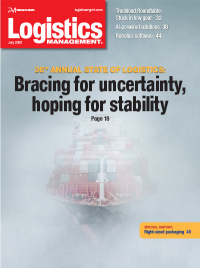
In today’s hyper-connected world—where trends are fleeting and attention spans are even shorter—there’s still no substitute for tradition, longevity, and deep market commitment.
For a leading B2B media brand, these qualities aren’t relics of the past—they’re the foundation of trust. At Logistics Management (LM), our long-standing investment in consistent, authoritative research has guided our editorial mission for six decades.
We kick off three consecutive issues spotlighting some of our most enduring and influential research in the logistics market—cornerstones that continue to deliver actionable insights for shippers year after year, decade after decade.
These traditions take the form of three flagship annual reports. This month, we frame the current logistics environment. In August, we recognize the carriers and service providers our readers say stand out in performance. And in September, we offer a “report card” from shippers themselves on the state of their logistics and transportation operations.
We begin with the 36th Annual State of Logistics (SoL) Report; next month brings our 42nd Quest for Quality Awards; and in September, we partner once again with the research team producing our 34th Annual Study of Logistics and Transportation Trends.
And if there’s one phrase that defines the industry’s mindset right now, it’s “navigating through the fog”—a metaphor that, frankly, many LM readers are tired of hearing. But that’s how the Council of Supply Chain Management Professionals (CSCMP) frames this year’s State of Logistics report, authored by global consultancy Kearney and released June 3.
This month, our transportation contributing editor John D. Schulz paints the current logistics landscape based on the report. Picture, if you will, a murky scene of hard-won progress amid persistent uncertainty—and a future precariously perched on “fragile optimism.” If that makes you feel uneasy, you’re not alone.
“While 2024 marked a return to pre-pandemic rhythms in some areas, the broader logistics landscape remained soft,” says Schulz. “Business volumes were flat, truck capacity outpaced demand, and rising labor and fuel costs continued to squeeze margins. E-commerce was a bright spot, but even there, growing pains and infrastructure pressures remain.”
Why the haze? It’s a complicated mix of tariff disputes, regional conflicts, extreme weather, and shifting trade policies. As Schulz explains: “The report emphasizes that logistics providers are increasingly turning to AI, automation, and integrated tech to build more agile operations—a needed shift as pressures mount across the board.”
Key metrics reinforce the theme: U.S. logistics costs rose to $2.6 trillion last year (8.7% of GDP); parcel revenue hit a record $229.7 billion; and trucking—still the industry’s backbone—faces margin pressures from policy volatility and freight unpredictability. Even with spot rates ticking up, a full recovery appears delayed until 2026.
The message of the SoL report is clear: logistics professionals must remain nimble and ready to implement the technology toolbox that’s well within reach. With continued investment in technology and talent, and a sharp focus on resilience, the industry can find its way—no matter how dense the fog may become.

Article Topics
CSCMP News & Resources
Looking at how Uber Freight is using AI to redefine logistics CSCMP EDGE sessions examine turning AI potential into results Tariffs, trade, and uncertainty drive supply chain strategy shifts, notes CSCMP EDGE panel Truckload, parcel, and LTL executives address regulatory uncertainty, market fragmentation at CSCMP EDGE Supply chain experts forecast stabilization amid rising costs and global uncertainty 36th Annual State of Logistics Report: Navigating uncertainty amid rising costs and global disruptions Viewpoint: Tradition, longevity, and deep market commitment will help shippers navigate the logistics fog More CSCMPLatest in Logistics
FTR’s Shippers Conditions Index shows modest growth Trucking executives are set to anxiously welcome in New Year amid uncertainty regarding freight demand ASCM’s top 10 supply chain trends highlight a year of intelligent transformation Tariffs continue to cast a long shadow over freight markets heading into 2026 U.S.-bound imports see November declines, reports S&P Global Market Intelligence FTR Trucking Conditions Index shows slight gain while remaining short of growth AAR reports mixed U.S. carload and intermodal volumes, for week ending December 6 More LogisticsAbout the Author

Subscribe to Logistics Management Magazine

Find out what the world's most innovative companies are doing to improve productivity in their plants and distribution centers.
Start your FREE subscription today.
December 2025 Logistics Management

Latest Resources












