2025 Rate Outlook: Navigate the unpredictable
Logistics Management's 20th Annual Rate Outlook offers insights into freight trends and prepares shippers for potential cost impacts in 2025 amid global trade uncertainties.

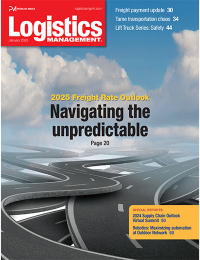
Logistics Management readers know how much we value our traditions. In fact, this year marks the 20th edition of our Rate Outlook cover story, which we complement with a dynamic web event (Jan. 30)—a “one-two punch” for shippers seeking clarity on where logistics costs are headed in the coming year.
The Rate Outlook was the trailblazer for a series of print/virtual events we’ve developed from surveys and panels over the past two decades. Year after year, the analytics confirm that this approach yields our most-read magazine feature and our most-attended web event.
If you’re new to Logistics Management, the process is simple: Start by reading our Annual Rate Outlook feature and jotting down a few questions. Then, watch your inbox for an e-mail invitation to register for the Jan. 30 virtual event. During the event, you’ll have the chance to pose your questions directly to a panel of leading logistics and freight transportation analysts.
And as he has for the past three years, Brooks Bentz, long-time supply chain consultant, carrier executive, and LM contributor and columnist, has rounded up this year’s panel of analysts. He spent the last three months in conversation with some of the industry’s top minds, and the results of those discussions unfold here.
As we approach the year ahead, Bentz highlights a few key factors shippers should keep in mind during their planning. “Domestically, demand for freight capacity remains somewhat soft, with no clear signs that this will change dramatically,” he explains. “In fact, this soft pricing could persist well into 2025, as supply in the logistics sector continues to outpace weaker demand.”
While rates will remain a focal point as we emerge from the longest freight recession in a generation, Bentz cautions that we’re navigating unusually turbulent times. Shifts in the global trade landscape could create further volatility, potentially affecting logistics costs in unpredictable ways.
“There are key questions that the incoming administration will answer, particularly as it relates to trade and tariffs and how we respond to the disruptive forces at work in the Middle East; Ukraine; and the western Pacific around China, the Philippines, and the Koreas,” says Bentz. “Tariffs on Chinese imports has already caused some to shift manufacturing and importing to more friendly locations like Vietnam and Myanmar, so the origin-destination pairs have shifted, but the impact has not been profound—at least not yet.”
Conversely, major imposition of tariffs on Mexico and Canada will have a direct impact on trade and the cost of goods, particularly food products, autos, and metals. “It’s too soon to tell how that will affect supply chains, but there will be a distinct ripple effect of undetermined magnitude,” adds Bentz.
With the uncertainty surrounding the potential impact of new tariffs and trade policies on importers’ bottom lines, Melissa Irmen, director of advocacy and strategic relations at the National Association of Foreign-Trade Zones (NAFTZ), provides a much-needed perspective. While recently inundated with questions, Irmen emphasizes that the true effects remain unclear until implementation begins.
“I fully understand the concern,” Irmen says. “But how U.S. importers approach international trade in 2025 hinges on the actions that unfold. My goal is to outline the possible scenarios, explain the mechanisms a President can use under these circumstances, and help importers prepare.”
For an in-depth look at Irmen’s insights, turn to “U.S. Trade in 2025: Possibilities and preparation”

Article Topics
Freight Rates News & Resources
FTR Shippers Conditions Index returns to growth FTR Shippers Conditions Index shows sequential improvement Spot truckload volumes and rates see August declines, reports DAT FTR’s Shippers Conditions Index remains close to neutral territory FTR’s Trucking Conditions Index inches back into negative territory April freight shipments and expenditures see mixed results in Cass Freight Index report New edition of FTR’s Shippers Conditions Index turns slightly negative More Freight RatesLatest in Logistics
FTR’s Shippers Conditions Index shows modest growth Trucking executives are set to anxiously welcome in New Year amid uncertainty regarding freight demand ASCM’s top 10 supply chain trends highlight a year of intelligent transformation Tariffs continue to cast a long shadow over freight markets heading into 2026 U.S.-bound imports see November declines, reports S&P Global Market Intelligence FTR Trucking Conditions Index shows slight gain while remaining short of growth AAR reports mixed U.S. carload and intermodal volumes, for week ending December 6 More LogisticsAbout the Author

Subscribe to Logistics Management Magazine

Find out what the world's most innovative companies are doing to improve productivity in their plants and distribution centers.
Start your FREE subscription today.
December 2025 Logistics Management
Latest Resources