
2019 State of Logistics: Less-than-truckload LTL
Rates up as carrier costs “go through the roof”


The $40 billion less-than-truckload (LTL) sector, with its high fixed costs associated with its intricate hub-and-spoke delivery networks, is enjoying a renaissance with solid rate hikes. However, carriers report that much of that revenue is being eaten up by huge increases in the cost of equipment, driver salaries and other essentials.
“Rates have held up well,” say Chuck Hammel, president of Pitt Ohio. “We’re getting 4% to 6% on average with our increases so that’s acceptable. Regardless of market conditions, trucking costs are going through the roof.”
Pitt Ohio and other major LTL carriers are coping with what Hammel describes as “big increases” in driver wages, truck and truck parts, highway tolls and pending increases in state fuel taxes to pay for badly needed infrastructure upgrades. “The fuel tax is slated for a big increase, and let’s not forget the driver shortage and the fact that technology cost are rising sharply due to the demand for connected supply chains and the ability to see where a shipment is at any given time,” he says.
Carriers are reporting “some pushback” from shippers on rates. “But, thus far, we’re still able to justify why we need the increase,” explains Hammel. “So, I don’t see that changing much unless foolish carriers begin cutting rates. If so, that would be disastrous.”
But even in the environment of the last three years—with volumes high and rates rising quickly—LTL carriers are still going out of business. New England Motor Freight, a venerable 101-year-old carrier that was the 17th-largest LTL carrier in the country, suddenly ceased operations in February.
According to Satish Jindel, principal of SJ Consulting, that’s helped Pitt Ohio, A. Duie Pyle and some FedEx and UPS units operating in the Northeast. However, NEMF’s demise is still a reminder to LTL carriers that they must price their freight according to their costs.
“The beauty of the LTL industry is that you don’t have to rely on demand in order to get profitability,” says Jindel, who closely tracks the LTL sector. “You just need to manage capacity. If demand is slowing, just don’t add capacity, you have to manage your business for profitability.”
Pitt Ohio’s Hammel says that his tonnage is down 3% to 5% year over year, but shipments are up 2% to 4%—probably a reflection of the smaller, lighter goods typical of e-commerce—and revenue is up so far as well.
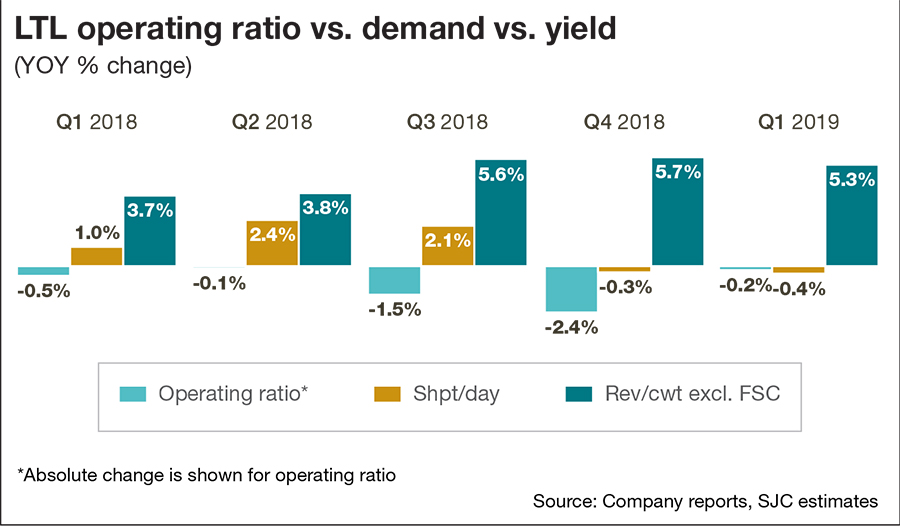
Hammel called the first quarter “dicey” with weather contributing to the monthly fluctuations—one month up the next down. Second quarter reports were trending up somewhat, while major publicly held LTL carriers reported April tonnage below expectations.
“Certainly with Easter falling later than normal in recent years, we haven’t seen that uptick that we’re looking for going into the summer months,” says Darren Hawkins, CEO of YRC. “But from our individual perspective, our contract renewals are still running in the 5% to 6% increase ranges in contract increases. We feel really good about the yield numbers.”
Hawkins adds that he’s “confident in our pricing measures,” which include the use of three-dimensional machines in all terminals to account for dimensional pricing, which allows carriers to charge more for light, bulky freight typical in e-commerce.
With unemployment is the lowest in history and first quarter GDP rising 3%, LTL executives are confident the underlying economy is doing well. However, a huge wild card is the cumulative effect President Trump’s tariffs will have on the overall economy.
Read the feature article on the 2019 State of Logistics here.

Article Topics
Motor Freight News & Resources
FedEx posts fiscal first quarter earnings growth DAT’s November Truckload Volume Index sees more mixed results Cass Freight Index sees annual declines in November PwC report indicates transportation and logistics dealmaking activity is focused on strategy, not scale National diesel average falls for the fourth straight week, reports EIA FTR’s Shippers Conditions Index shows modest growth Trucking executives are set to anxiously welcome in New Year amid uncertainty regarding freight demand More Motor FreightLatest in Logistics
Union Pacific-Norfolk Southern merger application is filed with the Surface Transportation Board FedEx posts fiscal first quarter earnings growth U.S. rail carload and intermodal volumes are down, for week ending December 15, reports AAR DAT’s November Truckload Volume Index sees more mixed results November intermodal volumes see annual decline, reports IANA Looking at the state of the parcel market with Robert Persuit, Sr. Director of Business Development, ShipMatrix Teamsters Rail Conference makes its case for the Union Pacific-Norfolk Southern proposed merger to not be approved by the STB More LogisticsSubscribe to Logistics Management Magazine

Find out what the world's most innovative companies are doing to improve productivity in their plants and distribution centers.
Start your FREE subscription today.
December 2025 Logistics Management

Latest Resources












