
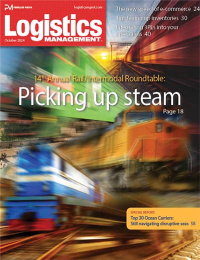
14th Annual Rail/Intermodal Roundtable: Picking up steam
Three of the nation’s top market analysts examine the current state of the freight railroad and intermodal markets, including a look at service levels, pricing, competition with other modes, and the ongoing implementation of automation.

Although year-to-date freight rail carload and intermodal volumes are showing some improvement, it’s important to note that last year’s figures were significantly affected by economic challenges such as inflation and weakened demand.
And amid some mixed patterns, there are reasons to look forward to what could be in store this coming year, including improved network fluidity; some carload volume momentum outside of coal; strong intermodal volumes; and improving service levels.
To help bring the current state of the nation’s rail and intermodal network into sharper focus, Logistics Management is joined by three of the nation’s foremost experts in the market, including:
- Anthony Hatch, rail analyst and principal at ABH Consulting;
- Adriene Bailey, partner and head of the North American Rail Team at Oliver Wyman;
- Jeff Kauffman, partner, transportation and logistics equity research at Vertical Research Partners.
Logistics Management (LM): How would you define the state of the rail carload market?
Jeff Kauffman: Overall, it’s showing some improvement, but it’s a tale of two cities. Intermodal volume is very good, up so far this quarter. Commodity carload volume is improving, but is down this quarter. The former is partially because of the inventory destocking being done and early shipping ahead of potential labor issues. The latter is a function of a still weak coal and industrial market, offsetting demand for autos, grain, chemicals, and petroleum.
Adriene Bailey: Indeed, structural declines in the coal business are providing significant headwinds to overall carload growth. But if you back out coal, the carload business is seeing modest growth in line with industrial production. Railroads are not yet gaining market share and penetrating shorter haul markets, but are generally holding their own.
Anthony Hatch: Rails haven’t recaptured the merchandise share lost when their service declined due in large part to crew shortages [2021-22]. Going up against weak comparisons flatters the rail numbers, but it’s really been a sluggish market.
Autos were a bright spot—now not as much. Chemicals are solid, and steel is weakening. For every green shoot there’s a dying leaf, it seems. Coal has been pretty bad, especially in the U.S. west. So, overall, it’s not awful, but not super, and the crystal ball at rail headquarters is quite cloudy.
LM: How would you describe the intermodal market from a volume and demand perspective?
Bailey: The intermodal market is made up of international overseas traffic and domestic North American traffic. International has been driving most of the growth seen in 2024 versus 2023 comparisons, and primarily on the West Coast, which is good for rail. Some disruptions in the Red Sea, the threat of an East Coast port strike, and a Canadian rail strike have all pushed traffic to U.S. West Coast ports.
On the domestic front, the freight market is still struggling. Trucking is seeing weak volumes and low rates, with some overcapacity in the market, and this makes an impact on intermodal as well. But domestic intermodal is being helped along by two avenues for growth: new, more competitive rail services to and from Mexico; and a renewed focus on service both in the east and west from railroads and their channel partners.
Hatch: Intermodal, particularly international intermodal, has been a bright spot all year. But a lot of this is smoke and mirrors, as last year was awful. We’re in the middle of the worst freight [truckload] recession in living memory, which affects both intermodal and carload. Sure, rail service has improved greatly, but there’s so much dirt-cheap truckload capacity, why change now?
Kauffman: There’s no doubt that intermodal is very strong right now. Some of this is because inventory destocking is over, and the consumer has slowed, but continues to spend at a healthy level, and we expect a more traditional holiday season.
However, there’s an element of this that may be borrowing from the future, as Suez safety challenges have drawn capacity out of the ocean market, raising the cost of shipping. And labor unrest has shippers uncertain about supply chain, leading to an early peak season favoring the U.S. West Coast, which is resulting in a greater need for domestic intermodal.
We may see more lackluster flows later this year. Low truck rates continue to put pressure on intermodal profitability, so the industry is handling more volume at a lower rate.
LM: How do you view current service levels compared to this time last year?
Hatch: Rail service is much better as they have graduated crews, and those crews have gained experience. Rails have spent a lot of money on labor, including hiring, training, retaining, and new inflationary contracts. This is one area where the higher wages, which hurt the operating ratio [OR], help in service as they have re-widened the gap between rail compensation and other blue-collar job pay. Having crews is critical, and the battle is not over. But, so far, service has improved.
Kauffman: Current service levels are much improved from a year ago, and many rails are running at higher on-time rates, leading to improved ability to rely on rail transportation. This is part of the reason intermodal is doing so well right now versus long-distance trucking.
Bailey: Current service levels are relatively good for intermodal, but mixed for carload. The only railroad reporting improvements in both dwell time and train velocity metrics in the second quarter of 2024 was Norfolk Southern. Overall service metrics, especially for intermodal, have been either flat or only slightly ahead of last year.
New Surface Transportation Board [STB] service metrics for OETA [Original Estimated Time of Arrival—essentially initial trip plan compliance] and ISP [Industry Spot/Pull] performance will be required starting this fall for manifest shipments. That should provide more shipper-
relevant service metrics than terminal dwell time and
train velocity.
LM: What can shippers expect in terms of service in the next year or so?
Kauffman: With supply chain challenges and labor hiring challenges largely in the rearview mirror, most railroads are seeing improved network flow and are able to put some of the excess locomotives and cars into storage, meaning fewer assets are on the rail lines, and as a result, fluidity is improving. While there are always challenges that show up, all of the major rail carriers have programs in place to improve network fluidity over the next two to three years.
Bailey: Public reporting of the new STB standardized service metrics likely will drive up service levels. The STB can also use the ‘stick’ of imposing reciprocal switching in some instances if thresholds for metrics are not being met.
But the equivalent ‘carrot’ is that better service may beget growth, and that’s what the industry really needs. All of North America would benefit if railroads could grow non-coal volumes and take share back from truck—providing a safer, more cost effective, more energy efficient solution.
Hatch: This is the question. Will rail service decline when true volume growth returns, following their classic pattern [low volumes=good service, high volumes=bottlenecks, poorer service]. The rails have pledged that, in effect, ‘this time is different,’ but they have initiated a ‘Great Experiment’ with their investor and analyst stakeholders.
Let’s look past the OR to return on invested capital [ROIC] through a cycle. This will require resilience. No business has proven adept at perfectly matching capacity with demand, and rails are no exception.
On the downside, historically, rails could adjust by using tools such as furloughs. But on the upside, as in the pandemic recovery boom, rails failed miserably. Hence, the solution is ‘buffer’—sacrifice protecting the slowdown by fulfilling service requirements in the up-markets. That’s the ‘Great Experiment.’
LM: Is pricing where it needs to be for railroad and intermodal in light of capital expenditure outlays made by carriers?
Bailey: A look at railroad free cash flow and operating ratio metrics strongly suggest that railroads are earning sufficient profits to support capital investment. For a large percentage of their traffic, and certainly all of their intermodal traffic, railroads must compete against trucking, which generally charges higher rates.
Right now, truck rates are at depressed levels that appear unsustainable for the long term, so a return to a more normalized demand/supply equation in trucking should raise overall freight rates. Railroads then will be able to choose between following the curve up or providing a bigger incentive to shippers to shift more volume to rail.
Hatch: Matching labor inflation is, and will be, hard, but easier, on the carload side. It’s perhaps not even a goal on the intermodal side, where rails are so truck-competitive that they must consider being more flexible in order to win share, fill volumes, earn shippers’ trust.
Kauffman: No. It’s below where it needs to be. This is in part because of the reduction in surcharges for storage and delays, low export coal prices, and, in part, because of continued depressed conditions in the trucking markets, which continue to see very low spot rates.
This is depressing intermodal rates, and making an impact on the rail’s ability to raise prices in many other categories. Having said that, we expect to see improvement in the truck rates, as volume improves in 2025 given capacity reductions, which should allow intermodal rates to rise along with that. And as volumes pick up in commodity rail categories on the back of interest rate cuts, the ability to increase price should improve.
LM: How do you view the current state of carrier and shipper relationships in rail carload merchandise and intermodal?
Hatch: If you asked any trade association in the merchandise area, they would say ‘lousy.’ The actual answer is, ‘pretty good.’ There always has been, and always will be, friction between carrier and shipper. But with service improvements comes shipper smiles. Also, we re-learned the lesson—reliable service is the key issue, not so much price.
Kauffman: With rail service improving, the relationship is improving. There are a number of shippers who have had to use higher cost alternatives because of inconsistent rail service post pandemic.
With employee counts in the right place and network fluidity improving, more shippers are reconsidering rail use again. Although in my view, the rails will have to be consistent, especially as volume growth eventually starts up.
Bailey: Railroads generally have long-term relationships with their customers, and we think both shippers and their rail providers generally work to ensure an open and productive dialogue. Shippers we’ve talked to want to do more with rail, but railroads must offer a reliable service product that can meet the needs of shippers’ supply chains.
Shippers express frustration with some of their experiences trying to do business with railroads and often question why it has to be so hard, so slow, and sometimes so frustrating. These things are all fixable.
LM: How do you view the emerging technology and automation in freight rail?
Kaufman: Technology has always played an important role for rails in ways many of us don’t see—X-ray track inspection, safety, and communications. I think ideas such as RailPulse, which provide shipment visibility, are an important part of giving shippers visibility like many other modes already have in place. Also, utilizing AI for pricing, scheduling, routing, and customer functions will improve speed, reliability, and accuracy. Autonomous and green technologies should also lead to new opportunities for the industry.
Bailey: Technology and automation are critical to ensuring railroads continue to improve, particularly as it can improve safety if leveraged effectively. It’s concerning to see that the courts have had to intervene in Federal Railroad Administration (FRA) oversight on an issue as clear and important as technology-enhanced automated track inspection.
We need our regulatory environment to support the railroads’ efforts to make their operations safer, more efficient, and more sustainable. The U.S. has led the world in rail freight efficiency, but we will quickly lose that edge if we erect barriers to railroads pursuing innovative ways of operating more safely and efficiently.
Hatch: There’s great stuff available now and in development. They range from safety and capacity, as well as service enhancements such as autonomous track inspection, or automated car inspection using Duos Technologies intelligence portals whereby cars can be inspected at speed in revenue service.
There are also new startups looking at short haul EV/AV intermodal. What’s the common theme? The FRA has prevented their development or implementation—the FRA, part of the same DOT that is enabling AV trucking. At least we now figure AV trucks are a decade or more away. When AV trucks come it will likely help intermodal, by the way.
LM: What are your thoughts on the regulatory front as it relates to things like reciprocal switching and Surface Transportation Board [STB] service mandates?
Bailey: The STB clearly believes rail growth is critical for the U.S. and North American economy as well as a broad set of stakeholders. The new service-based reciprocal switching rule elevates customers’ need for reliable service to a new level within the regulatory framework.
Establishing more shipper-centric metrics reinforces that what matters to shippers also should matter to the industry. Ultimately, railroads that achieve a higher degree of sustained service reliability and offer a better customer experience will grow faster than those that don’t.
That being said, there’s one regulatory gap—agencies are siloed and mode-centric to a fault. A holistic approach to freight policy would surely conclude that guiding the development of autonomous trucks and subsidizing truck electrification cannot make sense when railroads are being handicapped on some of those same dimensions. Railroads and shippers should be actively encouraging Washington and the states to address this issue.
Kauffman: Quite frankly, if a railroad cannot provide consistent service for a shipper, there should be an alternative remedy, and the new reciprocal switching rule provides a potential remedy for the customer and incentive for the carrier.
This is an industry that hasn’t delivered consistent service in the past while competitive modes have. It’s not a bad thing. Safety and service mandates are necessary as well. Eventually, technology may change some of those practices, but given recent events, there’s increased regulatory scrutiny of those practices.
LM: How will the rail and intermodal markets look five years from now?
Hatch: This is key. Who wins the race? Perhaps short-term investors, and maybe even more activists frustrated by the time it takes to prove growth in a freight recession. If that’s the case, they will look smaller and less dynamic.
But if the Great Experiment yields results, then all of the latent entrepreneurialism can be unleashed. Think of the partnerships [Falcon], the new services [Quantum], the new regional rail deals [IAIS, Indiana Railroad, FEC], the new developments CPKC/Americold, and CN in Chicago.
For me, I’m betting on the rails. With the new management teams, emerging technologies, and the shark-like ‘sink or swim’ crossroads we’ve reached, this time it’s different.
Kauffman: I believe there’s tremendous growth potential, and it’s in the industry’s hands to do what needs be done to achieve that. Secular trends such as e-commerce [intermodal], sustainability [all traffic], on-shoring [manufacturing], and a lack of truck drivers [intermodal] will provide the opportunity to grow.
However, the industry needs to look at service and reliability in a different way than it has in the past. The bar is being raised in the logistics industry, and the rails have lost share over the last 20 years because they haven’t moved the bar along with it. If that changes, there’s substantial opportunity for growth.
Bailey: With the falloff of coal, railroads must concentrate on taking market share back from truck, or they will see flexible freight—freight with a choice between truck and rail—continue to steadily migrate to trucking.
The critical question is whether railroads can achieve a higher level of sustained service performance. If not, then the inevitable loss of market share will create a slow structural volume decline.
If yes, then customers will return and increased volumes would bring substantial incremental cash flows and increased ROIC over the long term. Furthermore, if railroads can find profitable ways to serve shorter haul intermodal markets over the next decade, they could double intermodal volumes.
This would bring tremendous benefits to all stakeholders.

Article Topics
ABH Consulting News & Resources
15th Annual Rail/Intermodal Roundtable: Seeking growth drivers amid big M&A questions 36th Annual State of Logistics: Back on track? Rail and intermodal volumes hint at a rebound 14th Annual Rail/Intermodal Roundtable: Picking up steam State of Logistics 2024: Rail/Intermodal LM Podcast Series: Examining the freight railroad and intermodal markets with Tony Hatch Examining the freight railroad and intermodal markets with Tony Hatch 13th Annual Rail/Intermodal Roundtable: Emerging optimism? More ABH ConsultingLatest in Logistics
FTR’s Shippers Conditions Index shows modest growth Trucking executives are set to anxiously welcome in New Year amid uncertainty regarding freight demand ASCM’s top 10 supply chain trends highlight a year of intelligent transformation Tariffs continue to cast a long shadow over freight markets heading into 2026 U.S.-bound imports see November declines, reports S&P Global Market Intelligence FTR Trucking Conditions Index shows slight gain while remaining short of growth AAR reports mixed U.S. carload and intermodal volumes, for week ending December 6 More LogisticsAbout the Author

Subscribe to Logistics Management Magazine

Find out what the world's most innovative companies are doing to improve productivity in their plants and distribution centers.
Start your FREE subscription today.
December 2025 Logistics Management

Latest Resources












